The exchange of digital content, services, and personal data are the backbone of online commerce, that is why understanding the legal frameworks that govern these exchanges is paramount for businesses.
The Directive 2019/770 is a pivotal regulation addressing the “supply of digital content and digital services,” highlighting the nuances of digital transactions, especially concerning personal data as a form of payment.
For businesses operating within the B2C sector, whether online or offline, this directive delineates the obligations and rights tied to digital content and services provision.
Digital Content and Services Explained
Under Directive 2019/770, ‘digital content’ is defined as data produced and supplied in digital form. This encompasses a wide array of digital products, from ebooks and music to online courses and software. ‘Digital service,’ on the other hand, refers to services enabling consumers to create, process, store, or access digital data, including services for sharing or interacting with data uploaded by users. This broad definition ensures that various consumer interactions with digital environments are covered, from cloud storage solutions to social media platforms.
The directive applies to B2C contracts for digital content or services provided against payment or the disclosure of personal data, except where data is strictly necessary for contract performance or legal compliance. This inclusion of personal data as a form of payment marks a significant shift in recognizing the value and implications of personal data in digital transactions.
The Special Case of Personal Data
With the increasing acknowledgment of personal data as a valuable asset, Directive 2019/770 stipulates that contracts involving digital content and services must offer certain guarantee rights, even when personal data serves as payment. This approach underscores the evolving nature of consumer rights and business responsibilities in the digital marketplace, where personal data often plays a crucial role in transactions.
🚀 Luckily for businesses, iubenda is at the forefront of simplifying compliance with these complex regulations.
Our Terms & Conditions Generator includes specific clauses designed for scenarios where users are required to provide personal data to access or receive products.
This tool is crucial for businesses looking to navigate the intricacies of digital service provision while ensuring compliance with Directive 2019/770.
Why Choose iubenda?
iubenda’s comprehensive solution addresses the challenges posed by the legal requirements of providing digital content and services, especially concerning personal data. By incorporating our tailored clauses into your terms and conditions, you safeguard your business against legal pitfalls and reinforce trust with your users. Our platform offers a seamless way to adapt to regulatory requirements, ensuring your digital services are not only compliant but also positioned for success in the digital economy.
Leverage iubenda’s expertise to navigate these waters confidently. Explore how our Terms & Conditions Generator can streamline compliance for your digital content and services. Secure your business’s future by prioritizing compliance!
Directive 2019/770 states that contracts about the provision of digital content and digital services must provide for a certain set of guarantee rights also when the “payment” is not in the form of money or equivalent values, but personal data.
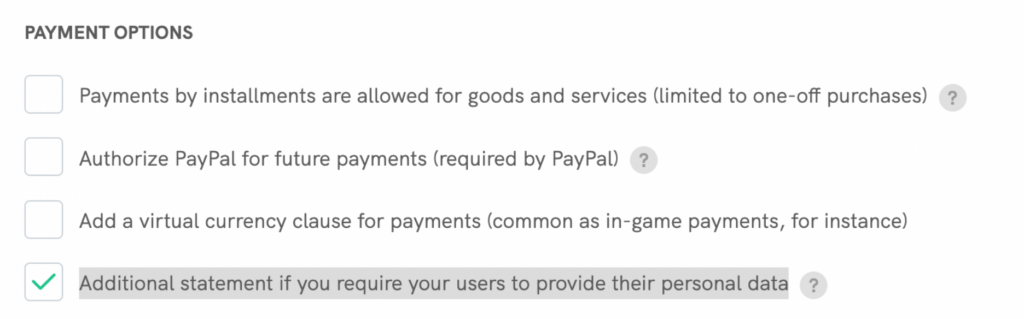
We have a very useful clause in our Terms and Conditions Generator, that means (end) users are required to provide their personal data, in order to access or receive some products provided via the website or application.
How to find the related clause:
Within our dashboard you can easily add this clause in three simple steps:
First, add clauses:

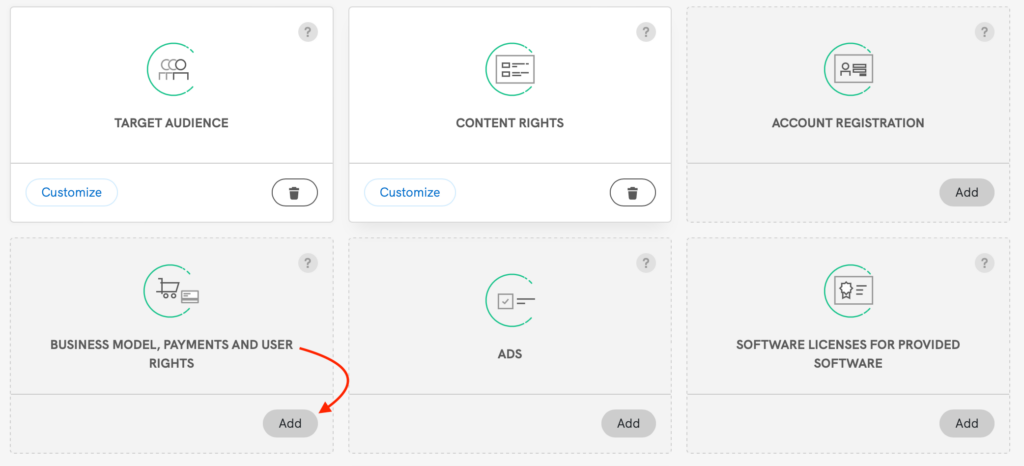
Then, click on the Business model, payments and user rights tile:
Finally, scroll down to Purchasing process and under Payment options tick the box next to Additional statement if you require your users to provide their personal data.