


Introduction to Subscription Models
A subscription is a recurring payment model where customers pay regularly (e.g., monthly, annually) for continuous access to a product, service, or content. This model also allows for automatic renewals, ensuring uninterrupted usage until the subscriber cancels. It’s popular for services like streaming, magazines, and software. Subscriptions provide convenience for users and stable revenue for providers.
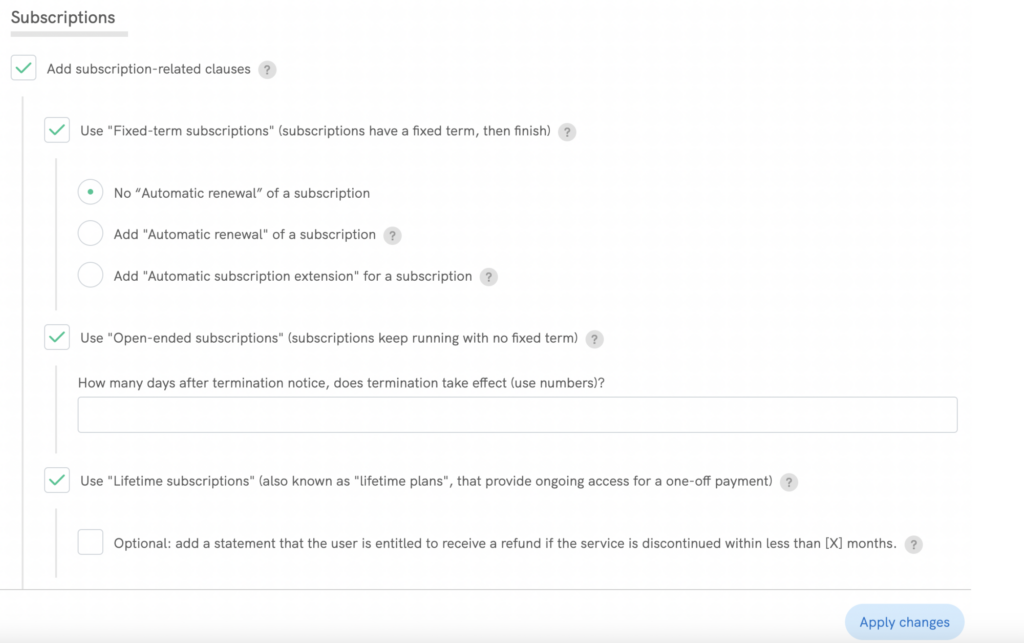
iubenda Subscription Clauses
- Fixed-term subscriptions (subscriptions have a fixed term – e.g. a year or a month – then finish):
- No Automatic Renewal;
- Automatic Renewal: Subscriptions will automatically renew for an equivalent term at the same conditions upon expiration, unless the user terminates the subscription within the specified period;
- Automatic Subscription Extension: Upon expiration of the initial term, subscriptions are automatically extended for an indefinite period under the same conditions. During this extension period, subscriptions can be terminated on a monthly basis, unlike the original term. This extension will occur unless the user terminates the subscription within the specified period.
- Open-Ended Subscriptions: Subscriptions continue indefinitely without a fixed term and will remain active unless terminated by the user within the specified notice period.
- Lifetime Subscriptions: Also known as ‘lifetime plans,’ these provide ongoing access with a one-time payment. Users pay once and enjoy uninterrupted access to the service for its entire duration, meaning as long as the service exists, without any further payments.
To add these clauses:
Navigate to Business model > Payments and user rights > Subscriptions > Add subscription-related clauses.
Country-specific rules
Brazil
Suppliers should inform about renewals 30 days in advance.
Czech Republic
Users must be sufficiently informed in advance about automatic renewals/automatic subscription extension. Notifications should be sent via email or preferred communication methods. Fixed-term subscriptions with no automatic renewal/automatic subscription extension are acceptable, while those with automatic renewal require prior user notification. If not agreed otherwise, open-ended subscriptions may be terminated at the end of a calendar quarter with three months’ notice.
Denmark
For B2C:
- Subscription services can be non-terminable by consumers for up to five months. After this period, they must be terminable with one month’s notice (however, a shorter binding period, such as two months can also be agreed upon).
This general rule does not apply for fixed-term subscriptions with no automatic renewal if (1) delivery of the goods or services must take place within a year from entering the agreement, (2) the total value of the services or goods delivered under the agreement is less than DKK 2,000, and (3) payment in full is made no longer than 14 days after entering the agreement. Practical examples are annual passes to e.g. the Zoo, a museum etc. Instead, this will be defined as a consumer purchase subject to a 14-day right of withdrawal.
- Specific rules apply to services like mobile subscriptions and electricity delivery.
For B2B:
- Termination terms can be agreed upon freely.
Germany
Subscriptions to consumers cannot exceed an initial term of two years. This is based on the German “Gesetz für faire Verbraucherverträge” and is mandatory when targeting Consumers in Germany.
On March 1st, 2022, Germany’s new act for fair consumer contracts came into effect. The most relevant provisions regard the termination of subscription contracts for the provision of goods or services over time.
All subscription plans are affected by the new criteria. Contracts and terms and conditions must be updated accordingly:
Please note: This applies to any consumer subscription contract.
From now on:
- no subscription offered to consumers may have an initial term longer than two years;
- the initial term may be extended tacitly (“auto renewal”). However, consumers must be given the option to prevent such tacit extension by terminating within a notice period no longer than one month prior to the tacit extension;
- if the initial term is tacitly extended (i.e., unless the consumer terminates, the subscription is prolonged beyond the initial term), such extension must be open-ended. The consumer must have the right to terminate monthly. Therefore, it won’t be possible to renew the subscription for another 1-year-term.
Note
This provision applies to subscription contracts closed starting from March 1st, 2022. Therefore, contracts already in place before this date are not subject to the new rules.
Please note: This only applies to consumer contracts closed online.
Online traders targeting consumers based in Germany must now make the following available to their users on or via their website/app:
- a button, control, switch, or any other command that allows users to terminate the contract easily. The law also regulates the following steps of the procedure: users must be redirected to a form in which they may insert their personal details, choose the kind of termination (ordinary/extraordinary for cause), etc. and eventually have the opportunity to review their statement before confirming;
- a downloadable copy (PDF) of the termination submitted as explained above bearing date and time for record-keeping purposes;
- an e-mail confirmation of receipt of the termination submitted.
In case of non-compliance with the termination button requirements by traders, users shall be entitled to terminate any contract without reasons and without any notice period (i.e., with immediate effect).
Note
This provision applies to all subscription contracts starting from July 1st, 2022, regardless of when they have been concluded.
Greece
Termination must occur within a “reasonable time,” which can be specified in the T&C.
“Reasonable time” is not determined by the applicable legal framework but is interpreted ad hoc.
Italy
The supplier must send the consumer a notice in writing, via SMS, or through another electronic means indicated by the consumer, at least 30 days before the automatic renewals/automatic subscription extension.
Sweden
Auto-renewal is permitted if:
a) Conditions for auto-renewal are clear.
b) The deadline set for the consumer to terminate the contract and avoid auto-renewal is not unreasonably early (no more than 30 days prior to the end of an ongoing term is advisable for agreements that run for a year at a time).
c) Reminders are sent in writing, at least a month before the deadline.
The requirement to remind the subscriber in due time before auto-renewal does not apply if the agreement can be canceled with three months’ notice (or less) after renewal. Agreements that are renewed one month at a time (e.g., digital content subscriptions) therefore do not call for reminders to be sent in accordance with (c) above.
If the supplier fails to send a written reminder in accordance with (c) above, the user will be entitled to terminate the agreement immediately at any time during the new subscription period.
The rule described stems from specific legislation and court practices that target fixed-term subscriptions that are auto-renewed. As regards trial periods, in principle, free trial periods that are converted into paid subscriptions should also be treated as fixed-term subscriptions in accordance with the principles below:
- a free trial period that is converted into a paid, fixed-term subscription should be regarded as a “Fixed-term subscription” with automatic renewal;
- a trial period converted into an open-ended subscription (i.e. extended monthly until further notice) should be treated as a “Fixed-term subscription” with automatic subscription extension, etc.
Switzerland
The following minimal criteria are required for automatic renewal to potentially hold up on a case-by-case basis:
- Explicit reference to automatic contract renewal upon conclusion of the contract, and;
- Explicit information about the cancellation (notice) period when the contract is concluded, and;
- Explicit notice of impending contract renewal in good time so that there is sufficient time to terminate the contract, and;
- No excessive restrictions for termination (such as only termination by fax is accepted).
For fixed-term subscriptions with automatic renewal, upon renewal, according to case law, a right of termination at any time with a maximum notice period of two months is established.
Subscription models offer significant benefits but require careful consideration of country-specific regulations. By using iubenda’s clauses and understanding the rules in different countries, businesses can ensure compliance and maintain transparent relationships with their customers.