





This article will explain the rules that retailers must go by when enacting a No Return, No Refund Policy and will provide writing tips so that you may create your own and publish it on your e-commerce website.
In short:
- What is a No Refund Policy?
- What is a No Return Policy?
- Is the No Refund Policy Illegal?
- Pros and Cons of a No Refund No Return Policy
- How to Write a No Refund Policy
- What is an Example of a No Refund Policy?
- Sample No Refund Policy Template
- Where to Display your No Refund Policy
- How to Enforce your No Refund Policy
- Is a No Refund Policy Enough?
Continue reading to learn the dos and don’ts, advantages and disadvantages, and learn how to best design your own no return and no refund policy.
Create No Refund Policy + more
What is a no refund policy?
A No Refund Policy is a term used by businesses to indicate that they will not provide money back to customers once a purchase has been made, regardless of the reason. This policy is often found regarding software downloads, event tickets, or other non-tangible items that cannot be returned.
Under such a policy, customers cannot return products or services for a refund, although they may still be entitled to exchanges, credits, or repairs depending on the specifics of the policy and local laws.
The specifics can vary from one business to another and can be subject to local, state, or federal regulations. For example, some businesses may allow refunds within a specific timeframe or under certain conditions, while strictly adhering to a “No Refund” rule otherwise.
What is a no return policy?
A No Return policy is a policy set by some businesses stating that once a product is purchased, it cannot be returned to the seller. The sale is considered final once the customer has completed the transaction.
This policy is typically found for products that are made to order, such as custom-made clothing or personalized gifts, and for products that have a limited lifespan, such as perishable food items.
Careful though as some juridisctions may override a No Return policy in certain circumstances, such as when the product is defective or not as described.
🤔 What’s the difference between returns, refunds and exchanges?
The difference between returns, refunds and exchanges lies in their outcome:
- A return involves a customer sending back an item they purchased, often for a refund.
- An exchange involves a customer exchanging the item they bought for a different one, usually a different size or color.
- Refund means that the store gives the money back to the customer after a return.
Is the no refund policy illegal?
No, the No Refund Policy is not illegal but this can depend on your jurisdiction, industry, and specific circumstances surrounding the sale, like the type of product/service you’re offering. In fact, consumer protection laws can vary widely from country to country, and some allow No Refund policies, others don’t, while others heavily regulate them.
Some examples:
- In some places, businesses are allowed to set their own refund policies, including No Refund policies, as long as they are clearly communicated to the customer before the purchase;
- Even in jurisdictions where a No Refund Policy may generally be legal, there are often exceptions. When a product is faulty or misrepresented, it can be a legal requirement for the seller to repair, replace or refund the item (i.e. regardless of their own refund policy);
- The EU has a “cooling-off” period of 14 days, during which they have the right to cancel the order and/or return their purchase for any reason or no reason at all.
💡 If a no-return, no-refund policy doesn’t legally apply to your case, or you simply prefer not to use one, you might want to consider other possibilities, like:
- letting clients exchange purchases for alternative items;
- giving store credit as opposed to a refund; or
- allowing clients to request refunds within a particular timeframe after a purchase (remember this is required in the UK and EU)
In which countries can I legally use a No Return, No Refund Policy?
The consumer regulations that apply to these rules vary based on the region you’re operating in. You must be informed of the many laws and regulations that apply to various nations and US states.
🇺🇸 The United States permits the use of No Return, No refund Policies.*
*Refund policies are defined by individual states and businesses; there are no federal rules governing them. In some circumstances, customers may be entitled to a refund even though a firm has explicitly said that it does not offer them by failing to prominently show a “no refunds” sign. Because these rules vary by state, it’s always a good idea to double-check the rules for the state you’re based in, as well as those that your business targets.
🇪🇺 In the EU, the consumer has the right to cancel and return within 14 days, for any reason and without a justification. However, there are exemptions. These are the cases in which you may be able to use a no return/ refund policy:
- plane and train tickets, as well as concert tickets, hotel bookings, car rental reservations and catering services for specific dates
- goods and drinks delivered to you by regular delivery – for example, delivery by a milkman
- goods made to order or clearly personalized – such as a tailor-made suit
- sealed audio, video or computer software, such as DVDs, which you have unsealed upon receipt
- online digital content, if you have already started downloading or streaming it, and you agreed that you would lose your right of withdrawal by starting the performance
- goods bought from a private individual rather than a company/trader
- urgent repairs and maintenance contracts – if you call a plumber to repair a leaking shower, you can’t cancel the work once you have agreed on the price of the service
For more on guarantees and returns from the European Union, see here →
🇬🇧 In the United Kingdom, there are a few conditions under which businesses can decline to offer a refund or accept returns. These include cases where the customer:
- knew an item was faulty when they bought it,
- damaged an item by trying to repair it themselves or getting someone else to do it (though they may still have the right to a repair, replacement or partial refund),
- no longer want an item (for example because it’s the wrong size or color) unless they bought it without seeing it.
Additionally, for certain types of items, you only have to offer a refund if they were defective:
- personalized items and custom-made items, for example curtains,
- perishable items, for example frozen food or flowers,
- newspapers and magazines,
- unwrapped CDs, DVDs, and computer software.
Outside these cases, in general, under UK law the consumer has 14 days to request a refund following a purchase. Then they have another 14 days to make a return after notifying the business.
See the government’s official “Accepting returns and giving refunds: the law” here →
🇨🇦 Canada permits the use of No Return, No refund Policies as long as they are clearly stated before the customer makes the purchase. Businesses in Canada are not required to accept returned goods unless they are defective.
Some stores will allow consumers to bring certain goods back, however refunds may exclude:
- personal goods such as earrings or swimsuits;
- cash refunds (i.e., exchange or store credit only);
- promotions and sale items; or
- if goods are not returned within a set number of days.
See the government’s official Refunds and Exchange policy here →
🇦🇺 Australia prohibits the use of No Return, No refund Policies. This rule was put in place to protect customers in the event that they were dissatisfied with their purchase. A business owner who fails to follow this law may be subject to fines and other sanctions.
Pros and Cons of a No Refund No Return Policy
✨ Pros
- Easier Inventory and Accounting Management: With a No Refund, No Return policy, your business won’t have to deal with returned items, restocking fees, or resale of returned products.
- Reduced Costs: Handling returns can be costly. Businesses may have to pay for shipping, inspect returned goods, restock items, and sometimes discard goods that can’t be resold.
- More Control and Clear Boundaries: You get to be selective by allowing returns on a case-by-case basis, refusing more general or casual refund and return requests. A strict policy like this one sets expectations for the customer up front, reducing the risk of disputes arising later on.
- Lower Impulse Buying: Knowing that they can’t return an item may make customers think more carefully before making a purchase, which could mean fewer unhappy customers in the long run.
❌ Cons
- Low Customer Satisfaction and Negative Reviews: Customers may not be happy to know that they don’t have the flexibility to return or get a refund for their product if it doesn’t meet their expectations or encounter issues post-purchase. This can lead them to leave negative comments on your business, harming your reputation.
- Competitive Disadvantage: Many online businesses offer flexible return and refund policies as a way to attract and reassure customers. A strict policy might make a store less appealing compared to competitors.
- Legal Risks: As previously discussed, consumer protection laws in some jurisdictions may not allow for a strict No Refund, No Return policy in all situations. Failing to comply with these laws could result in legal action.
- Potential Loss of Repeat Business: Customer retention can be more cost-effective than acquiring new customers. A strict policy may discourage customers from making future purchases.
- Impaired Trust: If customers know that they have no recourse if a product doesn’t meet their expectations, they may be less likely to trust the business in the first place, which could lower conversion rates.
- Complexity in International Sales: Laws governing returns and refunds can vary significantly between countries. If the online store sells internationally, it will need to be particularly cautious to ensure it is complying with local laws, which may not permit a No Refund, No Return policy.
How to Write a No Refund Policy
A good no-refund policy is clear, concise, and easy to understand. It should clearly state that you don’t accept refunds and whether there are exceptions to your policy (for example, a faulty item).
Remember to place it where it’s easily accessible, so that your customers know exactly what to expect when they buy from you.
Terms and Conditions Generator
Generate a No Refund Policy for your website
A simple No Refund Policy is often not enough to protect your business. Under most countries’ commercial law, you need to include other things like warranty information, limitations of liability and more. That’s why having a complete Terms and Conditions document is important.

Try it risk free with our 14-day money-back guarantee
0:35
0:04
See it in action ^
What is an Example of a No Refund Policy?
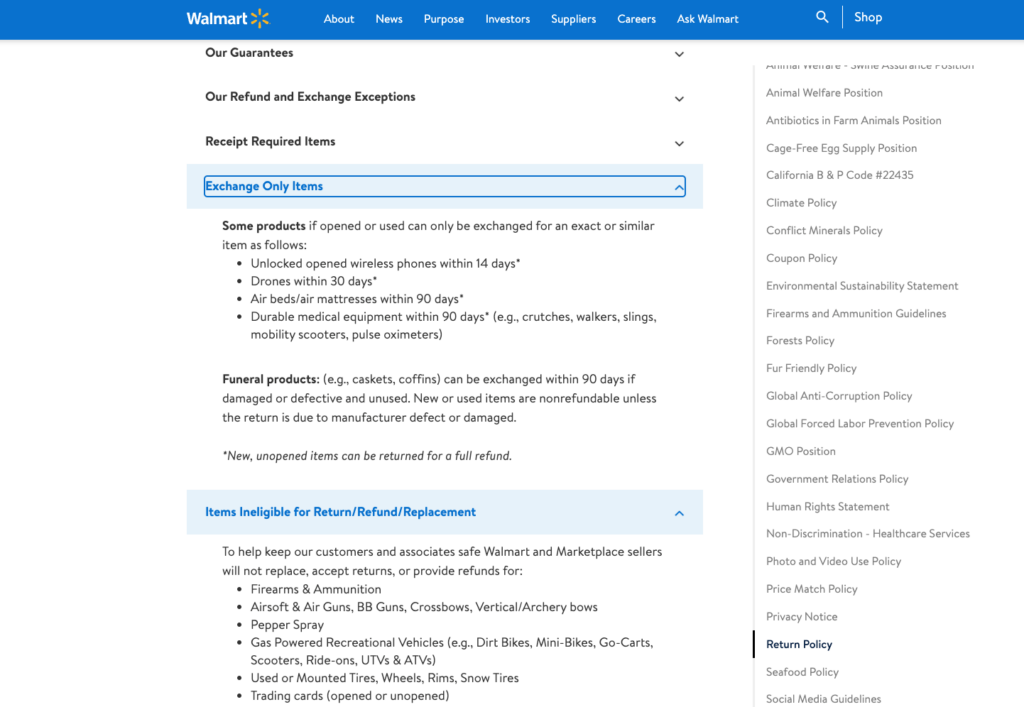
Let’s take a look at this example from Walmart. It is not a completely strict No Refund Policy, however we can see that the US chain has listed in their return policy a number of products that are ineligible for return/refund or replacement, such as prescription medications and devices or hygienic products. Other products like phones, drones or mattresses can only be exchanged, not refunded.
The following general clause is making refunds/returns dependent on Walmart’s decision: “Walmart reserves the right to limit or decline returns or exchanges regardless of whether the customer has a receipt. All non-receipt returns are subject to a refund verification process. All decisions regarding returns are subject to applicable laws.”
Other clauses have a clear No Refund Policy: “Tech Services Products (e.g., Device Setup, Connected Home Installations): are nonrefundable by Walmart.”
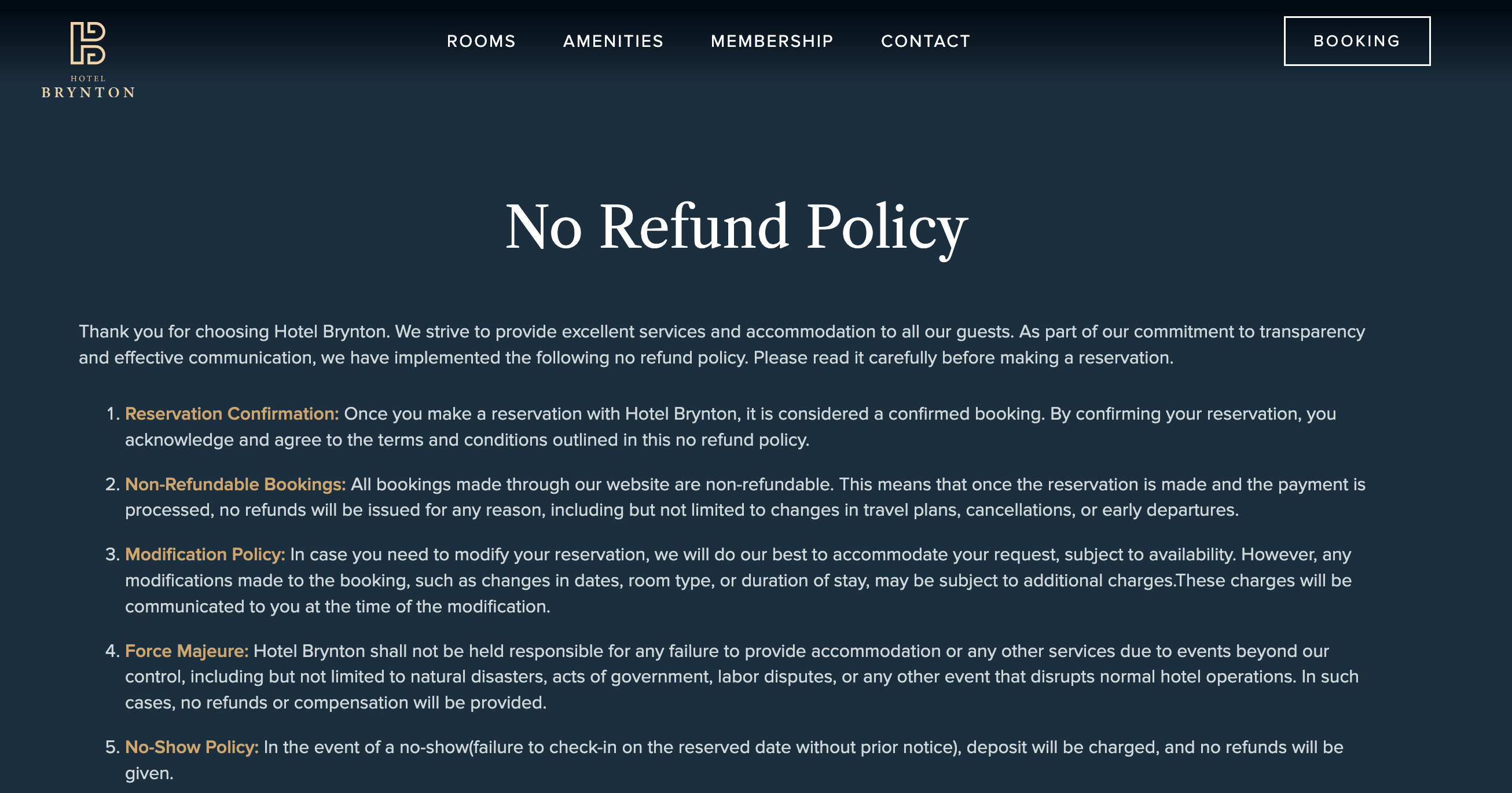
Another common example of a no-refund policy can be found in hotel bookings. Often, hotels don’t allow their guests to get a refund after they have booked a room, so they charge the whole amount.
Sample No Refund Policy Template
When it comes to legal documents, you want to be careful and thorough. In general, you must make sure that:
- a No Refund, No Return Policy can legally apply to your product or services (as mentioned in the section above);
- the language in your policy is as clear and unambiguous as possible; and
- that your clauses are carefully and professionally written.
🔍 Take a look at the sample No Refund Policy template below.
🚨 Please note this is only a template and should not substitute for legal advice. If you choose to use it, you must adapt it to your specific business situation. Be aware it may not contain all the legally-required information you need in your policy or to protect your business. This template is just a starting point and should be tailored to your specific needs.
Click to open the template:
No Refund Policy Template
Refund Policy
Last Updated: [Insert date of last update]
All Sales Are Final
Please carefully review your order before confirming your purchase. All sales are considered final. We do not offer refunds or exchanges for any products or services sold through [Insert Company Website or Platform].
Non-Refundable Items or Services
All items or services purchased from [Insert Company Name] are non-refundable unless otherwise specified in writing by [Insert Company Name]. This policy applies but is not limited to:
- Digital Products
- Gift Cards
- Software Licenses
- Subscription Services
- Custom-made Items
- Sale Items
Exceptions to the No Refund Policy
The only exceptions to our No Refund Policy include:
- Defective or Damaged Items: In the case of items that are received defective or damaged, please report this within [Insert Time Period, e.g., 5 days] of receiving the item. In such cases, a replacement may be provided at the discretion of [Insert Company Name].
- Wrong Item Sent: If you receive an item different from the one you ordered, please notify our Customer Service within [Insert Time Period, e.g., 5 days] for a possible refund or exchange.
- Incomplete Service: If a purchased service is not fully delivered or does not meet the predefined criteria as advertised, a partial or full refund may be considered.
- Expired Products: Receiving a product in an expired condition warrants a report to our Customer Service within [Insert Time Period, e.g., 5 days] for potential refund or replacement.
- Legal Requirements: Following applicable laws, any other conditions or circumstances where we are legally required to offer a refund will be honored.
How to Contact Us
For any questions or concerns regarding this No Refund Policy, please contact us at:
- Email: [Insert Customer Service Email]
- Phone: [Insert Customer Service Phone Number]
We reserve the right to modify this No Refund Policy at any time, effective upon posting of an updated version on our website. Please regularly check [Insert Company Website or Platform] for updates.
Where to Display your No Refund Policy
A No Refund Policy is usually clearly displayed within the Terms and Conditions of a website. This is due to the fact that it is a policy that every consumer should be aware of before making a purchase.
Your Terms and Conditions document should be linked and placed somewhere that’s easily accessible from all pages of your site.
For best-practice placement, consider linking:
- From the footer of your website; 👉 See how to add your terms and conditions to the footer of your website;
- On your checkout page; and
- On the FAQ page of your site.
How to Enforce Your No Refund Policy
Enforcing a No Refund Policy effectively hinges on clear communication, legal compliance, and consistent application.
The policy should be prominently displayed on your website, especially before a customer proceeds to checkout, and be included in your Terms and Conditions. Using the clickwrap consent method — where users check a box to indicate agreement — adds an extra layer of enforceability. This not only obliges users to acknowledge your No Refund Policy but also gives you proof of their consent, should disputes arise.
It’s crucial to ensure that your No Refund Policy is in compliance with local, state, and federal laws. A legal review can ensure that the policy meets all legal requirements, including any regional “cooling-off periods” or consumer protection laws that could override your policy.
Make sure that your customer service team is trained in politely yet firmly handling refund requests in accordance with your policy. This will allow you to minimize customer dissatisfaction.
Is a No Refund Policy Enough?
A No Refund Policy is just one facet of the broader legal and operational landscape of running an online business.
A comprehensive Terms and Conditions (T&C) agreement serves a much broader purpose, covering a variety of topics such as user conduct, intellectual property rights, dispute resolution, and limitations of liability. This not only sets clear expectations for user behavior but also offers you a broader legal shield in the case of disputes or unforeseen issues.
💡 Tailor your Terms to address unique aspects of your business model, align with industry regulations, and help you comply with specific laws like data protection or commercial law, and protect your business!
Don’t have a lawyer on hand? Try our Terms and Conditions Generator risk-free! It’s drafted by an international legal team and allows you to fully customize your clauses – allowing you to create terms and conditions that actually fit your specific business needs.