

惯性聚合 高效追踪和阅读你感兴趣的博客、新闻、科技资讯
阅读原文 在惯性聚合中打开

推荐订阅源

Google DeepMind News
博客园 - 司徒正美
WordPress大学
WordPress大学
爱范儿
爱范儿
小众软件
小众软件
钛媒体:引领未来商业与生活新知
钛媒体:引领未来商业与生活新知
罗磊的独立博客
博客园_首页
V
V2EX
让小产品的独立变现更简单 - ezindie.com
T
Tailwind CSS Blog
大猫的无限游戏
大猫的无限游戏
The Cloudflare Blog
MyScale Blog
MyScale Blog
IT之家
IT之家
H
Help Net Security
Blog — PlanetScale
Blog — PlanetScale
Microsoft Security Blog
H
Hackread – Cybersecurity News, Data Breaches, AI and More
Recent Announcements
F
Fortinet All Blogs
The GitHub Blog
The GitHub Blog
Y
Y Combinator Blog
人人都是产品经理
人人都是产品经理

Red Blob Games: latest blog posts

Red Blob Games: Differential heuristics Red Blob Games: Responsive design calculator Red Blob Games: Academic citations Red Blob Games: Highlighting interactive code blocks Red Blob Games: Optimizing page size Red Blob Games: Writing a guide to SDF fonts Red Blob Games: URLs with trailing punctuation Red Blob Games: What I did in 2025 Red Blob Games: Goodbye Sass Goodbye Sass Red Blob Games: RotMG map seeds Red Blob Games: Mapgen4 Mapgen4's use of WebGL2 Red Blob Games: Mapgen4 river shader Red Blob Games: Mapgen4 renderer Red Blob Games: Harnessing ChatGPT hallucinations Red Blob Games: Let Let's write a search engine, part 2 of 2 Red Blob Games: Let Let's write a search engine, part 1 of 2 Red Blob Games: Hexagon conversions Red Blob Games: Mapgen4 trade routes Red Blob Games: De-optimizing mapgen4 Red Blob Games: Hexagon spiral coordinates Red Blob Games: Thoughts on Flash Red Blob Games: What I did in 2024 Red Blob Games: Hexagon page animations Red Blob Games: SDF Halos SDF Halos Red Blob Games: SDF headless tests, part 2
Red Blob Games: English: a vs an
2026-09-17 · via Red Blob Games: latest blog posts
Blog post: 16 Sep 2026

In English, there is an “indefinite” article a that can go before a word. For example, a raccoon. But for some words, we use an. For example, an apple.

When procedurally generating text, I want a function a_or_an("apple") that tells me which article to use. That seems like it’d be easy. We can check the first letter to see if it’s a vowel. But that would mean we output an unicorn, not a unicorn.

The actual rule is not whether the written word starts with a vowel letter, but whether the spoken word starts with a vowel sound. The word unicorn starts with vowel letter (u) but a consonant sound (Y). The word hour starts with a consonant letter (h) but a vowel sound (OW).
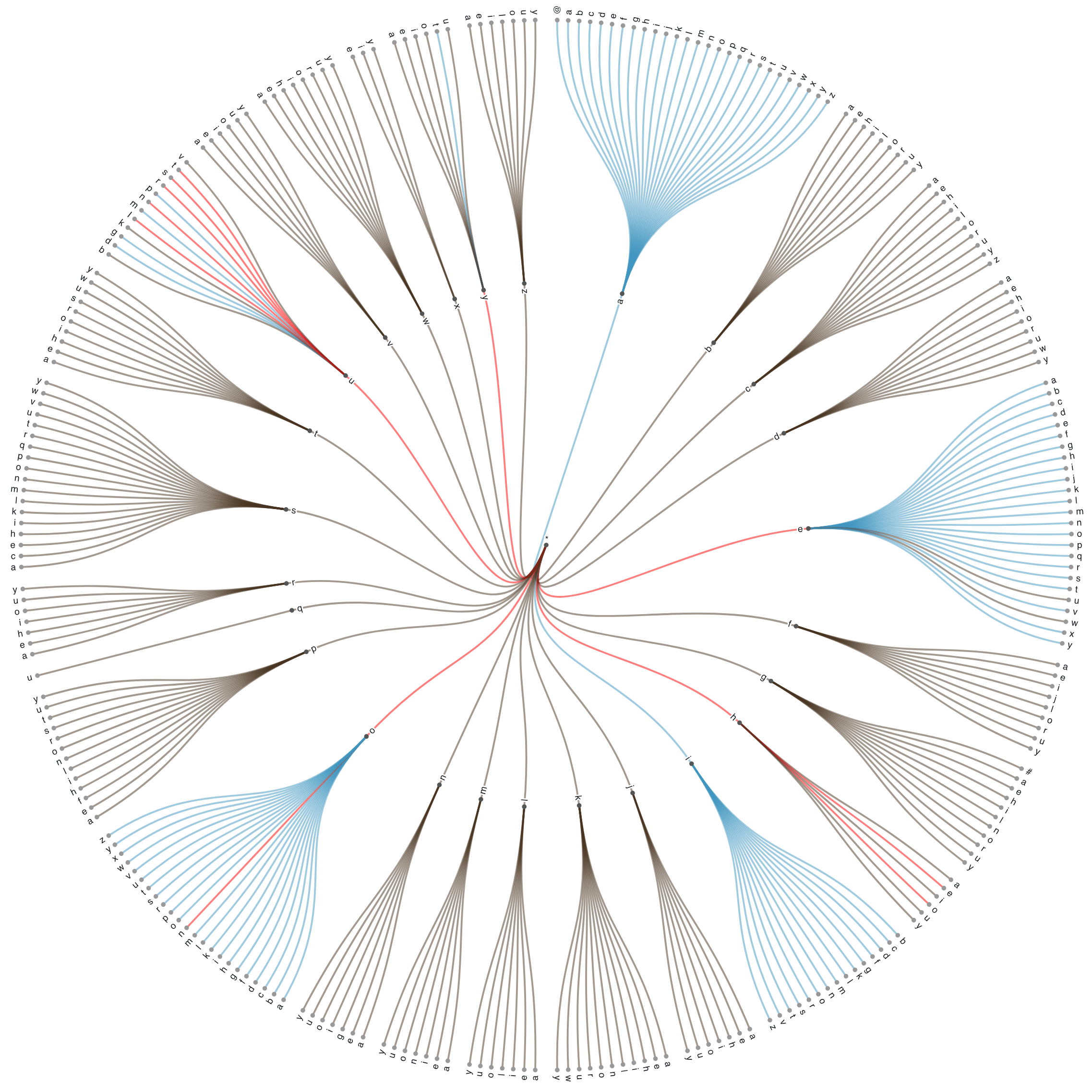
Tree style visualization of the first two letters of a word
Visualization showing whether the first two letters of a word are enough to determine whether it should have “a” or “an”

I was curious how often these exceptions occurred, and whether they can be grouped together, so I spent a day looking at the data and building some visualizations and wrote up the results. I was surprised that only 129 of the 32,455 words in my list needed exceptions.

[LLM note: I did not use LLMs to write any of this code, but in hindsight, I should have. This is one-off code to answer a question. It doesn’t need to be clean or maintainable. It only needs to be correct. I would’ve spent more time on the trie simplification algorithm and less time on parsing cmudict and re-learning d3.js.]