


惯性聚合 高效追踪和阅读你感兴趣的博客、新闻、科技资讯
阅读原文 在惯性聚合中打开

推荐订阅源

T
Threatpost
The Hacker News
The Hacker News
AWS News Blog
AWS News Blog
Spread Privacy
Spread Privacy
T
Tenable Blog
C
CERT Recently Published Vulnerability Notes
Cisco Talos Blog
Cisco Talos Blog
Threat Intelligence Blog | Flashpoint
S
Securelist
P
Privacy & Cybersecurity Law Blog
Know Your Adversary
Know Your Adversary
T
The Exploit Database - CXSecurity.com
Latest news
Latest news
D
Darknet – Hacking Tools, Hacker News & Cyber Security
I
Intezer
F
Fortinet All Blogs
Engineering at Meta
Engineering at Meta
Simon Willison's Weblog
The Register - Security
CTFtime.org: upcoming CTF events
L
Lohrmann on Cybersecurity
C
Cyber Attacks, Cyber Crime and Cyber Security
Microsoft Azure Blog
P
Proofpoint News Feed
H
Help Net Security
T
Threat Research - Cisco Blogs
D
DataBreaches.Net
S
Schneier on Security
Cyberwarzone
Cyberwarzone
Google DeepMind News
P
Privacy International News Feed
S
Secure Thoughts
Cyber Security Advisories - MS-ISAC
Recorded Future
Recorded Future
C
Cybersecurity and Infrastructure Security Agency CISA
MyScale Blog
MyScale Blog
M
MIT News - Artificial intelligence
Stack Overflow Blog
Stack Overflow Blog
IT之家
IT之家
人人都是产品经理
人人都是产品经理
NISL@THU
NISL@THU
博客园 - Franky
T
Tor Project blog
G
GRAHAM CLULEY
博客园 - 【当耐特】
Jina AI
Jina AI
Security Archives - TechRepublic
K
KPMG report finds enterprise disconnect between AI and its ROI | CIO
A
About on SuperTechFans
Hacker News - Newest:
Hacker News - Newest: "LLM"

Ubuntu blog

Tracing a memory leak bug in PID 1 and contributing an upstream fix: a Linux support story | Ubuntu MAAS installation: bare metal provisioning is easier than ever | Ubuntu Januscape vulnerability CVE-2026-53359 mitigations available | Ubuntu Managing Ubuntu on bare metal at scale Ubuntu Server: a platform made for enterprise scale | Ubuntu Building an open source chain of trust: new research uncovers key blockers and ways forward | Ubuntu Beyond safety and security: Why automotive open source demands dependability  | Ubuntu DirtyClone Linux kernel local privilege escalation vulnerability fixes available | Ubuntu pedit COW kernel local privilege escalation vulnerability mitigations | Ubuntu Canonical becomes Gold Sponsor of Trifecta Tech Foundation | Ubuntu Challenges designers face in open source (and how to fix them) | Ubuntu Hunting a 16-year-old SQLite bug with TLA+: is dqlite affected? | Ubuntu Anbox Cloud on C4A metal: Android, at scale, without friction | Ubuntu Canonical announces live kernel patching for Arm64 | Ubuntu How to use RISC-V custom instructions with Ubuntu | Ubuntu Ubuntu Summit 26.04: connected by open source | Ubuntu So you need to add microcontrollers to your fleet: now what? | Ubuntu Validating real-world skills through Canonical Academy | Ubuntu Virtualized Android comes to Anbox Cloud | Ubuntu Template: Streamlining open source design contributions | Ubuntu Beyond Mythos: responding to a new threat landscape | Ubuntu A look into Ubuntu Core 26: Building a local AI inference appliance in a virtual machine | Ubuntu A decade of Ubuntu on IBM Z and IBM LinuxONE | Ubuntu AI at the edge: simplifying infrastructure with Cisco and Canonical | Ubuntu The next era of telco clouds: get open infrastructure choice with Sylva and Canonical Kubernetes | Ubuntu What is RDMA over Converged Ethernet (RoCE)? | Ubuntu Beyond tokens per watt – using Ubuntu 26.04 LTS for AI | Ubuntu A look into Ubuntu Core 26: Deploying AI models on Renesas RZ/V series for production | Ubuntu RISC-V profiles – why is RVA23 significant? | Ubuntu AI with AMD ROCm on Ubuntu: your questions answered | Ubuntu Ubuntu and Ubuntu Pro on Azure Cobalt 200 VMs | Ubuntu What is InfiniBand? | Ubuntu How Canonical Support solves hard Linux performance bugs  – even in 12-year old code | Ubuntu Securing AI agent workflows on Ubuntu with the new NVIDIA OpenShell snap | Ubuntu Canonical announces optimized Ubuntu images for TPU virtual machines by Google Cloud | Ubuntu VMware hypervisor deployment using MAAS | Ubuntu Migrating from Apache Spark 3 to Spark 4 | Ubuntu Introducing Workshop: launch sandboxed development environments on Ubuntu with a single command | Ubuntu Run agentic workloads on Arm and Ubuntu | Ubuntu Decoding design: How design and engineering thrive together in open source | Ubuntu Developing web apps with local LLM inference | Ubuntu PinTheft Linux kernel vulnerability mitigation | Ubuntu Canonical announces fully Managed Kubeflow AI operations platform on the Microsoft Azure Marketplace | Ubuntu CVE-2026-46333 (ssh-keysign-pwn) Linux kernel vulnerability mitigations | Ubuntu Finding the blind spot: How Canonical hunts logic flaws with AI | Ubuntu Fragnesia Linux kernel local privilege escalation vulnerability mitigations | Ubuntu Rethinking BYOD security: protecting data without trusting devices | Ubuntu Dirty Frag Linux kernel local privilege escalation vulnerability mitigations | Ubuntu Three weeks to go: A sneak peek of the Ubuntu Summit 26.04 experience | Ubuntu How to use Ubuntu on Windows | Ubuntu Fixes available for CVE-2026-31431 (Copy Fail) Linux Kernel Local Privilege Escalation Vulnerability | Ubuntu Run NVIDIA Nemotron 3 Nano Omni locally in a single command | Ubuntu Why Web Engineering is great | Ubuntu Ubuntu 16.04 LTS has reached the end of standard Expanded Security Maintenance with Ubuntu Pro. Here are your options. | Ubuntu Understanding disaggregated GenAI model serving with llm-d | Ubuntu From Jammy to Resolute: how Ubuntu’s toolchains have evolved | Ubuntu Hybrid search and reranking: a deeper look at RAG | Ubuntu Canonical expands Ubuntu support to next-generation MediaTek Genio 520 and 720 platforms | Ubuntu Intentional leadership at Canonical | Ubuntu Ubuntu Pro comes to Nutanix bare-metal Kubernetes | Ubuntu RISC-V 101 – what is it and what does it mean for Canonical? | Ubuntu Ubuntu Summit 26.04 is coming: Save the date and share your story! | Ubuntu How to manage Ubuntu fleets using on-premises Active Directory and ADSys | Ubuntu Simplify bare metal operations for sovereign clouds | Ubuntu How to Harden Ubuntu SSH: From static keys to cloud identity | Ubuntu The “scanner report has to be green” trap | Ubuntu Modern Linux identity management: from local auth to the cloud with Ubuntu | Ubuntu Canonical welcomes NVIDIA’s donation of the GPU DRA driver to CNCF | Ubuntu Hot code burns: the supply chain case for letting your containers cool before you ship | Ubuntu
A look into Ubuntu Core 26: Cloud-powered edge computing with AWS IoT Greengrass and Azure IoT Edge | Ubuntu
Gabriel Agui · 2026-05-20 · via Ubuntu blog

Welcome to this blog series which explores innovative uses of Ubuntu Core. Throughout this series, Canonical’s Engineers will show what you can build with this Core 26 release, highlighting the features and tools available to you. 

In this first blog, Michael Croft-White, Engineer Director for Canonical’s Telemetry team, will show you how Ubuntu Core integrates with both AWS IoT Greengrass and Azure IoT Edge to enable cloud-driven device management and intelligent edge workloads. With these platforms, developers gain centralised control of deployments, flexible workload orchestration, and the ability to process data locally while still leveraging the awesome power of the cloud for analytics and monitoring. Coupled with Ubuntu Core architecture, this provides an end-to-end infrastructure for managing the complete lifecycle of devices in the field.

Scaling to meet edge and cloud demands

Cloud platforms have transformed how we build and operate connected systems. With services like AWS IoT Greengrass and Azure IoT Edge, developers can deploy, monitor, and manage workloads across fleets of devices from a central location.

However, not everything can happen in the cloud. Many IoT scenarios require workloads to run directly on the device, whether to reduce latency, operate with intermittent connectivity, or handle sensitive data locally. This is especially true for applications involving AI inference, real-time processing, or autonomous decision-making.
The challenge, then, is not choosing between cloud and edge, but combining them effectively. You need a way to run intelligent workloads locally while still benefiting from cloud-based orchestration, updates, and observability.

Ubuntu Core sits at the centre of this approach. By providing a secure, consistent, and immutable platform on the device, it enables seamless integration with cloud runtimes, allowing you to extend cloud intelligence to the edge without compromising on performance or control.

Cloud runtime integration

Both AWS and Azure bring their own way of extending cloud capabilities to the edge. On Ubuntu Core, these are delivered as snaps and container-based runtimes that sit neatly on top of the system.

When it comes to cloud runtime integration, both AWS IoT Greengrass and Azure IoT Edge offer a clean, secure path. Whether it’s Greengrass or the Azure, the agent snap cleanly authorises, authenticates, and integrates the device into the End-2-End workflow.

Once connected, the process is streamlined: the Greengrass snap registers with AWS and starts receiving cloud-defined components to capture, process, or send data; similarly, the Azure-provisioned device automatically pulls containerised modules via IoT Hub and executes them locally 

In both cases, the important part is that the device becomes an extension of the cloud. You don’t manually install applications anymore—you deploy them.

Deploying an edge AI workload

Let’s take a simple example. Imagine you want your device to capture images from a webcam and detect objects in real time.

With AWS IoT Greengrass, you can package this logic into components. One component captures images, another processes them using a model, and a third handles communication with the cloud. Once deployed, these components run continuously on the device, reacting to data as it arrives.
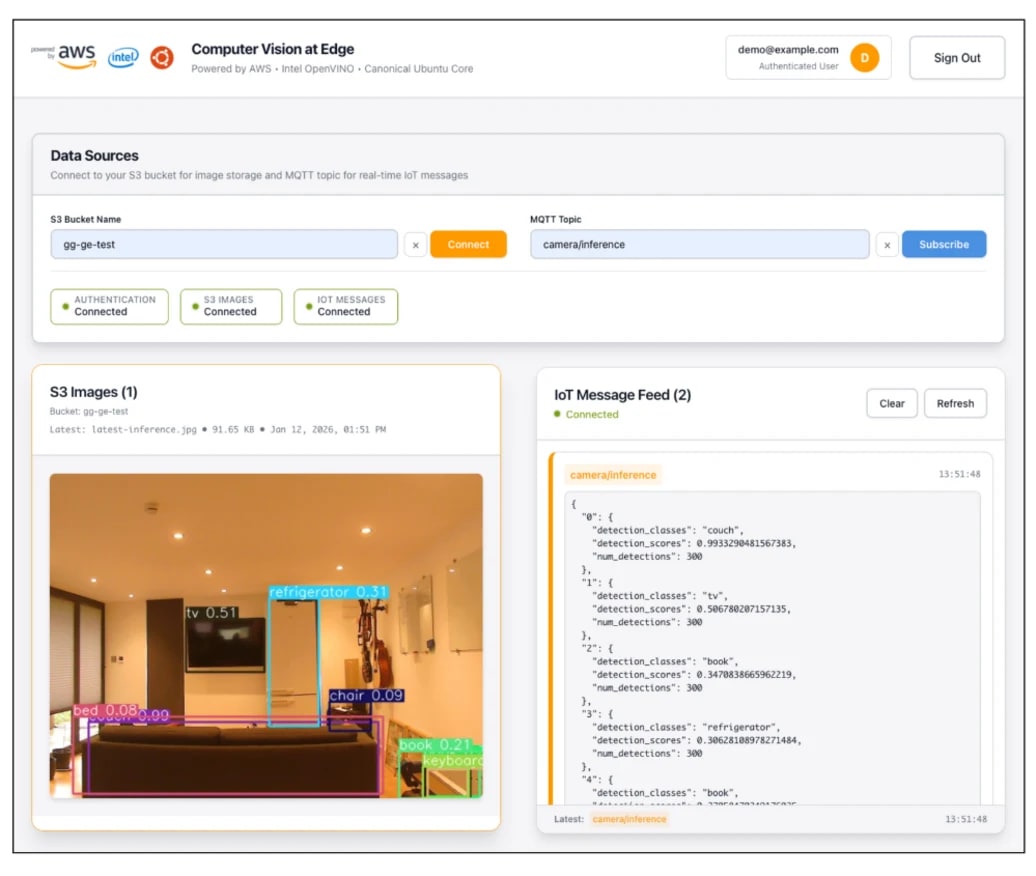
On Azure IoT Edge, you would achieve the same outcome using modules. A container pulls images from the camera, another runs inference—perhaps using Intel OpenVINO—and another sends results upstream. These modules are defined in the cloud and delivered automatically to the device.

In both cases, the device is doing the heavy lifting locally. It captures data, runs inference, and only sends the results back to the cloud. This keeps latency low and reduces the amount of data being transmitted.

Configuration and onboarding

One of the advantages of Ubuntu Core 26 is how easily you can prepare devices for this kind of deployment. You can build an image that already includes the necessary snaps—Greengrass or Azure components—and ship it directly to the field.

When the device boots, it connects to the network, authenticates with the cloud platform, and registers itself. From that point on, it appears in your cloud console, ready to receive workloads.

This is often referred to as zero-touch onboarding. The device effectively introduces itself, and you take over from the cloud side.

You could, for example, ship identical hardware to different customers without deciding upfront what each one will do. Once powered on, each device appears in your cloud environment, and you assign it a role by deploying the appropriate workload.

Updating and evolving workloads

After deployment, requirements rarely stay the same. You might want to update your AI model, tweak how images are processed, or change how results are handled.

With both Greengrass and Azure IoT Edge, you can make these changes centrally and push them to the device. The new version is deployed, the old one is replaced, and the system continues running.

Ubuntu Core supports this process by ensuring updates are transactional and reliable. If something goes wrong, the system can roll back to a known good state.

This means you can confidently evolve your application over time, even across a large fleet of devices.

Monitoring and debugging

Once your devices are running in the field, visibility becomes essential.

Through AWS or Azure, you can see whether your workloads are running, check logs, and monitor communication with the cloud. If something stops working, you don’t need to send someone on-site—you can investigate remotely and have full access to the system.
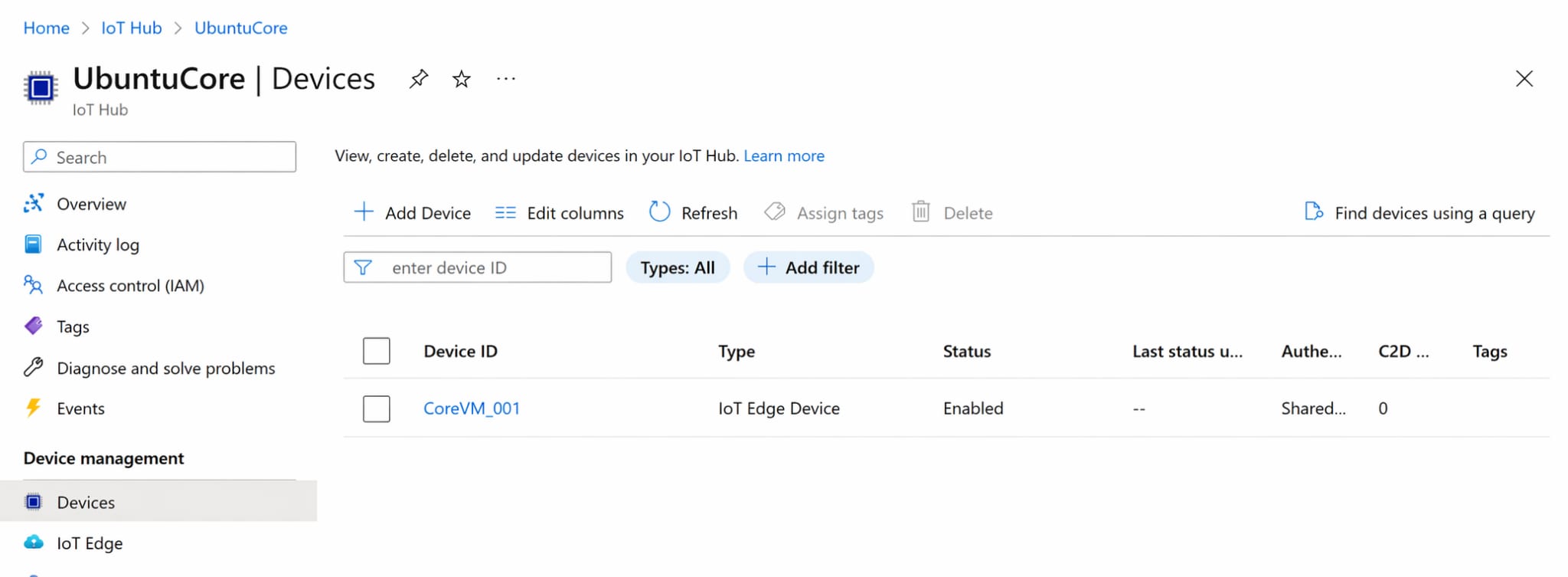
You can also redeploy components or modules, restart services, or update configurations, all from your cloud interface.

For devices deployed in remote or hard-to-reach locations, this capability is invaluable.

What’s next?

Ubuntu Core 26 provides a secure and reliable foundation for edge devices, while AWS IoT Greengrass and Azure IoT Edge bring the cloud-native capabilities needed to deploy and manage workloads at scale.

Together, they allow you to treat your devices not as isolated systems, but as part of a larger, cloud-connected platform—where applications can be deployed, updated, and monitored just like any other cloud service.

In future blogs, we’ll explore more advanced scenarios, including deeper integration with cloud services and more complex workload orchestration.

Below are some useful links for further reading: