


惯性聚合 高效追踪和阅读你感兴趣的博客、新闻、科技资讯
阅读原文 在惯性聚合中打开

推荐订阅源

酷 壳 – CoolShell
酷 壳 – CoolShell
H
Hacker News: Front Page
P
Palo Alto Networks Blog
T
ThreatConnect
Apple Machine Learning Research
博客园_首页
T
True Tiger Recordings
P
Privacy & Cybersecurity Law Blog
B
Blog
IT之家
IT之家
Last Week in AI
Last Week in AI
F
Full Disclosure
Hacker News: Ask HN
Hacker News: Ask HN
C
Comments on: Blog
Microsoft Azure Blog
C
Cybersecurity and Infrastructure Security Agency CISA
Microsoft Security Blog
博客园 - 【当耐特】
N
News and Events Feed by Topic
NISL@THU
NISL@THU
腾讯CDC
雷峰网
雷峰网
Security Latest
Security Latest
李成银的技术随笔
M
Microsoft Research Blog - Microsoft Research
L
LangChain Blog
L
Lohrmann on Cybersecurity
cs.CL updates on arXiv.org
C
Check Point Blog
Y
Y Combinator Blog
Recent Announcements
博客园 - Franky
N
News | PayPal Newsroom
V
V2EX
A
About on SuperTechFans
The Register - Security
月光博客
月光博客
奇客Solidot–传递最新科技情报
奇客Solidot–传递最新科技情报
Google Online Security Blog
MyScale Blog
MyScale Blog
Cisco Talos Blog
Cisco Talos Blog
Vercel News
Vercel News
WordPress大学
WordPress大学
C
Cyber Attacks, Cyber Crime and Cyber Security
The Hacker News
The Hacker News
IntelliJ IDEA : IntelliJ IDEA – the Leading IDE for Professional Development in Java and Kotlin | The JetBrains Blog
爱范儿
爱范儿
A
Arctic Wolf
L
LINUX DO - 最新话题
freeCodeCamp Programming Tutorials: Python, JavaScript, Git & More

MarkTechPost

Sakana AI Introduces KAME: A Tandem Speech-to-Speech Architecture That Injects LLM Knowledge in Real Time What is Tokenization Drift and How to Fix It? Mistral AI Launches Remote Agents in Vibe and Mistral Medium 3.5 with 77.6% SWE-Bench Verified Score Build a Multi-Agent AI Workflow for Biological Network Modeling, Protein Interactions, Metabolism, and Cell Signaling Simulation A Coding Implementation to Parsing, Analyzing, Visualizing, and Fine-Tuning Agent Reasoning Traces Using the lambda/hermes-agent-reasoning-traces Dataset A New NVIDIA Research Shows Speculative Decoding in NeMo RL Achieves 1.8× Rollout Generation Speedup at 8B and Projects 2.5× End-to-End Speedup at 235B A Coding Implementation of End-to-End Brain Decoding from MEG Signals Using NeuralSet and Deep Learning for Predicting Linguistic Features Meta Introduces Autodata: An Agentic Framework That Turns AI Models into Autonomous Data Scientists for High-Quality Training Data Creation A Coding Guide on LLM Post Training with TRL from Supervised Fine Tuning to DPO and GRPO Reasoning Qwen AI Releases Qwen-Scope: An Open-Source Sparse AutoEncoders (SAE) Suite That Turns LLM Internal Features into Practical Development Tools A Coding Deep Dive into Agentic UI, Generative UI, State Synchronization, and Interrupt-Driven Approval Flows Moonshot AI Open-Sources FlashKDA: CUTLASS Kernels for Kimi Delta Attention with Variable-Length Batching and H20 Benchmarks Microsoft Research’s World-R1 Uses Flow-GRPO and 3D-Aware Rewards to Inject Geometric Consistency Into Wan 2.1 Without Architectural Changes A Coding Implementation on Pyright Type Checking Covering Generics, Protocols, Strict Mode, Type Narrowing, and Modern Python Typing IBM Releases Two Granite Speech 4.1 2B Models: Autoregressive ASR with Translation and Non-Autoregressive Editing for Fast Inference Cursor Introduces a TypeScript SDK for Building Programmatic Coding Agents With Sandboxed Cloud VMs, Subagents, Hooks, and Token-Based Pricing Top 10 KV Cache Compression Techniques for LLM Inference: Reducing Memory Overhead Across Eviction, Quantization, and Low-Rank Methods Qwen Team Releases FlashQLA: a High-Performance Linear Attention Kernel Library That Achieves Up to 3× Speedup on NVIDIA Hopper GPUs Step by Step Guide to Build a Complete PII Detection and Redaction Pipeline with OpenAI Privacy Filter Meta FAIR Releases NeuralSet: A Python Package for Neuro-AI That Supports fMRI, M/EEG, Spikes, and HuggingFace Embeddings smol-audio: A Colab-Friendly Notebook Collection for Fine-Tuning Whisper, Parakeet, Voxtral, Granite Speech, and Audio Flamingo 3 A Coding Implementation on Document Parsing Benchmarking with LlamaIndex ParseBench Using Python, Hugging Face, and Evaluation Metrics Poolside AI Introduces Laguna XS.2 and M.1: Agentic Coding Models Reaching 68.2% and 72.5% on SWE-bench Verified How to Build Traceable and Evaluated LLM Workflows Using Promptflow, Prompty, and OpenAI OpenAI Releases Privacy Filter: A 1.5B-Parameter Open-Source PII Redaction Model with 50M Active Parameters Top 10 Physical AI Models Powering Real-World Robots in 2026 How to Build a Lightweight Vision-Language-Action-Inspired Embodied Agent with Latent World Modeling and Model Predictive Control Meet Talkie-1930: A 13B Open-Weight LLM Trained on Pre-1931 English Text for Historical Reasoning and Generalization Research Build a Reinforcement Learning Powered Agent that Learns to Retrieve Relevant Long-Term Memories for Accurate LLM Question Answering OpenMOSS Releases MOSS-Audio: An Open-Source Foundation Model for Speech, Sound, Music, and Time-Aware Audio Reasoning Meta AI Releases Sapiens2: A High-Resolution Human-Centric Vision Model for Pose, Segmentation, Normals, Pointmap, and Albedo The LoRA Assumption That Breaks in Production How to Build a Fully Searchable AI Knowledge Base with OpenKB, OpenRouter, and Llama How to Build Smarter Multilingual Text Wrapping with BudouX Through Parsing, HTML Rendering, Model Introspection, and Toy Training Top 7 Benchmarks That Actually Matter for Agentic Reasoning in Large Language Models RAG Without Vectors: How PageIndex Retrieves by Reasoning A Coding Tutorial on Datashader on Rendering Massive Datasets with High-Performance Python Visual Analytics xAI Launches grok-voice-think-fast-1.0: Topping τ-voice Bench at 67.3%, Outperforming Gemini, GPT Realtime, and More A Coding Implementation on kvcached for Elastic KV Cache Memory, Bursty LLM Serving, and Multi-Model GPU Sharing Google DeepMind Introduces Vision Banana: An Instruction-Tuned Image Generator That Beats SAM 3 on Segmentation and Depth Anything V3 on Metric Depth Estimation Meet GitNexus: An Open-Source MCP-Native Knowledge Graph Engine That Gives Claude Code and Cursor Full Codebase Structural Awareness A Coding Implementation on Deepgram Python SDK for Transcription, Text-to-Speech, Async Audio Processing, and Text Intelligence A Coding Implementation on Microsoft’s OpenMementos with Trace Structure Analysis, Context Compression, and Fine-Tuning Data Preparation DeepSeek AI Releases DeepSeek-V4: Compressed Sparse Attention and Heavily Compressed Attention Enable One-Million-Token Contexts Google DeepMind Introduces Decoupled DiLoCo: An Asynchronous Training Architecture Achieving 88% Goodput Under High Hardware Failure Rates Mend Releases AI Security Governance Framework: Covering Asset Inventory, Risk Tiering, AI Supply Chain Security, and Maturity Model Mend.io Releases AI Security Governance Framework Covering Asset Inventory, Risk Tiering, AI Supply Chain Security, and Maturity Model OpenAI Releases GPT-5.5, a Fully Retrained Agentic Model That Scores 82.7% on Terminal-Bench 2.0 and 84.9% on GDPval A Coding Tutorial on OpenMythos on Recurrent-Depth Transformers with Depth Extrapolation, Adaptive Computation, and Mixture-of-Experts Routing Google Cloud AI Research Introduces ReasoningBank: A Memory Framework that Distills Reasoning Strategies from Agent Successes and Failures Xiaomi Releases MiMo-V2.5-Pro and MiMo-V2.5: Matching Frontier Model Benchmarks at Significantly Lower Token Cost How to Design a Production-Grade CAMEL Multi-Agent System with Planning, Tool Use, Self-Consistency, and Critique-Driven Refinement Alibaba Qwen Team Releases Qwen3.6-27B: A Dense Open-Weight Model Outperforming 397B MoE on Agentic Coding Benchmarks A Detailed Implementation on Equinox with JAX Native Modules, Filtered Transforms, Stateful Layers, and End-to-End Training Workflows Next Leap to Harness Engineering: JiuwenClaw Pioneers ‘Coordination Engineering’ Photon Releases Spectrum: An Open-Source TypeScript Framework that Deploys AI Agents Directly to iMessage, WhatsApp, and Telegram OpenAI Open-Sources Euphony: A Browser-Based Visualization Tool for Harmony Chat Data and Codex Session Logs Hugging Face Releases ml-intern: An Open-Source AI Agent that Automates the LLM Post-Training Workflow A Coding Implementation to Build a Conditional Bayesian Hyperparameter Optimization Pipeline with Hyperopt, TPE, and Early Stopping Google Introduces Simula: A Reasoning-First Framework for Generating Controllable, Scalable Synthetic Datasets Across Specialized AI Domains A Coding Implementation on Qwen 3.6-35B-A3B Covering Multimodal Inference, Thinking Control, Tool Calling, MoE Routing, RAG, and Session Persistence Moonshot AI Releases Kimi K2.6 with Long-Horizon Coding, Agent Swarm Scaling to 300 Sub-Agents and 4,000 Coordinated Steps A Coding Implementation on Microsoft’s Phi-4-Mini for Quantized Inference Reasoning Tool Use RAG and LoRA Fine-Tuning OpenAI Scales Trusted Access for Cyber Defense With GPT-5.4-Cyber: a Fine-Tuned Model Built for Verified Security Defenders Moonshot AI and Tsinghua Researchers Propose PrfaaS: A Cross-Datacenter KVCache Architecture that Rethinks How LLMs are Served at Scale Meet OpenMythos: An Open-Source PyTorch Reconstruction of Claude Mythos Where 770M Parameters Match a 1.3B Transformer How TabPFN Leverages In-Context Learning to Achieve Superior Accuracy on Tabular Datasets Compared to Random Forest and CatBoost A Coding Implementation to Build an AI-Powered File Type Detection and Security Analysis Pipeline with Magika and OpenAI NVIDIA Releases Ising: the First Open Quantum AI Model Family for Hybrid Quantum-Classical Systems xAI Launches Standalone Grok Speech-to-Text and Text-to-Speech APIs, Targeting Enterprise Voice Developers A Coding Tutorial for Running PrismML Bonsai 1-Bit LLM on CUDA with GGUF, Benchmarking, Chat, JSON, and RAG A Coding Guide for Property-Based Testing Using Hypothesis with Stateful, Differential, and Metamorphic Test Design Anthropic Releases Claude Opus 4.7: A Major Upgrade for Agentic Coding, High-Resolution Vision, and Long-Horizon Autonomous Tasks Google AI Releases Auto-Diagnose: An Large Language Model LLM-Based System to Diagnose Integration Test Failures at Scale A End-to-End Coding Guide to Running OpenAI GPT-OSS Open-Weight Models with Advanced Inference Workflows Top 19 AI Red Teaming Tools (2026): Secure Your ML Models A Coding Guide to Build a Production-Grade Background Task Processing System Using Huey with SQLite, Scheduling, Retries, Pipelines, and Concurrency Control Qwen Team Open-Sources Qwen3.6-35B-A3B: A Sparse MoE Vision-Language Model with 3B Active Parameters and Agentic Coding Capabilities OpenAI Launches GPT-Rosalind: Its First Life Sciences AI Model Built to Accelerate Drug Discovery and Genomics Research Building Transformer-Based NQS for Frustrated Spin Systems with NetKet UCSD and Together AI Research Introduces Parcae: A Stable Architecture for Looped Language Models That Achieves the Quality of a Transformer Twice the Size How to Build a Universal Long-Term Memory Layer for AI Agents Using Mem0 and OpenAI A Coding Implementation to Build Multi-Agent AI Systems with SmolAgents Using Code Execution, Tool Calling, and Dynamic Orchestration A Technical Deep Dive into the Essential Stages of Modern Large Language Model Training, Alignment, and Deployment Google AI Launches Gemini 3.1 Flash TTS: A New Benchmark in Expressive and Controllable AI Voice Google DeepMind Releases Gemini Robotics-ER 1.6: Bringing Enhanced Embodied Reasoning and Instrument Reading to Physical AI Google Launches ‘Skills’ in Chrome: Turning Reusable AI Prompts into One-Click Browser Workflows A Coding Implementation of Crawl4AI for Web Crawling, Markdown Generation, JavaScript Execution, and LLM-Based Structured Extraction TinyFish AI Releases Full Web Infrastructure Platform for AI Agents: Search, Fetch, Browser, and Agent Under One API Key NVIDIA and the University of Maryland Researchers Released Audio Flamingo Next (AF-Next): A Super Powerful and Open Large Audio-Language Model A Hands-On Coding Tutorial for Microsoft VibeVoice Covering Speaker-Aware ASR, Real-Time TTS, and Speech-to-Speech Pipelines Meta AI and KAUST Researchers Propose Neural Computers That Fold Computation, Memory, and I/O Into One Learned Model A Coding Implementation of MolmoAct for Depth-Aware Spatial Reasoning, Visual Trajectory Tracing, and Robotic Action Prediction MiniMax Just Open Sourced MiniMax M2.7: A Self-Evolving Agent Model that Scores 56.22% on SWE-Pro and 57.0% on Terminal Bench 2 Liquid AI Releases LFM2.5-VL-450M: a 450M-Parameter Vision-Language Model with Bounding Box Prediction, Multilingual Support, and Sub-250ms Edge Inference Researchers from MIT, NVIDIA, and Zhejiang University Propose TriAttention: A KV Cache Compression Method That Matches Full Attention at 2.5× Higher Throughput How to Build a Secure Local-First Agent Runtime with OpenClaw Gateway, Skills, and Controlled Tool Execution How Knowledge Distillation Compresses Ensemble Intelligence into a Single Deployable AI Model Alibaba’s Tongyi Lab Releases VimRAG: a Multimodal RAG Framework that Uses a Memory Graph to Navigate Massive Visual Contexts A Coding Guide to Markerless 3D Human Kinematics with Pose2Sim, RTMPose, and OpenSim
Meta Superintelligence Lab Releases Muse Spark: A Multimodal Reasoning Model With Thought Compression and Parallel Agents
2026-04-09 · via MarkTechPost

Meta Superintelligence Labs recently made a significant move by unveiling ‘Muse Spark’ — the first model in the Muse family. Muse Spark is a natively multimodal reasoning model with support for tool-use, visual chain of thought, and multi-agent orchestration.
https://ai.meta.com/static-resource/muse-spark-eval-methodology

What ‘Natively Multimodal’ Actually Means

When Meta describes Muse Spark as ‘natively multimodal,’ it means the model was trained from the ground up to process and reason across text and visual inputs simultaneously — not a vision module bolted onto a language model after the fact. Muse Spark is built from the ground up to integrate visual information across domains and tools, achieving strong performance on visual STEM questions, entity recognition, and localization.

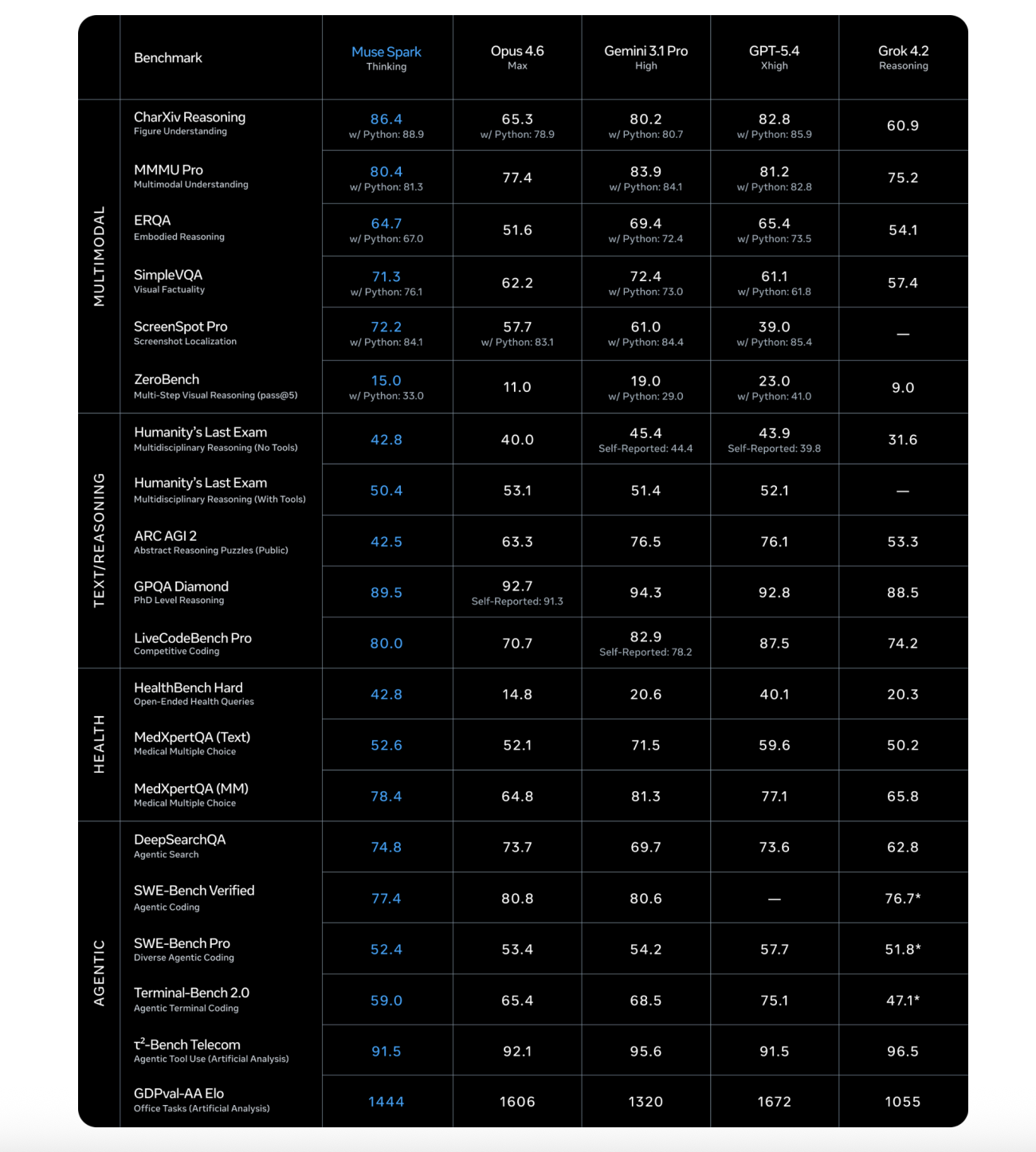
This architectural choice has real consequences on tasks that combine language and vision. On the ScreenSpot Pro benchmark — which tests screenshot localization, requiring the model to identify specific UI elements in images — Muse Spark scores 72.2 (84.1 with Python tools), compared to Claude Opus 4.6 Max’s 57.7 (83.1 with Python) and GPT-5.4 Xhigh’s 39.0 (85.4 with Python).

Three Scaling Axes: Pretraining, RL, and Test-Time Reasoning

The most technically interesting part of the Muse Spark announcement is Meta’s explicit framing around three scaling axes — the levers they’re pulling to improve model capability in a predictable and measurable way. To support further scaling across all three, Meta is making strategic investments across the entire stack — from research and model training to infrastructure, including the Hyperion data center.

Pretraining is where the model learns its core world knowledge, reasoning, and coding abilities. Over the last nine months, Meta rebuilt its pretraining stack with improvements to model architecture, optimization, and data curation. The payoff is substantial efficiency gains: Meta can reach the same capabilities with over an order of magnitude less compute than its previous model, Llama 4 Maverick. For devs, ‘an order of magnitude’ means roughly 10x more compute-efficient — a major improvement that makes larger future models more financially and practically viable.

Reinforcement Learning (RL) is the second axis. After pretraining, RL is applied to amplify capabilities by training the model on outcome-based feedback rather than just token prediction. Think of it this way: pretraining teaches the model facts and patterns; RL teaches it to actually get answers right. Even though large-scale RL is notoriously prone to instability, Meta’s new stack delivers smooth, predictable gains. The research team reports log-linear growth in pass@1 and pass@16 on training data, that means the model improves consistently as RL compute scales. pass@1 means the model gets the answer right on its first try; pass@16 means at least one success across 16 attempts — a measure of reasoning diversity.

Test-Time Reasoning is the third axis. This refers to the compute the model uses at inference time — the period when it’s actually generating an answer for a user. Muse Spark is trained to ‘think’ before it responds, a process Meta’s research team calls test-time reasoning. To deliver the most intelligence per token, RL training maximizes correctness subject to a penalty on thinking time. This produces a phenomenon the research team calls thought compression: after an initial period where the model improves by thinking longer, the length penalty causes thought compression — Muse Spark compresses its reasoning to solve problems using significantly fewer tokens. After compressing, the model then extends its solutions again to achieve stronger performance.
https://ai.meta.com/static-resource/muse-spark-eval-methodology

Contemplating Mode: Multi-Agent Orchestration at Inference

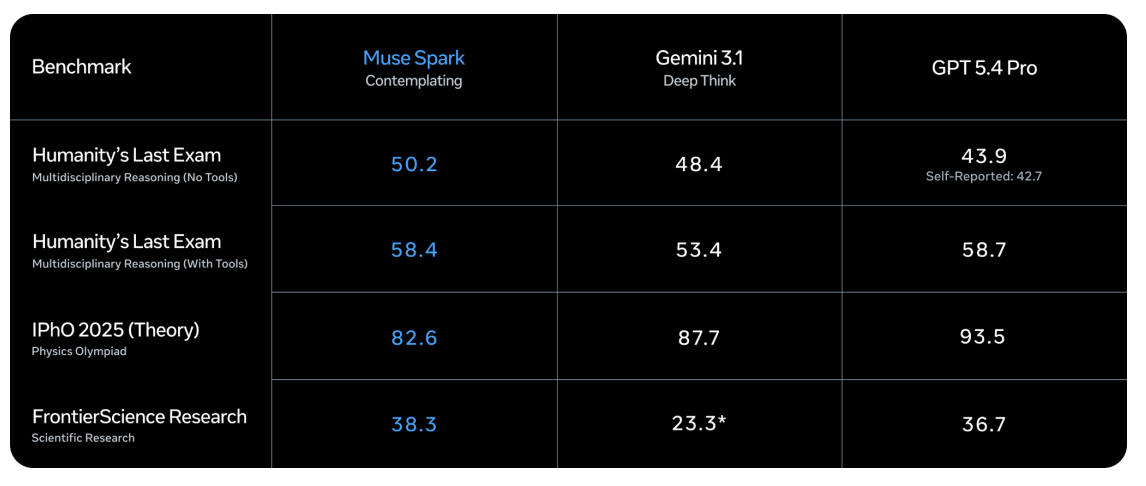
Perhaps the most architecturally interesting feature is Contemplating mode. The research team describes it as a novel multi-round test-time scaling scaffold covering solution generation, iterative self-refinement, and aggregation. In plain terms: instead of one model generating one answer, multiple agents run in parallel, each producing solutions that are then refined and aggregated into a final output.

While standard test-time scaling has a single agent think for longer, scaling Muse Spark with multi-agent thinking enables superior performance with comparable latency. This is a key engineering trade-off: latency scales with the depth of a single chain of thought, but parallel agents can add capability without proportionally adding wait time.

In Contemplating mode, Muse Spark scores 58.4 on Humanity’s Last Exam With Tools — a benchmark designed to test expert-level multidisciplinary knowledge — compared to Gemini 3.1 Deep Think’s 53.4 and GPT-5.4 Pro’s 58.7. On FrontierScience Research, Muse Spark Contemplating reaches 38.3, ahead of GPT-5.4 Pro’s 36.7 and Gemini 3.1 Deep Think’s 23.3.

Where Muse Spark Leads — and Where It Trails

On health benchmarks, Muse Spark posts its most decisive results. On HealthBench Hard — a subset of 1,000 open-ended health queries — Muse Spark scores 42.8, compared to Claude Opus 4.6 Max’s 14.8, Gemini 3.1 Pro High’s 20.6, and GPT-5.4 Xhigh’s 40.1. This is not just luck: to improve Muse Spark’s health reasoning capabilities, Meta’s research team collaborated with over 1,000 physicians to curate training data that enables more factual and comprehensive responses.

On coding benchmarks, the picture is more competitive. On SWE-Bench Verified, where models must resolve real GitHub issues using a bash tool and file operation tool in a single-attempt setup averaged over 15 attempts per problem, Muse Spark scores 77.4 — behind Claude Opus 4.6 Max at 80.8 and Gemini 3.1 Pro High at 80.6. On GPQA Diamond, a PhD-level reasoning benchmark averaged over 4 runs to reduce variance, Muse Spark scores 89.5, behind Claude Opus 4.6 Max’s 92.7 and Gemini 3.1 Pro High’s 94.3.

The sharpest gap appears on ARC AGI 2, the abstract reasoning puzzles benchmark run on a public set of 120 prompts reported at pass@2. Muse Spark scores 42.5 — meaningfully behind Gemini 3.1 Pro High at 76.5 and GPT-5.4 Xhigh at 76.1. This is the clearest current weak spot in Muse Spark’s profile.

Key Takeaways

  • Meta’s fresh start, not an iteration: Muse Spark is the first model from the newly formed Meta Superintelligence Labs — built on a completely rebuilt pretraining stack that is over 10x more compute-efficient than Llama 4 Maverick, signaling a deliberate ground-up reset of Meta’s AI strategy.
  • Health is the headline benchmark win: Muse Spark’s most decisive advantage over competitors is in health reasoning — scoring 42.8 on HealthBench Hard versus Claude Opus 4.6 Max’s 14.8 and Gemini 3.1 Pro High’s 20.6, backed by training data curated with over 1,000 physicians.
  • Contemplating mode trades parallel compute for lower latency: Instead of making a single model think longer — which increases response time — Muse Spark’s Contemplating mode runs multiple agents in parallel that refine and aggregate answers, achieving competitive performance on hard reasoning tasks without proportionally higher latency.
  • Abstract reasoning is the clearest weak spot. On ARC AGI 2, Muse Spark scores 42.5 against Gemini 3.1 Pro High’s 76.5 and GPT-5.4 Xhigh’s 76.1 — the largest performance gap in the entire benchmark table.

Check out the Technical details and PaperAlso, feel free to follow us on Twitter and don’t forget to join our 120k+ ML SubReddit and Subscribe to our Newsletter. Wait! are you on telegram? now you can join us on telegram as well.

Need to partner with us for promoting your GitHub Repo OR Hugging Face Page OR Product Release OR Webinar etc.? Connect with us