


惯性聚合 高效追踪和阅读你感兴趣的博客、新闻、科技资讯
阅读原文 在惯性聚合中打开

推荐订阅源

WordPress大学
WordPress大学
D
Darknet – Hacking Tools, Hacker News & Cyber Security
Hacker News: Ask HN
Hacker News: Ask HN
N
News and Events Feed by Topic
Forbes - Security
Forbes - Security
The Last Watchdog
The Last Watchdog
TaoSecurity Blog
TaoSecurity Blog
Schneier on Security
SecWiki News
SecWiki News
V
Vulnerabilities – Threatpost
Project Zero
Project Zero
O
OpenAI News
W
WeLiveSecurity
Security Archives - TechRepublic
Exploit-DB.com RSS Feed
H
Hacker News: Front Page
Cisco Talos Blog
Cisco Talos Blog
Spread Privacy
Spread Privacy
Help Net Security
Help Net Security
P
Privacy & Cybersecurity Law Blog
K
Kaspersky official blog
S
Security @ Cisco Blogs
Latest news
Latest news
AWS News Blog
AWS News Blog
U
Unit 42
Martin Fowler
Martin Fowler
阮一峰的网络日志
阮一峰的网络日志
S
Secure Thoughts
CTFtime.org: upcoming CTF events
Application and Cybersecurity Blog
Know Your Adversary
Know Your Adversary
Scott Helme
Scott Helme
博客园 - 司徒正美
B
Blog RSS Feed
C
Check Point Blog
Hacker News - Newest:
Hacker News - Newest: "LLM"
D
Docker
Google Online Security Blog
Jina AI
Jina AI
aimingoo的专栏
aimingoo的专栏
Recent Commits to openclaw:main
Last Week in AI
Last Week in AI
月光博客
月光博客
C
CXSECURITY Database RSS Feed - CXSecurity.com
S
SegmentFault 最新的问题
NISL@THU
NISL@THU
T
The Blog of Author Tim Ferriss
C
Cisco Blogs
Attack and Defense Labs
小众软件
小众软件

MarkTechPost

A Coding Implementation of End-to-End Brain Decoding from MEG Signals Using NeuralSet and Deep Learning for Predicting Linguistic Features Meta Introduces Autodata: An Agentic Framework That Turns AI Models into Autonomous Data Scientists for High-Quality Training Data Creation A Coding Guide on LLM Post Training with TRL from Supervised Fine Tuning to DPO and GRPO Reasoning Qwen AI Releases Qwen-Scope: An Open-Source Sparse AutoEncoders (SAE) Suite That Turns LLM Internal Features into Practical Development Tools A Coding Deep Dive into Agentic UI, Generative UI, State Synchronization, and Interrupt-Driven Approval Flows Moonshot AI Open-Sources FlashKDA: CUTLASS Kernels for Kimi Delta Attention with Variable-Length Batching and H20 Benchmarks Microsoft Research’s World-R1 Uses Flow-GRPO and 3D-Aware Rewards to Inject Geometric Consistency Into Wan 2.1 Without Architectural Changes A Coding Implementation on Pyright Type Checking Covering Generics, Protocols, Strict Mode, Type Narrowing, and Modern Python Typing IBM Releases Two Granite Speech 4.1 2B Models: Autoregressive ASR with Translation and Non-Autoregressive Editing for Fast Inference Top 10 KV Cache Compression Techniques for LLM Inference: Reducing Memory Overhead Across Eviction, Quantization, and Low-Rank Methods Qwen Team Releases FlashQLA: a High-Performance Linear Attention Kernel Library That Achieves Up to 3× Speedup on NVIDIA Hopper GPUs Step by Step Guide to Build a Complete PII Detection and Redaction Pipeline with OpenAI Privacy Filter Meta FAIR Releases NeuralSet: A Python Package for Neuro-AI That Supports fMRI, M/EEG, Spikes, and HuggingFace Embeddings smol-audio: A Colab-Friendly Notebook Collection for Fine-Tuning Whisper, Parakeet, Voxtral, Granite Speech, and Audio Flamingo 3 A Coding Implementation on Document Parsing Benchmarking with LlamaIndex ParseBench Using Python, Hugging Face, and Evaluation Metrics Poolside AI Introduces Laguna XS.2 and M.1: Agentic Coding Models Reaching 68.2% and 72.5% on SWE-bench Verified How to Build Traceable and Evaluated LLM Workflows Using Promptflow, Prompty, and OpenAI OpenAI Releases Privacy Filter: A 1.5B-Parameter Open-Source PII Redaction Model with 50M Active Parameters Top 10 Physical AI Models Powering Real-World Robots in 2026 How to Build a Lightweight Vision-Language-Action-Inspired Embodied Agent with Latent World Modeling and Model Predictive Control Meet Talkie-1930: A 13B Open-Weight LLM Trained on Pre-1931 English Text for Historical Reasoning and Generalization Research Build a Reinforcement Learning Powered Agent that Learns to Retrieve Relevant Long-Term Memories for Accurate LLM Question Answering Meta AI Releases Sapiens2: A High-Resolution Human-Centric Vision Model for Pose, Segmentation, Normals, Pointmap, and Albedo The LoRA Assumption That Breaks in Production How to Build a Fully Searchable AI Knowledge Base with OpenKB, OpenRouter, and Llama How to Build Smarter Multilingual Text Wrapping with BudouX Through Parsing, HTML Rendering, Model Introspection, and Toy Training Top 7 Benchmarks That Actually Matter for Agentic Reasoning in Large Language Models RAG Without Vectors: How PageIndex Retrieves by Reasoning A Coding Tutorial on Datashader on Rendering Massive Datasets with High-Performance Python Visual Analytics xAI Launches grok-voice-think-fast-1.0: Topping τ-voice Bench at 67.3%, Outperforming Gemini, GPT Realtime, and More A Coding Implementation on kvcached for Elastic KV Cache Memory, Bursty LLM Serving, and Multi-Model GPU Sharing Google DeepMind Introduces Vision Banana: An Instruction-Tuned Image Generator That Beats SAM 3 on Segmentation and Depth Anything V3 on Metric Depth Estimation Meet GitNexus: An Open-Source MCP-Native Knowledge Graph Engine That Gives Claude Code and Cursor Full Codebase Structural Awareness A Coding Implementation on Deepgram Python SDK for Transcription, Text-to-Speech, Async Audio Processing, and Text Intelligence A Coding Implementation on Microsoft’s OpenMementos with Trace Structure Analysis, Context Compression, and Fine-Tuning Data Preparation DeepSeek AI Releases DeepSeek-V4: Compressed Sparse Attention and Heavily Compressed Attention Enable One-Million-Token Contexts Google DeepMind Introduces Decoupled DiLoCo: An Asynchronous Training Architecture Achieving 88% Goodput Under High Hardware Failure Rates Mend Releases AI Security Governance Framework: Covering Asset Inventory, Risk Tiering, AI Supply Chain Security, and Maturity Model Mend.io Releases AI Security Governance Framework Covering Asset Inventory, Risk Tiering, AI Supply Chain Security, and Maturity Model OpenAI Releases GPT-5.5, a Fully Retrained Agentic Model That Scores 82.7% on Terminal-Bench 2.0 and 84.9% on GDPval A Coding Tutorial on OpenMythos on Recurrent-Depth Transformers with Depth Extrapolation, Adaptive Computation, and Mixture-of-Experts Routing Google Cloud AI Research Introduces ReasoningBank: A Memory Framework that Distills Reasoning Strategies from Agent Successes and Failures Xiaomi Releases MiMo-V2.5-Pro and MiMo-V2.5: Matching Frontier Model Benchmarks at Significantly Lower Token Cost How to Design a Production-Grade CAMEL Multi-Agent System with Planning, Tool Use, Self-Consistency, and Critique-Driven Refinement Alibaba Qwen Team Releases Qwen3.6-27B: A Dense Open-Weight Model Outperforming 397B MoE on Agentic Coding Benchmarks A Detailed Implementation on Equinox with JAX Native Modules, Filtered Transforms, Stateful Layers, and End-to-End Training Workflows Next Leap to Harness Engineering: JiuwenClaw Pioneers ‘Coordination Engineering’ Photon Releases Spectrum: An Open-Source TypeScript Framework that Deploys AI Agents Directly to iMessage, WhatsApp, and Telegram OpenAI Open-Sources Euphony: A Browser-Based Visualization Tool for Harmony Chat Data and Codex Session Logs Hugging Face Releases ml-intern: An Open-Source AI Agent that Automates the LLM Post-Training Workflow A Coding Implementation to Build a Conditional Bayesian Hyperparameter Optimization Pipeline with Hyperopt, TPE, and Early Stopping Google Introduces Simula: A Reasoning-First Framework for Generating Controllable, Scalable Synthetic Datasets Across Specialized AI Domains A Coding Implementation on Qwen 3.6-35B-A3B Covering Multimodal Inference, Thinking Control, Tool Calling, MoE Routing, RAG, and Session Persistence Moonshot AI Releases Kimi K2.6 with Long-Horizon Coding, Agent Swarm Scaling to 300 Sub-Agents and 4,000 Coordinated Steps A Coding Implementation on Microsoft’s Phi-4-Mini for Quantized Inference Reasoning Tool Use RAG and LoRA Fine-Tuning OpenAI Scales Trusted Access for Cyber Defense With GPT-5.4-Cyber: a Fine-Tuned Model Built for Verified Security Defenders Moonshot AI and Tsinghua Researchers Propose PrfaaS: A Cross-Datacenter KVCache Architecture that Rethinks How LLMs are Served at Scale Meet OpenMythos: An Open-Source PyTorch Reconstruction of Claude Mythos Where 770M Parameters Match a 1.3B Transformer How TabPFN Leverages In-Context Learning to Achieve Superior Accuracy on Tabular Datasets Compared to Random Forest and CatBoost A Coding Implementation to Build an AI-Powered File Type Detection and Security Analysis Pipeline with Magika and OpenAI NVIDIA Releases Ising: the First Open Quantum AI Model Family for Hybrid Quantum-Classical Systems xAI Launches Standalone Grok Speech-to-Text and Text-to-Speech APIs, Targeting Enterprise Voice Developers A Coding Tutorial for Running PrismML Bonsai 1-Bit LLM on CUDA with GGUF, Benchmarking, Chat, JSON, and RAG A Coding Guide for Property-Based Testing Using Hypothesis with Stateful, Differential, and Metamorphic Test Design Anthropic Releases Claude Opus 4.7: A Major Upgrade for Agentic Coding, High-Resolution Vision, and Long-Horizon Autonomous Tasks Google AI Releases Auto-Diagnose: An Large Language Model LLM-Based System to Diagnose Integration Test Failures at Scale A End-to-End Coding Guide to Running OpenAI GPT-OSS Open-Weight Models with Advanced Inference Workflows Top 19 AI Red Teaming Tools (2026): Secure Your ML Models A Coding Guide to Build a Production-Grade Background Task Processing System Using Huey with SQLite, Scheduling, Retries, Pipelines, and Concurrency Control Qwen Team Open-Sources Qwen3.6-35B-A3B: A Sparse MoE Vision-Language Model with 3B Active Parameters and Agentic Coding Capabilities OpenAI Launches GPT-Rosalind: Its First Life Sciences AI Model Built to Accelerate Drug Discovery and Genomics Research Building Transformer-Based NQS for Frustrated Spin Systems with NetKet UCSD and Together AI Research Introduces Parcae: A Stable Architecture for Looped Language Models That Achieves the Quality of a Transformer Twice the Size How to Build a Universal Long-Term Memory Layer for AI Agents Using Mem0 and OpenAI A Coding Implementation to Build Multi-Agent AI Systems with SmolAgents Using Code Execution, Tool Calling, and Dynamic Orchestration A Technical Deep Dive into the Essential Stages of Modern Large Language Model Training, Alignment, and Deployment Google AI Launches Gemini 3.1 Flash TTS: A New Benchmark in Expressive and Controllable AI Voice Google DeepMind Releases Gemini Robotics-ER 1.6: Bringing Enhanced Embodied Reasoning and Instrument Reading to Physical AI Google Launches ‘Skills’ in Chrome: Turning Reusable AI Prompts into One-Click Browser Workflows A Coding Implementation of Crawl4AI for Web Crawling, Markdown Generation, JavaScript Execution, and LLM-Based Structured Extraction TinyFish AI Releases Full Web Infrastructure Platform for AI Agents: Search, Fetch, Browser, and Agent Under One API Key NVIDIA and the University of Maryland Researchers Released Audio Flamingo Next (AF-Next): A Super Powerful and Open Large Audio-Language Model A Hands-On Coding Tutorial for Microsoft VibeVoice Covering Speaker-Aware ASR, Real-Time TTS, and Speech-to-Speech Pipelines Meta AI and KAUST Researchers Propose Neural Computers That Fold Computation, Memory, and I/O Into One Learned Model A Coding Implementation of MolmoAct for Depth-Aware Spatial Reasoning, Visual Trajectory Tracing, and Robotic Action Prediction MiniMax Just Open Sourced MiniMax M2.7: A Self-Evolving Agent Model that Scores 56.22% on SWE-Pro and 57.0% on Terminal Bench 2 Liquid AI Releases LFM2.5-VL-450M: a 450M-Parameter Vision-Language Model with Bounding Box Prediction, Multilingual Support, and Sub-250ms Edge Inference Researchers from MIT, NVIDIA, and Zhejiang University Propose TriAttention: A KV Cache Compression Method That Matches Full Attention at 2.5× Higher Throughput How to Build a Secure Local-First Agent Runtime with OpenClaw Gateway, Skills, and Controlled Tool Execution How Knowledge Distillation Compresses Ensemble Intelligence into a Single Deployable AI Model Alibaba’s Tongyi Lab Releases VimRAG: a Multimodal RAG Framework that Uses a Memory Graph to Navigate Massive Visual Contexts A Coding Guide to Markerless 3D Human Kinematics with Pose2Sim, RTMPose, and OpenSim NVIDIA Releases AITune: An Open-Source Inference Toolkit That Automatically Finds the Fastest Inference Backend for Any PyTorch Model Five AI Compute Architectures Every Engineer Should Know: CPUs, GPUs, TPUs, NPUs, and LPUs Compared An End-to-End Coding Guide to NVIDIA KVPress for Long-Context LLM Inference, KV Cache Compression, and Memory-Efficient Generation Meta Superintelligence Lab Releases Muse Spark: A Multimodal Reasoning Model With Thought Compression and Parallel Agents Sigmoid vs ReLU Activation Functions: The Inference Cost of Losing Geometric Context A Coding Guide to Build Advanced Document Intelligence Pipelines with Google LangExtract, OpenAI Models, Structured Extraction, and Interactive Visualization Google AI Research Introduces PaperOrchestra: A Multi-Agent Framework for Automated AI Research Paper Writing A Comprehensive Implementation Guide to ModelScope for Model Search, Inference, Fine-Tuning, Evaluation, and Export
OpenMOSS Releases MOSS-Audio: An Open-Source Foundation Model for Speech, Sound, Music, and Time-Aware Audio Reasoning
Asif Razzaq · 2026-04-28 · via MarkTechPost

Understanding what’s happening in an audio clip is a deceptively hard problem. Transcribing spoken words is the easy part. A truly capable system also needs to recognize who is speaking, detect their emotional state, interpret background sounds, analyze musical content, and answer time-grounded questions like ‘what did the speaker say at the 2-minute mark?’. Tackling all of that required stitching together multiple specialized systems.

Tthe OpenMOSS team, MOSI.AI, and Shanghai Innovation Institute released MOSS-Audio: an open-source audio understanding model designed to unify all of those capabilities inside a single foundation model.

What MOSS-Audio Actually Does

MOSS-Audio supports speech understanding, environmental sound understanding, music understanding, audio captioning, time-aware QA, and complex reasoning over real-world audio. Its capability set breaks down into several distinct areas. Speech & Content Understanding accurately recognizes and transcribes spoken content, supporting both word-level and sentence-level timestamp alignment. Speaker, Emotion & Event Analysis identifies speaker characteristics, analyzes emotional states based on tone, timbre, and context, and detects key acoustic events within the audio. Scene & Sound Cue Extraction pulls meaningful signals from background sounds, environmental noise, and non-speech signals to infer scene context and atmosphere. Music Understanding analyzes musical style, emotional progression, and instrumentation. Audio Question Answering & Summarization handles questions and summaries across speech, podcasts, meetings, and interviews. Finally, Complex Reasoning performs multi-hop reasoning over audio content, powered by both chain-of-thought training and reinforcement learning.
In practical terms, a single MOSS-Audio model can do all of the above without switching between different specialized systems.

Four Model Variants

The team released four variants at launch: MOSS-Audio-4B-Instruct, MOSS-Audio-4B-Thinking, MOSS-Audio-8B-Instruct, and MOSS-Audio-8B-Thinking. The naming convention is worth understanding if you’re deciding which to use. The Instruct variants are optimized for direct instruction following, making them well-suited for production pipelines where you want predictable, structured outputs. The Thinking variants provide stronger chain-of-thought reasoning capabilities, better suited for tasks requiring multi-hop inference. The 4B models use Qwen3-4B as the LLM backbone, and the 8B models use Qwen3-8B, resulting in total model sizes of approximately 4.6B and 8.6B parameters respectively.
https://github.com/OpenMOSS/MOSS-Audio

The Architecture: Three Components Working Together

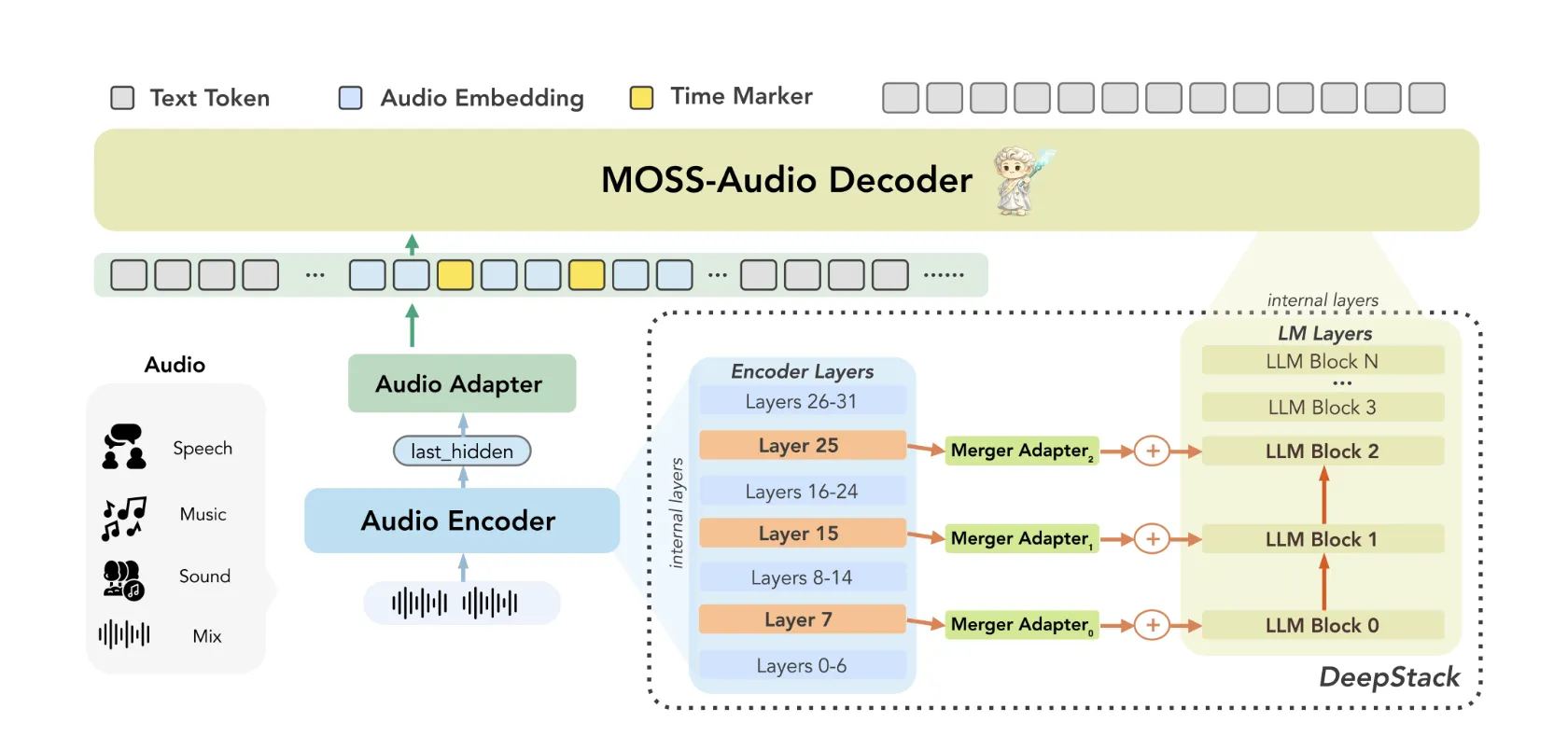
MOSS-Audio follows a modular design comprising three components: an audio encoder, a modality adapter, and a large language model. Raw audio is first encoded by the MOSS-Audio-Encoder into continuous temporal representations at 12.5 Hz. Those representations are then projected into the language model’s embedding space through the adapter, and finally consumed by the LLM for auto-regressive text generation.

The research team trained the encoder from scratch rather than relying on off-the-shelf audio frontends. Their reasoning: a dedicated encoder delivers more robust speech representations, tighter temporal alignment, and better extensibility across acoustic domains.

Two architectural innovations inside MOSS-Audio are worth understanding in detail.

DeepStack Cross-Layer Feature Injection: A common weakness in audio models is that relying only on the encoder’s top-layer features tends to lose low-level acoustic information, things like prosody, transient events, and local time-frequency structure. MOSS-Audio addresses this with a DeepStack-inspired cross-layer injection module between the encoder and the language model: in addition to the encoder’s final-layer output, features from earlier and intermediate layers are selected, independently projected, and injected into the language model’s early layers. This preserves multi-granularity information ranging from low-level acoustic details to high-level semantic abstractions, helping the model retain rhythm, timbre, transients, and background structure that a single high-level representation cannot fully capture.

Time-Aware Representation: Time is a critical dimension in audio that text models aren’t naturally equipped to handle. MOSS-Audio addresses this through a time-marker insertion strategy during pretraining: explicit time tokens are inserted between audio frame representations at fixed time intervals to indicate temporal positions. This lets the model learn ‘what happened when’ within a unified text generation framework, naturally supporting timestamp ASR, event localization, time-based QA, and long-audio retrospection — without requiring a separate localization head or post-processing pipeline.

Benchmark Performance

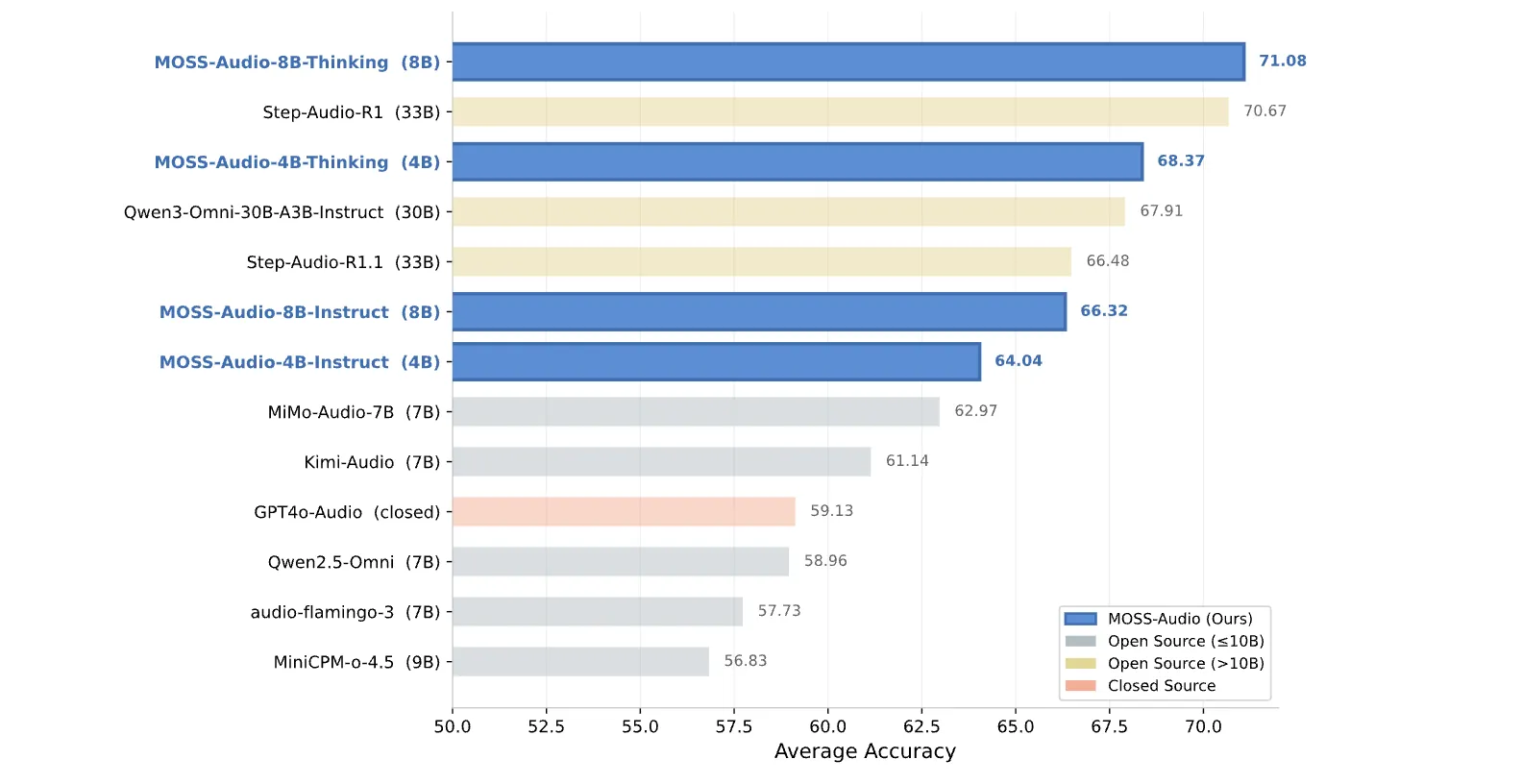
The numbers are strong. On general audio understanding, MOSS-Audio-8B-Thinking achieves an average accuracy of 71.08 across four benchmarks — 77.33 on MMAU, 64.92 on MMAU-Pro, 66.53 on MMAR, and 75.52 on MMSU, outperforming majority of open-source models. That includes larger models: Step-Audio-R1 at 33B scores 70.67, and Qwen3-Omni-30B-A3B-Instruct at 30B scores 67.91. For further context, Kimi-Audio (7B) scores 61.14 and MiMo-Audio-7B scores 62.97 on the same average. The 4B Thinking variant scores 68.37, meaning the smaller model with chain-of-thought training beats all larger open-source instruct-only competitors.

On speech captioning, evaluated with an LLM-as-a-Judge methodology across 13 fine-grained dimensions including gender, age, accent, pitch, volume, speed, texture, clarity, fluency, emotion, tone, personality, and summary, MOSS-Audio-Instruct variants lead across 11 out of 13 dimensions, with MOSS-Audio-8B-Instruct achieving the best overall average score of 3.7252.

On automatic speech recognition (ASR) spanning 12 evaluation dimensions — including health condition, code-switching, dialect, singing, and non-speech scenarios — MOSS-Audio-8B-Instruct achieves the lowest overall CER (Character Error Rate) of 11.30 across all tested models.
https://github.com/OpenMOSS/MOSS-Audio

Key Takeaways

  • Single Model, Full Audio Stack: MOSS-Audio unifies speech transcription, speaker and emotion analysis, environmental sound understanding, music analysis, audio captioning, time-aware QA, and complex reasoning into one open-source model, eliminating the need to chain multiple specialized systems together.
  • Two Architectural Innovations Drive Performance: DeepStack Cross-Layer Feature Injection preserves multi-granularity acoustic information by injecting features from intermediate encoder layers directly into the LLM’s early layers, while time-marker insertion during pretraining gives the model explicit temporal awareness for timestamp-grounded tasks.
  • Best-in-Class Benchmark Results at Efficient Scale: MOSS-Audio-8B-Thinking achieves an average accuracy of 71.08 on general audio understanding benchmarks, outperforming all open-source models including 30B+ systems, while the 4B Thinking variant alone beats every larger open-source instruct-only competitor.
  • Dominant Timestamp ASR Accuracy: MOSS-Audio-8B-Instruct scores 35.77 AAS on AISHELL-1 and 131.61 AAS on LibriSpeech, dramatically outperforming both Qwen3-Omni-30B-A3B-Instruct (833.66) and the closed-source Gemini-3.1-Pro (708.24) on the same benchmark.

Check out the Model Weights and Repo. Also, feel free to follow us on Twitter and don’t forget to join our 130k+ ML SubReddit and Subscribe to our Newsletter. Wait! are you on telegram? now you can join us on telegram as well.

Need to partner with us for promoting your GitHub Repo OR Hugging Face Page OR Product Release OR Webinar etc.? Connect with us