惯性聚合 高效追踪和阅读你感兴趣的博客、新闻、科技资讯
阅读原文 在惯性聚合中打开

推荐订阅源

WordPress大学
WordPress大学
Project Zero
Project Zero
Engineering at Meta
Engineering at Meta
Microsoft Azure Blog
小众软件
小众软件
T
The Blog of Author Tim Ferriss
S
SegmentFault 最新的问题
量子位
V
Visual Studio Blog
F
Full Disclosure
博客园 - 叶小钗
Recent Announcements
G
Google Developers Blog
博客园 - Franky
F
Fortinet All Blogs
有赞技术团队
有赞技术团队
B
Blog
aimingoo的专栏
aimingoo的专栏
钛媒体:引领未来商业与生活新知
钛媒体:引领未来商业与生活新知
N
Netflix TechBlog - Medium
L
LINUX DO - 最新话题
S
Security @ Cisco Blogs
Google DeepMind News
B
Blog RSS Feed
Cloudbric
Cloudbric
Exploit-DB.com RSS Feed
Last Week in AI
Last Week in AI
SecWiki News
SecWiki News
H
Hackread – Cybersecurity News, Data Breaches, AI and More
云风的 BLOG
云风的 BLOG
阮一峰的网络日志
阮一峰的网络日志
N
News and Events Feed by Topic
让小产品的独立变现更简单 - ezindie.com
Microsoft Security Blog
D
DataBreaches.Net
人人都是产品经理
人人都是产品经理
Schneier on Security
Webroot Blog
Webroot Blog
T
Troy Hunt's Blog
P
Proofpoint News Feed
Application and Cybersecurity Blog
Jina AI
Jina AI
PCI Perspectives
PCI Perspectives
Martin Fowler
Martin Fowler
O
OpenAI News
Hacker News: Ask HN
Hacker News: Ask HN
S
Secure Thoughts
P
Privacy International News Feed
I
InfoQ
C
Cyber Attacks, Cyber Crime and Cyber Security

MarkTechPost

A Coding Implementation of End-to-End Brain Decoding from MEG Signals Using NeuralSet and Deep Learning for Predicting Linguistic Features Meta Introduces Autodata: An Agentic Framework That Turns AI Models into Autonomous Data Scientists for High-Quality Training Data Creation Qwen AI Releases Qwen-Scope: An Open-Source Sparse AutoEncoders (SAE) Suite That Turns LLM Internal Features into Practical Development Tools A Coding Deep Dive into Agentic UI, Generative UI, State Synchronization, and Interrupt-Driven Approval Flows Moonshot AI Open-Sources FlashKDA: CUTLASS Kernels for Kimi Delta Attention with Variable-Length Batching and H20 Benchmarks Microsoft Research’s World-R1 Uses Flow-GRPO and 3D-Aware Rewards to Inject Geometric Consistency Into Wan 2.1 Without Architectural Changes A Coding Implementation on Pyright Type Checking Covering Generics, Protocols, Strict Mode, Type Narrowing, and Modern Python Typing IBM Releases Two Granite Speech 4.1 2B Models: Autoregressive ASR with Translation and Non-Autoregressive Editing for Fast Inference Top 10 KV Cache Compression Techniques for LLM Inference: Reducing Memory Overhead Across Eviction, Quantization, and Low-Rank Methods Qwen Team Releases FlashQLA: a High-Performance Linear Attention Kernel Library That Achieves Up to 3× Speedup on NVIDIA Hopper GPUs Step by Step Guide to Build a Complete PII Detection and Redaction Pipeline with OpenAI Privacy Filter Meta FAIR Releases NeuralSet: A Python Package for Neuro-AI That Supports fMRI, M/EEG, Spikes, and HuggingFace Embeddings smol-audio: A Colab-Friendly Notebook Collection for Fine-Tuning Whisper, Parakeet, Voxtral, Granite Speech, and Audio Flamingo 3 A Coding Implementation on Document Parsing Benchmarking with LlamaIndex ParseBench Using Python, Hugging Face, and Evaluation Metrics Poolside AI Introduces Laguna XS.2 and M.1: Agentic Coding Models Reaching 68.2% and 72.5% on SWE-bench Verified How to Build Traceable and Evaluated LLM Workflows Using Promptflow, Prompty, and OpenAI OpenAI Releases Privacy Filter: A 1.5B-Parameter Open-Source PII Redaction Model with 50M Active Parameters Top 10 Physical AI Models Powering Real-World Robots in 2026 How to Build a Lightweight Vision-Language-Action-Inspired Embodied Agent with Latent World Modeling and Model Predictive Control Meet Talkie-1930: A 13B Open-Weight LLM Trained on Pre-1931 English Text for Historical Reasoning and Generalization Research Build a Reinforcement Learning Powered Agent that Learns to Retrieve Relevant Long-Term Memories for Accurate LLM Question Answering OpenMOSS Releases MOSS-Audio: An Open-Source Foundation Model for Speech, Sound, Music, and Time-Aware Audio Reasoning Meta AI Releases Sapiens2: A High-Resolution Human-Centric Vision Model for Pose, Segmentation, Normals, Pointmap, and Albedo The LoRA Assumption That Breaks in Production How to Build a Fully Searchable AI Knowledge Base with OpenKB, OpenRouter, and Llama How to Build Smarter Multilingual Text Wrapping with BudouX Through Parsing, HTML Rendering, Model Introspection, and Toy Training Top 7 Benchmarks That Actually Matter for Agentic Reasoning in Large Language Models RAG Without Vectors: How PageIndex Retrieves by Reasoning A Coding Tutorial on Datashader on Rendering Massive Datasets with High-Performance Python Visual Analytics xAI Launches grok-voice-think-fast-1.0: Topping τ-voice Bench at 67.3%, Outperforming Gemini, GPT Realtime, and More A Coding Implementation on kvcached for Elastic KV Cache Memory, Bursty LLM Serving, and Multi-Model GPU Sharing Google DeepMind Introduces Vision Banana: An Instruction-Tuned Image Generator That Beats SAM 3 on Segmentation and Depth Anything V3 on Metric Depth Estimation Meet GitNexus: An Open-Source MCP-Native Knowledge Graph Engine That Gives Claude Code and Cursor Full Codebase Structural Awareness A Coding Implementation on Deepgram Python SDK for Transcription, Text-to-Speech, Async Audio Processing, and Text Intelligence A Coding Implementation on Microsoft’s OpenMementos with Trace Structure Analysis, Context Compression, and Fine-Tuning Data Preparation DeepSeek AI Releases DeepSeek-V4: Compressed Sparse Attention and Heavily Compressed Attention Enable One-Million-Token Contexts Google DeepMind Introduces Decoupled DiLoCo: An Asynchronous Training Architecture Achieving 88% Goodput Under High Hardware Failure Rates Mend Releases AI Security Governance Framework: Covering Asset Inventory, Risk Tiering, AI Supply Chain Security, and Maturity Model Mend.io Releases AI Security Governance Framework Covering Asset Inventory, Risk Tiering, AI Supply Chain Security, and Maturity Model OpenAI Releases GPT-5.5, a Fully Retrained Agentic Model That Scores 82.7% on Terminal-Bench 2.0 and 84.9% on GDPval A Coding Tutorial on OpenMythos on Recurrent-Depth Transformers with Depth Extrapolation, Adaptive Computation, and Mixture-of-Experts Routing Google Cloud AI Research Introduces ReasoningBank: A Memory Framework that Distills Reasoning Strategies from Agent Successes and Failures Xiaomi Releases MiMo-V2.5-Pro and MiMo-V2.5: Matching Frontier Model Benchmarks at Significantly Lower Token Cost How to Design a Production-Grade CAMEL Multi-Agent System with Planning, Tool Use, Self-Consistency, and Critique-Driven Refinement Alibaba Qwen Team Releases Qwen3.6-27B: A Dense Open-Weight Model Outperforming 397B MoE on Agentic Coding Benchmarks A Detailed Implementation on Equinox with JAX Native Modules, Filtered Transforms, Stateful Layers, and End-to-End Training Workflows Next Leap to Harness Engineering: JiuwenClaw Pioneers ‘Coordination Engineering’ Photon Releases Spectrum: An Open-Source TypeScript Framework that Deploys AI Agents Directly to iMessage, WhatsApp, and Telegram OpenAI Open-Sources Euphony: A Browser-Based Visualization Tool for Harmony Chat Data and Codex Session Logs Hugging Face Releases ml-intern: An Open-Source AI Agent that Automates the LLM Post-Training Workflow A Coding Implementation to Build a Conditional Bayesian Hyperparameter Optimization Pipeline with Hyperopt, TPE, and Early Stopping Google Introduces Simula: A Reasoning-First Framework for Generating Controllable, Scalable Synthetic Datasets Across Specialized AI Domains A Coding Implementation on Qwen 3.6-35B-A3B Covering Multimodal Inference, Thinking Control, Tool Calling, MoE Routing, RAG, and Session Persistence Moonshot AI Releases Kimi K2.6 with Long-Horizon Coding, Agent Swarm Scaling to 300 Sub-Agents and 4,000 Coordinated Steps A Coding Implementation on Microsoft’s Phi-4-Mini for Quantized Inference Reasoning Tool Use RAG and LoRA Fine-Tuning OpenAI Scales Trusted Access for Cyber Defense With GPT-5.4-Cyber: a Fine-Tuned Model Built for Verified Security Defenders Moonshot AI and Tsinghua Researchers Propose PrfaaS: A Cross-Datacenter KVCache Architecture that Rethinks How LLMs are Served at Scale Meet OpenMythos: An Open-Source PyTorch Reconstruction of Claude Mythos Where 770M Parameters Match a 1.3B Transformer How TabPFN Leverages In-Context Learning to Achieve Superior Accuracy on Tabular Datasets Compared to Random Forest and CatBoost A Coding Implementation to Build an AI-Powered File Type Detection and Security Analysis Pipeline with Magika and OpenAI NVIDIA Releases Ising: the First Open Quantum AI Model Family for Hybrid Quantum-Classical Systems xAI Launches Standalone Grok Speech-to-Text and Text-to-Speech APIs, Targeting Enterprise Voice Developers A Coding Tutorial for Running PrismML Bonsai 1-Bit LLM on CUDA with GGUF, Benchmarking, Chat, JSON, and RAG A Coding Guide for Property-Based Testing Using Hypothesis with Stateful, Differential, and Metamorphic Test Design Anthropic Releases Claude Opus 4.7: A Major Upgrade for Agentic Coding, High-Resolution Vision, and Long-Horizon Autonomous Tasks Google AI Releases Auto-Diagnose: An Large Language Model LLM-Based System to Diagnose Integration Test Failures at Scale A End-to-End Coding Guide to Running OpenAI GPT-OSS Open-Weight Models with Advanced Inference Workflows Top 19 AI Red Teaming Tools (2026): Secure Your ML Models A Coding Guide to Build a Production-Grade Background Task Processing System Using Huey with SQLite, Scheduling, Retries, Pipelines, and Concurrency Control Qwen Team Open-Sources Qwen3.6-35B-A3B: A Sparse MoE Vision-Language Model with 3B Active Parameters and Agentic Coding Capabilities OpenAI Launches GPT-Rosalind: Its First Life Sciences AI Model Built to Accelerate Drug Discovery and Genomics Research Building Transformer-Based NQS for Frustrated Spin Systems with NetKet UCSD and Together AI Research Introduces Parcae: A Stable Architecture for Looped Language Models That Achieves the Quality of a Transformer Twice the Size How to Build a Universal Long-Term Memory Layer for AI Agents Using Mem0 and OpenAI A Coding Implementation to Build Multi-Agent AI Systems with SmolAgents Using Code Execution, Tool Calling, and Dynamic Orchestration A Technical Deep Dive into the Essential Stages of Modern Large Language Model Training, Alignment, and Deployment Google AI Launches Gemini 3.1 Flash TTS: A New Benchmark in Expressive and Controllable AI Voice Google DeepMind Releases Gemini Robotics-ER 1.6: Bringing Enhanced Embodied Reasoning and Instrument Reading to Physical AI Google Launches ‘Skills’ in Chrome: Turning Reusable AI Prompts into One-Click Browser Workflows A Coding Implementation of Crawl4AI for Web Crawling, Markdown Generation, JavaScript Execution, and LLM-Based Structured Extraction TinyFish AI Releases Full Web Infrastructure Platform for AI Agents: Search, Fetch, Browser, and Agent Under One API Key NVIDIA and the University of Maryland Researchers Released Audio Flamingo Next (AF-Next): A Super Powerful and Open Large Audio-Language Model A Hands-On Coding Tutorial for Microsoft VibeVoice Covering Speaker-Aware ASR, Real-Time TTS, and Speech-to-Speech Pipelines Meta AI and KAUST Researchers Propose Neural Computers That Fold Computation, Memory, and I/O Into One Learned Model A Coding Implementation of MolmoAct for Depth-Aware Spatial Reasoning, Visual Trajectory Tracing, and Robotic Action Prediction MiniMax Just Open Sourced MiniMax M2.7: A Self-Evolving Agent Model that Scores 56.22% on SWE-Pro and 57.0% on Terminal Bench 2 Liquid AI Releases LFM2.5-VL-450M: a 450M-Parameter Vision-Language Model with Bounding Box Prediction, Multilingual Support, and Sub-250ms Edge Inference Researchers from MIT, NVIDIA, and Zhejiang University Propose TriAttention: A KV Cache Compression Method That Matches Full Attention at 2.5× Higher Throughput How to Build a Secure Local-First Agent Runtime with OpenClaw Gateway, Skills, and Controlled Tool Execution How Knowledge Distillation Compresses Ensemble Intelligence into a Single Deployable AI Model Alibaba’s Tongyi Lab Releases VimRAG: a Multimodal RAG Framework that Uses a Memory Graph to Navigate Massive Visual Contexts A Coding Guide to Markerless 3D Human Kinematics with Pose2Sim, RTMPose, and OpenSim NVIDIA Releases AITune: An Open-Source Inference Toolkit That Automatically Finds the Fastest Inference Backend for Any PyTorch Model Five AI Compute Architectures Every Engineer Should Know: CPUs, GPUs, TPUs, NPUs, and LPUs Compared An End-to-End Coding Guide to NVIDIA KVPress for Long-Context LLM Inference, KV Cache Compression, and Memory-Efficient Generation Meta Superintelligence Lab Releases Muse Spark: A Multimodal Reasoning Model With Thought Compression and Parallel Agents Sigmoid vs ReLU Activation Functions: The Inference Cost of Losing Geometric Context A Coding Guide to Build Advanced Document Intelligence Pipelines with Google LangExtract, OpenAI Models, Structured Extraction, and Interactive Visualization Google AI Research Introduces PaperOrchestra: A Multi-Agent Framework for Automated AI Research Paper Writing A Comprehensive Implementation Guide to ModelScope for Model Search, Inference, Fine-Tuning, Evaluation, and Export
Miso Labs Releases MisoTTS: An 8B Emotive Text-to-Speech Model with Open Weights
Asif Razzaq · 2026-06-04 · via MarkTechPost

Miso Labs has released MisoTTS, an open-weights 8-billion-parameter text-to-speech model. It generates expressive speech from both text and audio context. The model uses residual vector quantization (RVQ) to widen its sonic range. This avoids scaling a single flat vocabulary while keeping parameter count fixed.

What is MisoTTS

MisoTTS is an 8B-parameter text-to-dialogue RVQ Transformer. It is inspired by the Sesame CSM architecture. It pairs a Llama 3.2-style backbone with a smaller audio decoder. It generates Mimi audio codes from text and optional audio context. The model conditions on both text and prior audio. That second input lets it respond to the speaker’s tone.

The text vocabulary is 128,256 tokens, and there are 32 audio codebooks. Mimi is the audio tokenizer, and max sequence length is 2,048. Default inference runs in torch.bfloat16.

Miso Labs claims 110ms latency. It lists ElevenLabs at 700ms and Sesame at 300ms.

The Vocabulary Size Problem

Standard transformers generate from a fixed vocabulary of discrete tokens. That works when a small vocabulary covers the target space. Human speech does not fit that assumption. It varies across pitch, rhythm, emphasis, emotion, and accent.

Expanding the audio vocabulary is the obvious fix. But larger vocabularies need more parameters in a standard transformer. Each token must be represented and predicted by the model. Miso Labs calls this the vocabulary size problem.

The second issue is conditioning. Most TTS models condition only on text. They ignore the interlocutor’s tone. Miso Labs argues this contributes to the “uncanny valley” effect.

Residual Vector Quantization: The Core Idea

MisoTTS addresses both problems with residual vector quantization (RVQ). Miso Labs traces RVQ to image-generation research and to Sesame’s CSM for audio. Instead of one token index, the model emits a vector of indices.

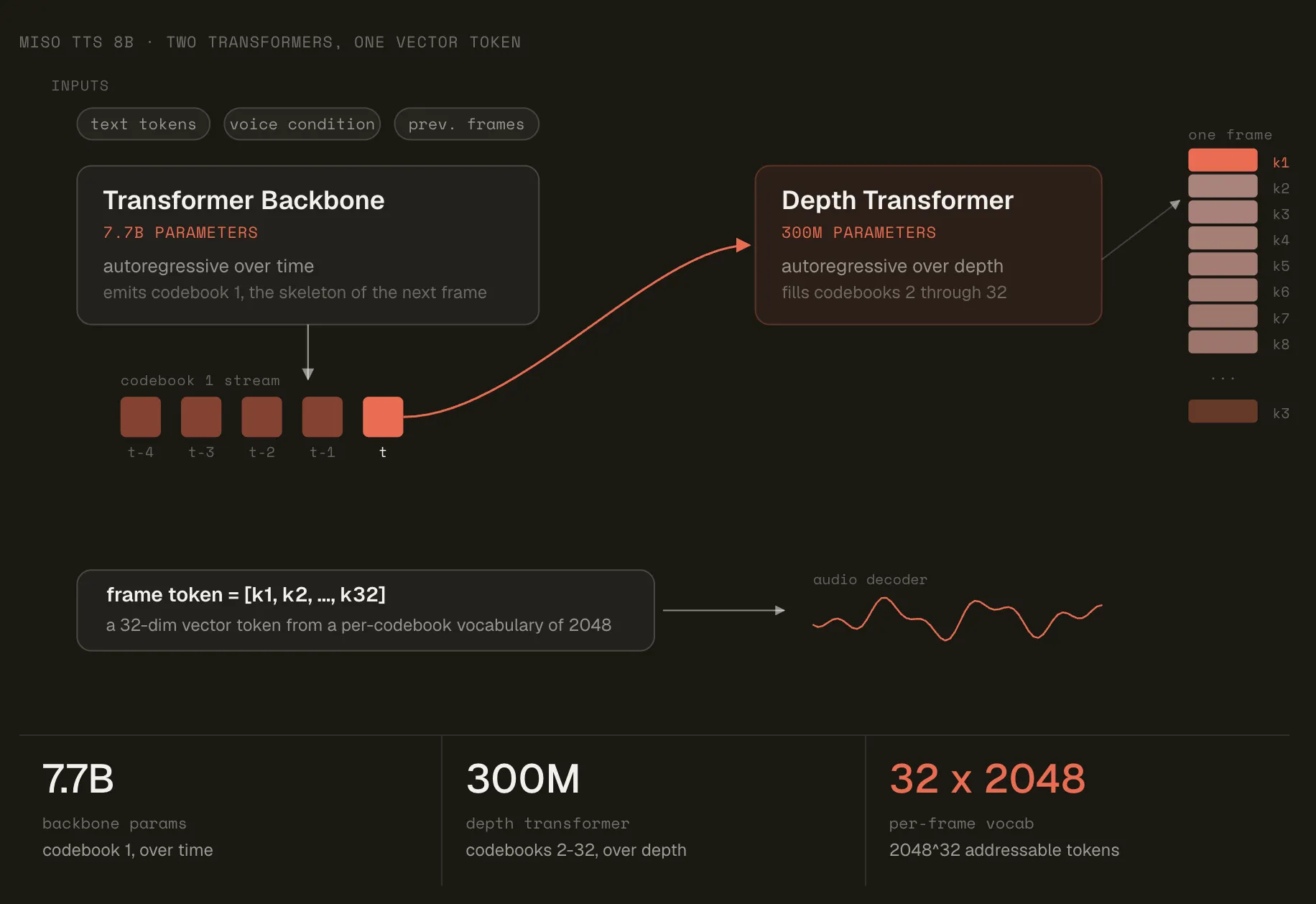
Each audio token is 32 codebook indices over 2048-way codebooks. The model keeps a separate codebook for each position in the vector. To recover the sound, it sums the looked-up vectors. Each codebook adds another refinement to the signal.

This is what makes the scaling work. Addressable vocabulary equals codebook size raised to the depth. Growing the depth adds no parameters to the model. So MisoTTS reaches about 204832, or roughly 10105 addressable tokens. Miso Labs notes naive scaling would require a far larger network.
https://www.misolabs.ai/blog/miso-tts-8b

The Two-Transformer Architecture

The model splits into a backbone and a decoder. The backbone is a 7.7B-parameter transformer, autoregressive over time. It predicts the first codebook index and a final hidden state.

A 300M-parameter decoder then runs autoregressively over depth. It predicts the remaining codebook indices, one position at a time. Each prediction conditions on the indices already chosen in the frame. The same 300M parameters are reused for every position.

Embeddings follow the same logic. Text tokens use a single lookup. An audio token’s embedding is the sum of per-position codebook lookups. Interleaving text and audio lets the backbone use conversation history. That is how it carries context across turns.

Strengths and Challenges

Strengths:

  • Open weights on day one, under a modified MIT license.
  • RVQ scales the sonic range without scaling parameter count.
  • Conditions on audio context, not text alone.
  • Local deployment keeps sensitive audio data in-house.
  • The architecture and math are documented in a public blog post.

Challenges:

  • Half-duplex only, with no turn-taking yet.
  • The large model needs a capable CUDA GPU.
  • API access is announced but not yet available.
  • Latency and quality claims still need third-party testing.

Marktechpost’s Visual Explainer

Marktechpost · Model Brief 01 / 09

Open-Weights Release · June 3, 2026

An 8B emotive text-to-speech model from Miso Labs, built on residual vector quantization and conditioned on both text and audio.

8B params RVQ Transformer Mimi codes modified MIT

What MisoTTS Is

A text-to-dialogue RVQ Transformer

  • An 8B-parameter model inspired by the Sesame CSM architecture.
  • Pairs a Llama 3.2-style backbone with a smaller audio decoder.
  • Generates Mimi audio codes from text and optional audio context.
  • Conditions on prior audio, so output responds to speaker tone.

At a Glance

Published specifications

Parameters

8B (7.7B + 300M)

Architecture

RVQ Transformer

Audio codebooks

32 (2048-way)

Default precision

torch.bfloat16

The Motivation

The vocabulary size problem

  • Transformers generate from a fixed vocabulary of discrete tokens.
  • Speech varies in pitch, rhythm, emphasis, emotion, and accent.
  • A bigger audio vocabulary needs more parameters in a standard transformer.
  • Most TTS condition only on text, ignoring tone — the “uncanny valley” effect.

The Core Idea

Residual vector quantization

  • The model emits a vector of indices, not a single token index.
  • Each token is 32 codebook indices over 2048-way codebooks.
  • Summing the looked-up vectors reconstructs the sound.
  • Depth scales addressable vocabulary to ~204832 (≈10105) with no added parameters.

Architecture

Two transformers, one vector token

  • Backbone (7.7B) — autoregressive over time; predicts codebook index k₁ and hidden state h₀.
  • Decoder (300M) — autoregressive over depth; predicts k₂ through k₃₂.
  • The same 300M parameters are reused for every position.
  • Interleaved text and audio let the backbone use conversation history.

Run It Locally

Inference in a few lines

from generator import load_miso_8b
import torchaudio

gen = load_miso_8b(device="cuda",
    model_path_or_repo_id="MisoLabs/MisoTTS")

audio = gen.generate(
    text="Hello from Miso.",
    speaker=0, context=[],
    max_audio_length_ms=10_000)

torchaudio.save("miso.wav",
    audio.unsqueeze(0).cpu(), gen.sample_rate)

Setup uses uv with Python 3.10. Weights download from Hugging Face. Audio is watermarked by default via SilentCipher. One-shot voice cloning works from a ~10-second clip.

Limitations

Where it stops, for now

  • Handles individual turns only; no turn-taking yet.
  • Generates half-duplex audio — it cannot speak while the other party speaks.
  • Miso Labs frames full-duplex and turn-taking as future work.
  • API access is announced but not yet available.

Key Takeaways

The short version

  • Open-weights 8B TTS under a modified MIT license.
  • Conditions on text and audio, so output tracks speaker tone.
  • RVQ scales vocabulary to ~204832 without adding parameters.
  • 7.7B backbone over time, 300M decoder over depth.
  • Half-duplex and single-turn today; API access pending.

Key Takeaways

  • Miso Labs open-sourced MisoTTS, an 8B text-to-speech model, under a modified MIT license.
  • It conditions on both text and audio context, making generations responsive to speaker tone.
  • Residual vector quantization (32 codebooks × 2048-way) scales vocabulary to ~2048³² without adding parameters.
  • Architecture splits a 7.7B backbone (over time) and a 300M decoder (over depth).
  • It is half-duplex and single-turn only today; API access is still pending.

Check out the Model Weights, Repo and Technical detailsAlso, feel free to follow us on Twitter and don’t forget to join our 150k+ ML SubReddit and Subscribe to our Newsletter. Wait! are you on telegram? now you can join us on telegram as well.

Need to partner with us for promoting your GitHub Repo OR Hugging Face Page OR Product Release OR Webinar etc.? Connect with us