












The concept of vibe coding is interesting; you don’t need to be a developer or software engineer to build your own applications. You can describe your idea to an AI in plain language, and it will build, edit, and refine your applications so you don’t have to write code line by line. It sounds simple enough until it is time to actually put the words into action. Generating the code/vibe coding is the easy part, as literally every AI tool can generate code; however, before you write a single prompt, you need to validate that the idea has real demand, and after you ship your application, you need SEO pages that rank, ad campaigns that convert, analytics that tell you what’s working, and infrastructure that doesn’t fall apart as soon as your clients start clicking around.
The majority of AI app builders or vibe coding apps, without a doubt, can build an application for you, and you can create a polished demo with it as well. But they usually fail when it comes to market research, deployment, distribution, and monetization. The tooling gap isn’t in code generation anymore; it’s in the rest of the product lifecycle. That is where tools like Atom come in, approaching the problem differently.
Atoms is built by the team behind MetaGPT, the open-source multi-agent framework with over 68.7k GitHub stars, and has published 11 major academic papers at top-tier artificial intelligence and machine learning venues. Atoms structures itself as a team of AI employees rather than a single code-generating assistant.
When you describe an idea, a coordinated set of agents takes over:
You shouldn’t just consider Atoms as building an app with an AI tool, but it is running a product business with AI agents, with research, design, coding, deployment, and marketing in one place, and no coding required.
Step 1: Using Atoms is very simple; you just need a solid idea. Visit the Atoms website to sign up and create an account using your Gmail account.
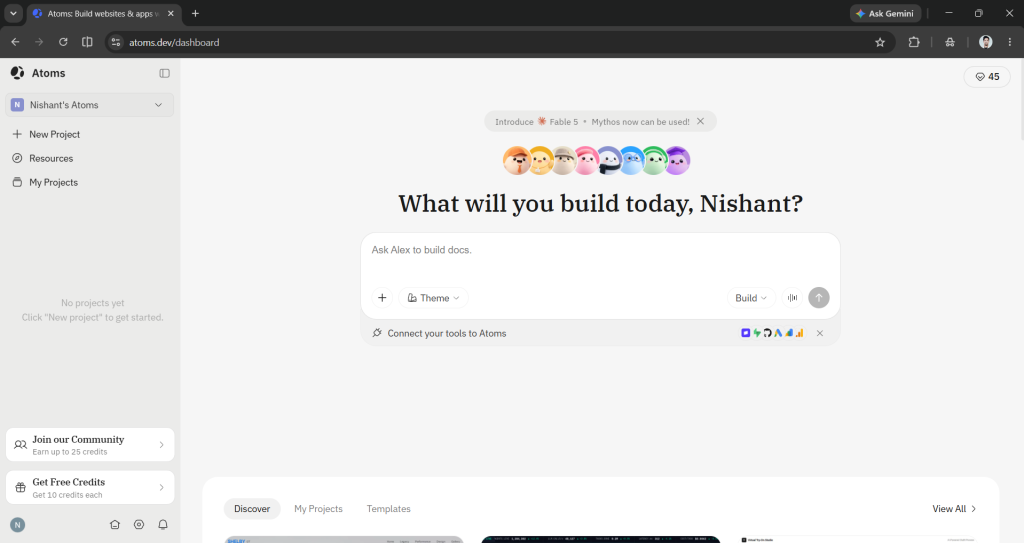
Step 2: The user interface is simple and easy to use. Before you enter a prompt, you can connect Atoms to third-party tools, choose/create a theme, and choose whether to use Build or Goal mode.
Step 3: For this article, I went with Build mode. Add your prompt and hit send.
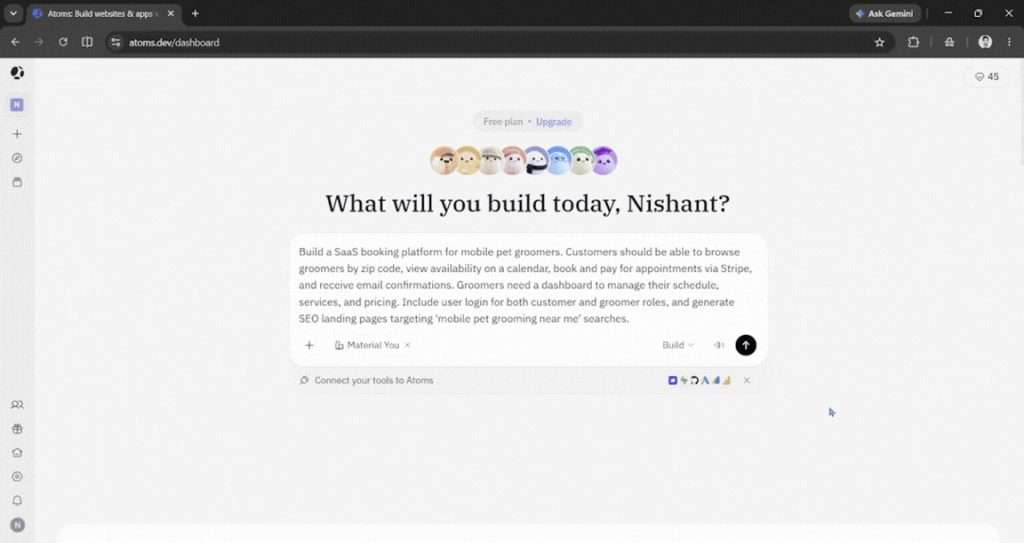
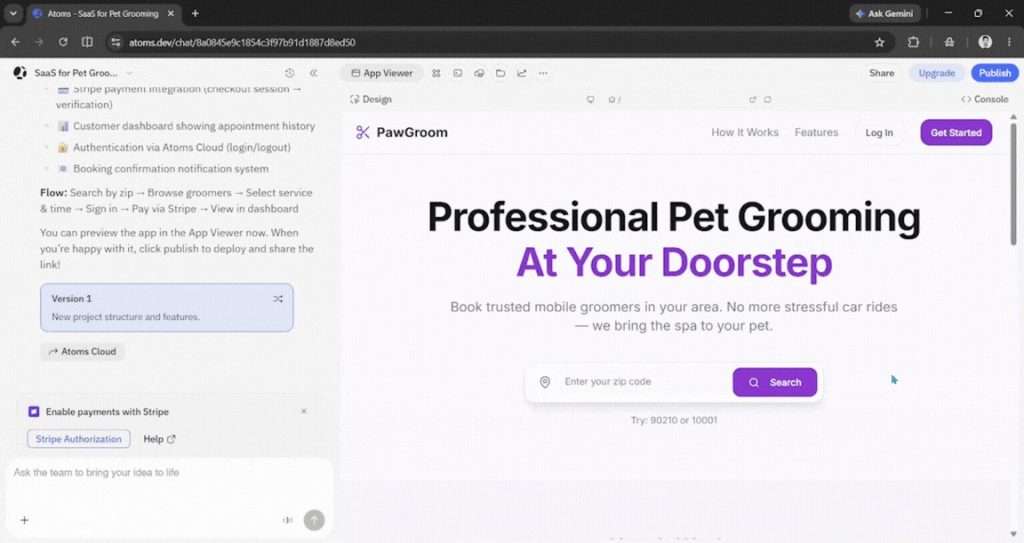
Step 4: Test the app yourself. It took Atoms ~10 minutes to complete everything, and the application felt smooth when I was clicking around, and everything worked well. Obviously, you can change its style and theme based on personal preference.
Atoms uses a transparent credit system, with usage visible in real time on your dashboard.
Yearly billing can save up to 21%, and unused credits roll over for one month in certain cases. You can use the discount code MARKTECHPOST10 for 10% off.
| Atoms | Lovable | Base44 | |
| Core approach | Multi-agent AI team (research → build → market) | AI chat-to-app builder | All-in-one AI app builder |
| Backend & auth | Built in (Atoms Cloud) | Built in (Lovable Cloud) | Built in |
| Growth tools | SEO + Ads agents included | Not built in | Not built in |
| Multi-model | Race Mode (Max plan) | No | No |
| Code export / GitHub | Yes | Yes | Yes (paid tiers) |
| Free tier | 15 credits/day | 5 credits/day (~30/mo) | 25 credits/mo |
| Paid plans | From $20/mo | From $25/mo | From $20/mo |
All three can create a beautiful app fast, but Atoms can also validate, build, and acquire customers with its agent-team model.
The first generation of AI app builders proved that anyone can ship software. Atoms is the next generation that not only builds apps but can also package research, full-stack development, deployment, and customer acquisition into a single multi-agent workflow. You can test and try it for free, and if you like it, you can use the discount code MARKTECHPOST10 for 10% off. Atoms is a credible option for founders who want to go from idea to paying customers without assembling a toolchain or a team. If you are a non-technical builder considering AI app builders in 2026, you should try Atoms.
Note: This article is sponsored by Atoms.dev team

Michal Sutter is a data science professional with a Master of Science in Data Science from the University of Padova. With a solid foundation in statistical analysis, machine learning, and data engineering, Michal excels at transforming complex datasets into actionable insights.
此内容由惯性聚合(RSS阅读器)自动聚合整理,仅供阅读参考。 原文来自 — 版权归原作者所有。