


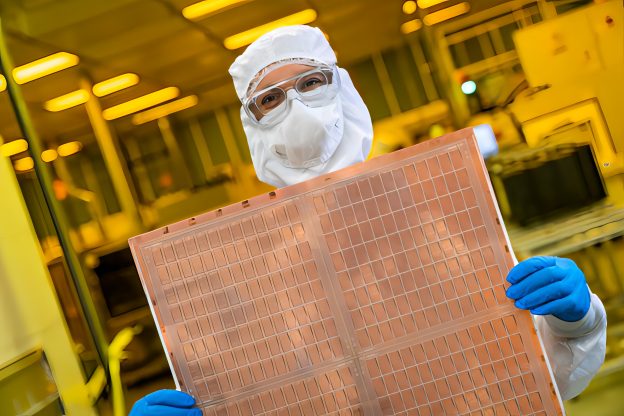
Commercialization of glass substrates is accelerating, with South Korean players and Intel increasingly competing head-on for leadership. According to Global Economic, sources indicate that Intel has laid out a glass substrate roadmap targeting 2030 to secure a technological edge, while Korean firms are ramping up commercialization efforts to prevent Intel from gaining the upper hand in setting industry standards.
As the report notes, the stakes center on control of design standards: if Intel succeeds in establishing them, fabless companies worldwide could be compelled to follow its specifications—potentially posing a significant threat to Korea’s semiconductor ecosystem.
Notably, the significance of glass substrates extends beyond current applications. As the report highlights, their key advantage lies in compatibility with the emerging photonics era, where data is transmitted using light rather than electrical signals.
Korea Moves to Scale First, Challenge Intel on Glass Substrate Standards
South Korean companies are stepping up their efforts. The report notes that, in response to Intel’s push, SKC subsidiary Absolics has taken a strategic step by building the world’s first mass-production facility for glass substrates in Georgia. While Intel remains at the research stage, Absolics aims to move into full-scale production first and secure an early lead in materials standards.
Chosun Biz notes that SKC plans to invest approximately KRW 590 billion, which represents about 60% of the funds raised through a recent paid in capital increase, into Absolics’ product development.
Based on the principle that the first to scale production often sets the standard, Absolics’ Georgia facility is already attracting interest from major Silicon Valley tech companies, Global Economic adds.
Samsung Accelerates Integrated Glass Strategy to Counter Intel’s Push
Meanwhile, Samsung is accelerating its efforts as well. According to Global Economic, Samsung Electronics is advancing the commercialization of glass substrates in collaboration with its affiliate Samsung Electro-Mechanics. Beyond component supply, the company is developing an integrated solution in which chips operate directly on glass substrates to deliver an optimized computing environment. Leveraging its strengths in both memory and foundry, Samsung aims to challenge Intel’s lead and establish a Korea-led glass ecosystem.
Corning Draws Focus in Glass Substrate Race
Still, as noted by Bridge Economy, major technical hurdles remain in glass substrate commercialization, with brittleness the most critical. The market believes leadership in next-generation AI semiconductor packaging will hinge on who can first overcome these challenges. As Bridge Economy indicates, the industry is closely watching Corning, a global optical fiber specialist with deep glass expertise, which signed a $6 billion long-term supply deal with Meta in January and has begun collaborating on AI infrastructure expansion.
Competition in the glass substrate market is also intensifying with China’s entry. According to Chosun Biz, Chinese display maker BOE is among the most active players. The company is operating a pilot production line and has reportedly made progress in TGV technology. With a focus on AI chips, BOE plans to begin mass production as early as this year.
Read more
- [News] SKC Reportedly Channels Over Half of ₩1T Capital Increase Into Absolics to Fast-Track Glass Substrates
- [News] Intel Reportedly Presents First Thick-Core Glass Substrate with EMIB, Targeting AI Data Centers
(Photo credit: Intel)
Please note that this article cites information from Global Economic, Bridge Economy, and Chosun Biz.