





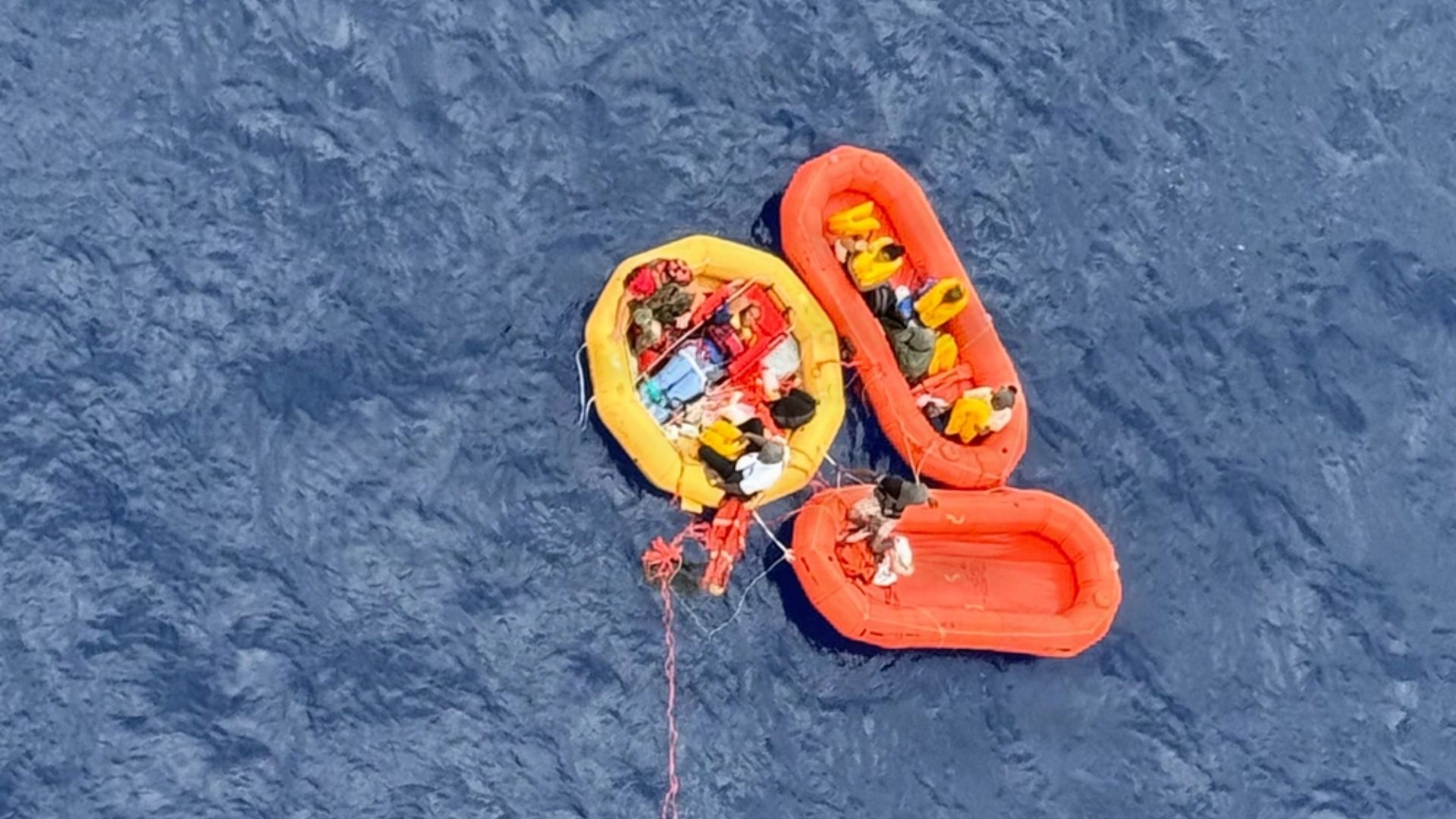
Eleven people survived after a private plane crashed into the Atlantic Ocean off Florida’s central coast on Tuesday. They spent almost five hours in a life raft before U.S. military rescue crews pulled them to safety.
The aircraft, identified as a Beechcraft 300 King Air turboprop, crashed about 50 miles off Vero Beach, Florida, after reportedly losing engine power during a flight between islands in the Bahamas.
Officials said the pilot landed the plane in the ocean and got everyone into an inflatable raft before the plane sank. The aircraft’s emergency locator beacon set off the rescue response. An Air Force Reserve rescue team, already training nearby, quickly joined the search.
“For all those people to survive is pretty miraculous,” said U.S. Air Force Major Elizabeth Piowaty, who commanded one of the rescue aircraft, during a news briefing on Wednesday.
Piowaty said her HC-130J Combat King II aircraft was already in the air when the emergency call came in. The plane, built for search-and-rescue missions, went straight to the crash site.
Her crew found the survivors as a thunderstorm was moving in. They dropped survival supplies like food, water, flotation gear, and two extra rafts. The survivors waited for help, crowded together under a tarp in rough seas. Rescue crews said waves were between 3 and 5 feet high.
“You could tell just by looking at them that they were in distress, physically, mentally, and emotionally,” said Air Force Capt. Rory Whipple, a pararescue specialist, entered the water during the rescue. “You have to imagine the emotional injuries they suffered out there, not knowing if someone would rescue them.” Officials said the extra flotation devices let survivors spread out while waiting for the helicopter team.
The rescue operation became increasingly urgent as weather conditions worsened and the helicopter crew approached its fuel limits. An HH-60W Jolly Green II rescue helicopter from the Air Force Reserve’s 920th Rescue Wing carried out the final recovery effort. Crew members used a hoist system to pull the survivors from the water one by one.
Whipple said all 11 survivors were brought aboard in nine separate hoists. The last rescue happened just minutes before the helicopter would have had to refuel in the air or land right away.
Officials said the rescued passengers were flown to Melbourne Orlando International Airport, where emergency medical teams were waiting. Authorities later confirmed all survivors were in stable condition. Three passengers reportedly had minor injuries.
Piowaty credited the pilot’s actions during the emergency with saving lives. She explained that landing a plane in the ocean is extremely dangerous because pilots have to manage the waves and slow the aircraft enough to reduce the impact.
According to officials, the aircraft had departed Marsh Harbour on Great Abaco Island and was heading to Grand Bahama International Airport in Freeport, a trip of about 100 miles.
The US Coast Guard said the plane reportedly had engine trouble before the pilot made the emergency landing in the water. By Wednesday, rescuers still had not found the sunken aircraft.
Bahamian authorities are leading the investigation, and the US Federal Aviation Administration said it would also review the incident. Officials have not shared more details about the passengers or the exact cause of the engine failure.

Get the latest in engineering, tech, space & science - delivered daily to your inbox.
A versatile writer, Sujita has worked with Mashable Middle East and News Daily 24. When she isn't writing, you can find her glued to the latest web series and movies.
此内容由惯性聚合(RSS阅读器)自动聚合整理,仅供阅读参考。 原文来自 — 版权归原作者所有。