






The XLUUV is designed to support up to 12 different payload configurations.
A Turkish defense company has recently unveiled a new strike-capable extra-large uncrewed underwater vehicle that can unleash drones, missiles, torpedoes, and mine warfare payloads to take out threats.
Datum Submarine Technologies, a defense firm that specializes in the design and engineering of manned and unmanned mini-submarines, demonstrated its Sinarit XLUUV (Extra Large Uncrewed Undersea Vehicle) concept at the SAHA Expo 2026. The event took place in Istanbul from May 5 to 9.
Often called Orca by the US Navy, the Sinarit UUV is a large, autonomous diesel-electric submarine drone created for months-long, independent and long-range missions without human presence on board.
To make the unmanned underwater vehicle (UUV), Datum used experience gained from earlier mini-submarines designed for deep and shallow waters. The vehicle is made with interchangeable 12.5-foot (3.8-meter) payload sections. These help it switch between intelligence gathering, mine countermeasures, torpedo missions, and strike operations.
New drone submarine
During the event, Datum revealed visuals portraying the 19.8-ton (18-tonne) UUV deploying one-way-attack FPV (First Person View) drones from under the surface.
The company said the platform can be configured for up to 12 different mission payloads. These include Baykar swarm drone launch systems, Malaman smart bottom mines, Akya and Orka torpedoes, and advanced intelligence-gathering sensors from Aselsan.
The submarine can also integrate Meteksan synthetic aperture sonar (SAS), ROV systems for mine countermeasure missions, alongside Roketsan Atmaca and Cakir anti-ship missiles, Tubitak Gezgin land-attack missiles, and Gokdogan surface-to-air missiles for operations targeting sea, land, and aerial threats.
“Sinarit is an underwater pickup truck,” Munir Cansin Ozden, PhD, Datum board chairman and ITU faculty member, pointed out. “Whatever payload you put in its 3.8-meter cargo bay, it can secretly carry it to wherever you want underwater.”
Strike missions underwater
The 37.7-foot UUV can be transported inside a standard shipping container and can also be airlifted by an A400M cargo aircraft. According to Baird Maritime, it will boast a maximum surface speed of 12 knots and a top submerged speed of eight knots. It will reportedly be designed to operate at depths of up to 328 feet (100 meters).
“While submerged, it cannot be detected by radar, cannot be tracked by satellite, and because it is designed with a low sonar cross-section and very quiet operation, detection by sonar is nearly impossible,” Ozden told Türkiye Today.
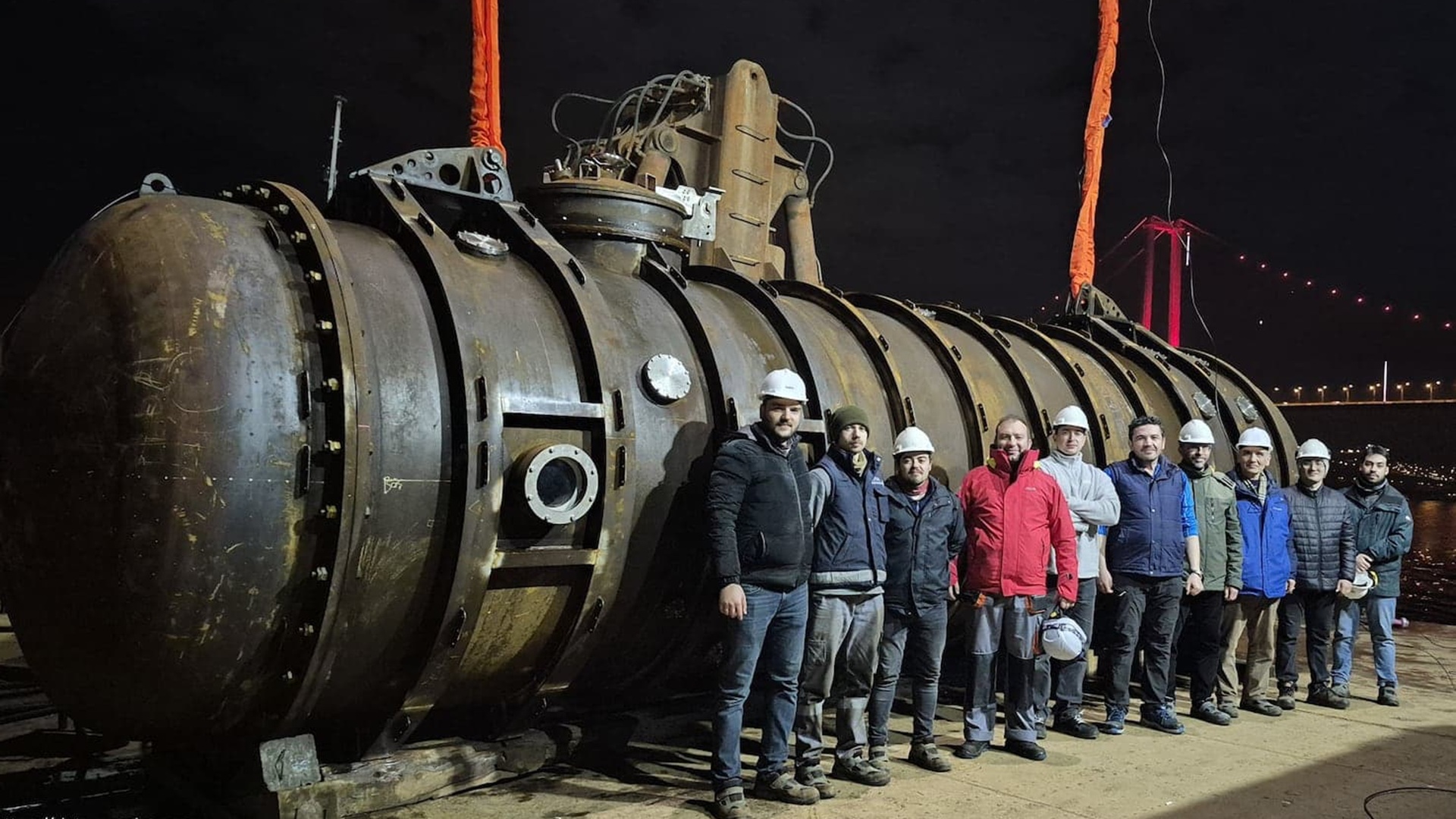
Credit: DATUM
Alongside the Sinarit reveal, Datum also showcased its more mature ÇAMD mini submarine program, which completed its first unmanned dive on April 14, in the Sea of Marmara off Karamursel. The test was observed by representatives from the Defense Industries Secretariat and Turkish Lloyd surveyors, while the assembly took place at Sefine Shipyard.
The 39-foot (12-meter) platform can operate at depths of nearly 1,000 feet (300 meters) and can reach speeds of up to 10 knots. Over 80 percent of the system is made with domestic components. Some of them include a pressure hull produced by Yakut Kazan, a motor supplied by Femsan DC Motor Factory, and a propeller developed by Eris Pervane.
Datum said that ÇAMD is planned as a test platform for systems developed under the nation’s Milden submarine program. It will help with underwater testing without using operational submarines.

Get the latest in engineering, tech, space & science - delivered daily to your inbox.
Based in Skopje, North Macedonia. Her work has appeared in Daily Mail, Mirror, Daily Star, Yahoo, NationalWorld, Newsweek, Press Gazette and others. She covers stories on batteries, wind energy, sustainable shipping and new discoveries. When she's not chasing the next big science story, she's traveling, exploring new cultures, or enjoying good food with even better wine.