






Europe’s mountains, long celebrated for tourism and ski slopes, may soon be famous for what lies beneath them. A new international study reveals that rock erosion plays a critical yet ambivalent role in the formation and accumulation of natural hydrogen beneath mountain ranges.
The study was led by the University of Lausanne (Unil) and the GFZ Helmholtz Center for Geosciences. Building on 2025 research, this study confirms that the Pyrenees and the Alps could be key targets for natural hydrogen exploration.
“Unexpectedly, erosion turns out to be a key and ambivalent factor in natural hydrogen production. This research supports the view that the Pyrenees and the Alps are key targets for natural H2 exploration,” said Frank Zwaan, lead author of the study, formerly at GFZ and now a researcher at the Faculty of Geosciences and Environment of the University of Lausanne (Unil).
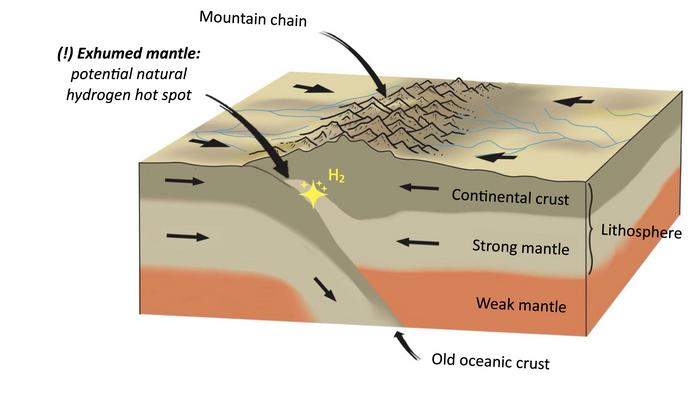
Scientists now believe that the geological forces that shaped Europe’s most majestic mountain ranges are hiding a vast, untapped treasury of hydrogen.
Driven by the urgent need for affordable clean energy, researchers are eyeing the subsurface of mountain ranges such as the Alps and the Pyrenees as promising sources of natural hydrogen.
Deep, iron-rich mantle rocks were pushed toward the surface over millions of years as plates first ripped apart and then collided.
When these rocks interact with water at specific temperatures, they undergo a chemical process called serpentinization, which releases hydrogen gas that can accumulate in porous rock reservoirs.
This naturally occurring resource could bypass the high costs and pollution associated with current manufactured hydrogen. In turn, it could offer a viable pathway to power vehicles and decarbonize heavy industries.
“We already know that the Earth produces large amounts of hydrogen, and local-scale exploitation is already ongoing in Mali. The key question now is whether large-scale hydrogen accumulations can be found, because, as with petroleum systems, very specific conditions must be met, with all key elements in place at the right time,” explained Zwaan.
Using advanced numerical models, scientists discovered that erosion acts as a delicate regulator of natural hydrogen production.
While moderate erosion promotes the uplift of mantle rocks, improving the conditions for hydrogen-generating chemical reactions, nature can also be too aggressive. Excessively rapid or intense erosion can backfire by destroying reservoir rocks and disrupting those necessary temperatures.
In addition, the simulations revealed that a region’s ancient geological history plays a role in determining its ultimate hydrogen potential. Specifically, the duration of tectonic extension phases that occurred long before mountains were even formed heavily influences this outcome.
When researchers compared different mountain belts, they demonstrated that hydrogen potential varies significantly across ranges. Among the scenarios examined, the Pyrenees emerged as highly favorable, while the Alps also showed interesting potential, whereas Spain’s Betic Cordillera was less promising.
The study authors noted that while these findings help pinpoint where to investigate, further research remains essential to precisely map out where natural hydrogen exploration should take place.
The study was published in the Journal of Geophysical Research: Solid Earth.

Get the latest in engineering, tech, space & science - delivered daily to your inbox.
Mrigakshi is a science journalist who enjoys writing about space exploration, biology, and technological innovations. Her work has been featured in well-known publications including Nature India, Supercluster, The Weather Channel and Astronomy magazine. If you have pitches in mind, please do not hesitate to email her.
此内容由惯性聚合(RSS阅读器)自动聚合整理,仅供阅读参考。 原文来自 — 版权归原作者所有。