


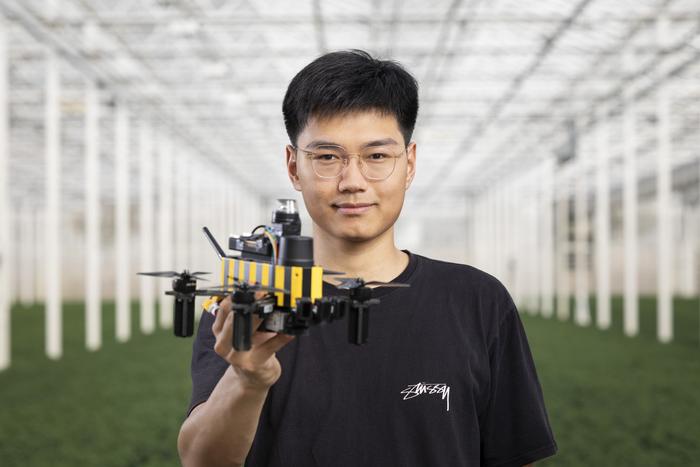
An international team of researchers has developed “Bee-Nav,” a new navigation strategy for drones inspired by honeybees’ homing behavior.
This system allows tiny, lightweight robots to navigate long distances and return home without the need for heavy, energy-hungry hardware or GPS.
It allows tiny drones to find their way home using a neural network of just 42 kilobytes.
It could pave the way for lightweight, safe swarms to handle delicate applications like greenhouse monitoring and industrial inspections.
The development comes from roboticists at Delft University of Technology and biologists at Wageningen University (both in the Netherlands) and Carl von Ossietzky University of Oldenburg (Germany).
Future autonomous robots face a major hurdle: navigation requires building detailed maps, which demand excessive computing power and battery life.
To solve this, researchers are looking to honeybees, which navigate by combining odometry with visual memory of their home base. Odometry helps to track distance and direction through visual motion cues.
Although odometry provides a rough estimate of location, it becomes less accurate over time due to drift. Hence, it necessitates the use of visual landmarks for precise homing. Bridging the gap between these two biological methods offers a path to creating lightweight, energy-efficient robots that can navigate without GPS.
Inspired by honeybees’ behavior, researchers developed a navigation strategy based on learning flights. Just as bees scout the immediate area around their hive before venturing out, robots can capture snapshots of their home environment to build a foundational visual memory.
This brief initial orientation helps to recognize their neighborhood from any direction and ensures that robots can find their way back even after long distances.
“We were fascinated by the fact that honeybees can fly far away from home along winding paths, yet return almost straight back,” said Guido de Croon, Professor of Bio-inspired AI for drones at Delft University of Technology.
“Biologists have shown that bees rely on odometry for the return journey, and use visual memory more as they get closer to home. But exactly what and how they learn for their visual memory is still not fully understood. That was the gap we needed to bridge to create a practical navigation strategy for robots,” Croon added.
The researchers successfully scaled the Bee-Nav strategy from small indoor tests to expansive environments, including a 600-meter outdoor flight powered by a tiny 42-kilobyte neural network.
Interestingly, the system achieved a perfect success rate in large indoor hangars, but performance dipped to 70% in windy outdoor conditions. This drop was primarily due to wind forcing the drone to tilt, which distorted the panoramic images the AI relies on for navigation — an area for future technical refinement.
“The experiments are very encouraging. But they also show that our current system needs to become more robust in real-world conditions,” the researchers stated.
The Bee-Nav technology is particularly promising for greenhouse monitoring, where lightweight, insect-like drones can safely navigate alongside humans to detect pests and diseases early. This efficiency helps growers increase crop yields and reduce waste without the need for heavy hardware.
Beyond its industrial potential, the research also offers valuable biological insights, providing a new perspective on how honeybees integrate visual learning to successfully navigate back to their hives.
The study was published in the journal Nature.

Get the latest in engineering, tech, space & science - delivered daily to your inbox.
Mrigakshi is a science journalist who enjoys writing about space exploration, biology, and technological innovations. Her work has been featured in well-known publications including Nature India, Supercluster, The Weather Channel and Astronomy magazine. If you have pitches in mind, please do not hesitate to email her.
此内容由惯性聚合(RSS阅读器)自动聚合整理,仅供阅读参考。 原文来自 — 版权归原作者所有。