








The Sun fired off two powerful X-class solar flares within hours, triggering temporary radio blackouts across parts of the Pacific, Australia and East Asia, according to NASA and U.S. space weather officials.
NASA said the first flare, classified as X2.4, peaked at 9:07 p.m. EDT on April 23. A second, slightly stronger X2.5 flare followed at 4:13 a.m. EDT on April 24. Both eruptions were captured by NASA’s Solar Dynamics Observatory.
“Solar flares are powerful bursts of energy,” NASA said in an update. “Flares and solar eruptions can impact radio communications, electric power grids, navigation signals, and pose risks to spacecraft and astronauts.”
X-class flares are the strongest category used by scientists to rank solar eruptions. The number attached to the label offers more detail about intensity, meaning an X2.5 event is stronger than an X2.4 flare.
The back-to-back eruptions came from active sunspot region AR4419 near the Sun’s western limb. Because of that position, any associated coronal mass ejections are less likely to strike Earth directly, though forecasters are still analyzing their paths.
The radiation from the flares reached Earth quickly and disturbed the ionosphere, the upper atmospheric layer that carries many radio and navigation signals. That disruption caused shortwave radio blackouts on the sunlit side of the planet.
The first blackout affected parts of the Pacific Ocean and Australia. The second impacted East Asia, according to monitoring data from NOAA’s Space Weather Prediction Center.
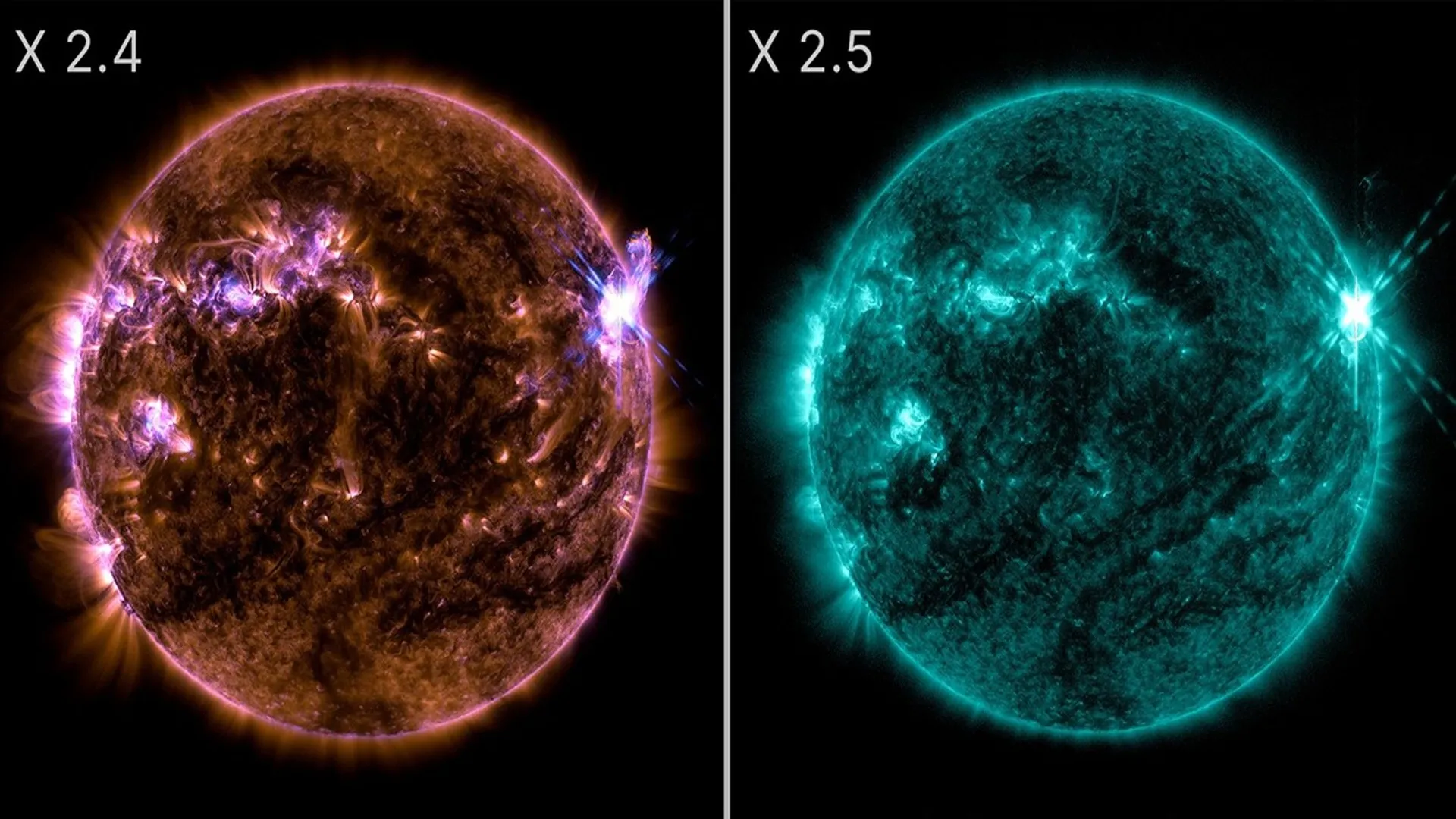
Solar flares release bursts of electromagnetic radiation, including X-rays and ultraviolet light. Unlike charged particles from slower-moving solar storms, flare radiation arrives at Earth at the speed of light.
NASA noted that harmful radiation from a flare cannot pass through Earth’s atmosphere to physically affect people on the ground. However, intense events can interfere with systems that rely on signals passing through the atmosphere, including GPS and communications networks.
Scientists classify solar flares into five groups: A, B, C, M, and X. Each level marks roughly a tenfold jump in energy output, placing X-class flares at the top of the scale.
Even so, the latest pair were far below the strongest flare ever recorded. In November 2003, an event estimated at X40 or higher blasted from the Sun during a period of extreme solar activity. The Sun remains highly active as Solar Cycle 25 continues. NASA and NOAA confirmed in late 2024 that the Sun had entered solar maximum, the peak phase of its roughly 11-year activity cycle. Elevated flare activity can continue even after the peak period.
For now, forecasters are watching whether any material from the latest eruptions delivers a glancing blow to Earth’s magnetic field in the coming days. If that happens, minor geomagnetic storms and bright auroras could follow.
NASA urged the public to monitor NOAA’s Space Weather Prediction Center for updated forecasts, watches, and warnings.
此内容由惯性聚合(RSS阅读器)自动聚合整理,仅供阅读参考。 原文来自 — 版权归原作者所有。