








The one-mile tunnel will be built through the narrowest part of the Stad Peninsula.
Norway is preparing to move ahead with the construction of the world’s first ship tunnel after securing funding in the revised national budget, and completing the evaluation of contractor bids for the project.
The Norwegian Coastal Administration (Kystverket) announced that it is ready to sign a contract with the winning contractor for the Stad Ship Tunnel project. The government agency expects construction to begin in early 2027.
The decision follows after Norway’s center-left parties reached an agreement to include funding for the project in the revised national budget. Final approval by the Norwegian Parliament is expected by June 19.
“We have received the news regarding the ship tunnel,” Einar Vik Arset, Kystverket General Director, said. “We are ready to initiate the processes needed to facilitate a construction start in the beginning of 2027.”
World’s first ship tunnel
First mentioned in an article in the Nordre Bergenhus Amtstidende newspaper, in 1874, the Stad Ship Tunnel will be the world’s largest ship tunnel. Located on the Stadlandet Peninsula, it is expected to stretch 1.1 miles (1.7 kilometers) through solid rock, or 1.37 miles (2.2 kilometers) when entrance sections are included.
The tunnel will measure 164 feet (50 meters) in height and 118 feet (36 meters) in width. Officials noted that it will be excavated through the narrowest part of the peninsula, connecting Moldefjord and Kjødepollen in the Vanylvsfjord region. The dimensions are large enough to accommodate vessels up to the size of Norway’s famous Coastal Route ships, including the Hurtigruten fleet.
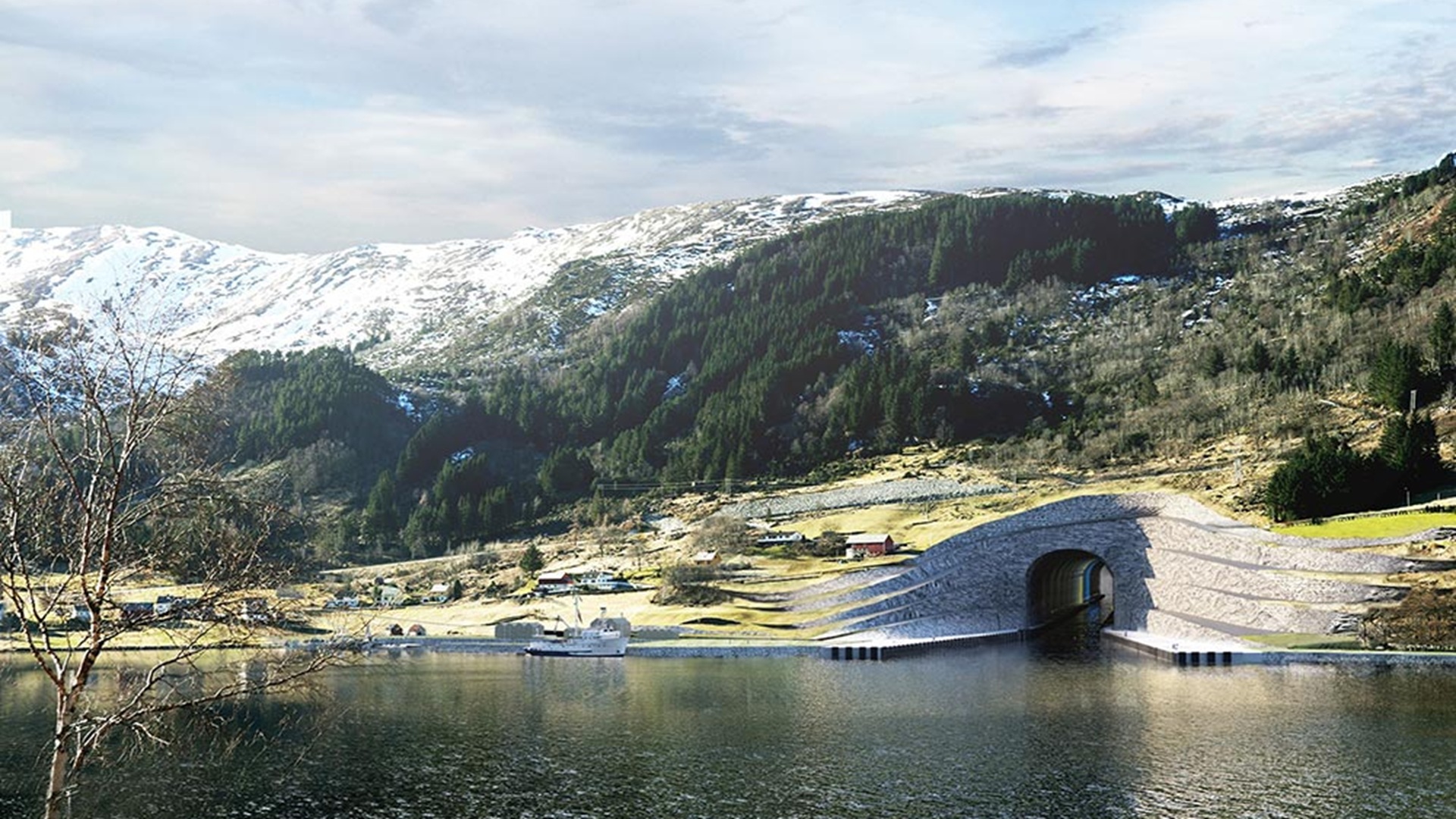
Credit: Kystverket / Snøhetta
It will allow large cargo vessels, ferries, and cruise ships to bypass the Stadhavet Sea. The waters are considered among the most hazardous along Norway’s coast, with rough weather, powerful currents, and high waves contributing to more than 30 maritime deaths since World War II.
“This is a major project, but we have prepared thoroughly over several years,” Arset pointed out. “We are ready as soon as we receive instructions from the Ministry of Trade, Industry and Fisheries.”
According to Kystverket, about 81 percent of today’s ship traffic will be able to use the tunnel. Cruise ships will reportedly be limited to a speed of eight knots inside it. This will allow them to complete the passage in about 10 minutes.
Built for modern shipping
For its construction, Norway will excavate roughly three million cubic meters of rock. This is equivalent to around 750,000 truckloads of material. The project will rely on conventional drill-and-blast methods to carve the tunnel through hard gneiss rock beneath the peninsula.
Kystverket said that it has completed its review of bids from three consortiums competing for the project’s main construction contract. The final contenders include Norway’s AF Gruppen, France’s Eiffage Génie Civil, and a joint venture between Sweden’s Skanska and Norway’s Vassbakk & Stol.
“The evaluation has been completed,” Harald Inge Johnsen, one of the project’s manager, concluded in a press release. “Once the contract award is announced, there will be a standstill period for any complaints before the contract can be signed as planned.”
Additional contracts covering demolition work and new water infrastructure near the tunnel site are also ready to be tendered. The Stad Ship Tunnel is expected to improve navigational safety and reliability for maritime traffic along Norway’s rugged western coast.
Recommended Articles

Get the latest in engineering, tech, space & science - delivered daily to your inbox.
Based in Skopje, North Macedonia. Her work has appeared in Daily Mail, Mirror, Daily Star, Yahoo, NationalWorld, Newsweek, Press Gazette and others. She covers stories on batteries, wind energy, sustainable shipping and new discoveries. When she's not chasing the next big science story, she's traveling, exploring new cultures, or enjoying good food with even better wine.