






Researchers at Canada’s Western University designed a foam-backed floating photovoltaic (FPV) system.
It was tested in a stormwater pond in Ontario, Canada. The system generated 7.7 megawatt-hours of electricity over a year, outperforming a standard reference floating system by about 2.7 percent.
“The results of this study established foam-based FPV as a promising and adaptable platform for renewable energy generation,” the team noted in the study paper.
Solar power has long had a geography problem.
To build the massive solar farms required to displace fossil fuels, developers need land. Usually, that means competing with agriculture or cutting into natural conservation areas. The solution in warmer climates has been “floatovoltaics“—placing solar panels on giant plastic pontoons over lakes and reservoirs.
But if you try that in a Canadian winter, thick moving ice will crush the structures like aluminum cans.
Now, researchers have solved the cold-weather problem using a deceptively simple combination of materials: shipping foam and hot tub bubbles. In particular, a monocrystalline foam-backed FPV system was fabricated.
It shows that floating solar can not only survive freezing temperatures but actually thrive in them.
Compared with tilted plastic rafts used in warmer climates, this design attaches flexible solar panels directly to thick, waterproof foam sheets, reducing wind exposure.
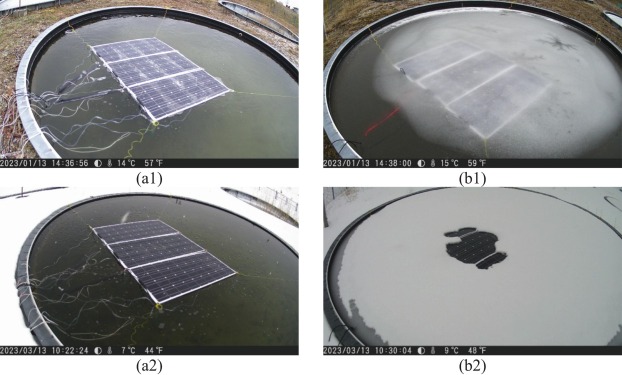
To prevent ice damage, an underwater air-bubbler system was installed. A shore-based pump pushes bubbles from the bottom of the pond, carrying warmer deep water to the surface to keep the area around the panels ice-free. It acted like a localized defroster.
The results showed that on days when the rest of the pond was frozen, the water directly surrounding the solar array remained completely clear.
Keeping the ice away didn’t break the energy bank, either. Over a year of continuous monitoring, the air-bubbler system consumed as little as 0.02 percent of the total energy the panels generated. At its peak during the worst winter storms, it reduced yield by only 14.5 percent.
“A regression model developed in this study indicated that the foam-based FPV system generated 7.7. MWh/year, representing up to 2.7% more energy than other PV models,” the study noted.
It also pulled double duty as a water conservation tool.
In sitting flat against the water’s surface, the foam-backed array acted as a physical shield, blocking direct sunlight and cutting off the wind that typically drives evaporation. The researchers calculated that the relationship between solar coverage and water savings is linear, meaning that every additional square meter of panel added results in a predictable drop in water loss.
“FPV coverage linearly reduced pond evaporation, aiding agricultural water conservation,” the study stated.
If scaled up to cover just half of the Ontario stormwater pond, this innovative setup would trap and save roughly 927 cubic meters of water annually.
For local communities and farmers, that means keeping hundreds of thousands of gallons of precious water in the reservoir to support agricultural irrigation when it is needed most.
With the concept proven on a small scale, the researchers are looking to take their foam-and-bubble design out of the pond. The next step is testing the technology on a larger scale across harsher, more diverse bodies of water.
The findings were published in the journal Applied Energy.

Get the latest in engineering, tech, space & science - delivered daily to your inbox.
Mrigakshi is a science journalist who enjoys writing about space exploration, biology, and technological innovations. Her work has been featured in well-known publications including Nature India, Supercluster, The Weather Channel and Astronomy magazine. If you have pitches in mind, please do not hesitate to email her.
此内容由惯性聚合(RSS阅读器)自动聚合整理,仅供阅读参考。 原文来自 — 版权归原作者所有。