




A Danish company has finished the installation of the first fully commissioned XXL monopile foundation at what is set to become the world’s largest offshore wind farm, once it enters operation in 2027.
Copenhagen-based offshore wind specialist Cadeler confirmed on Thursday, May 14, that the first monopile foundation is now in place at renewable energy giant Ørsted’s massive Hornsea 3 offshore wind farm project.
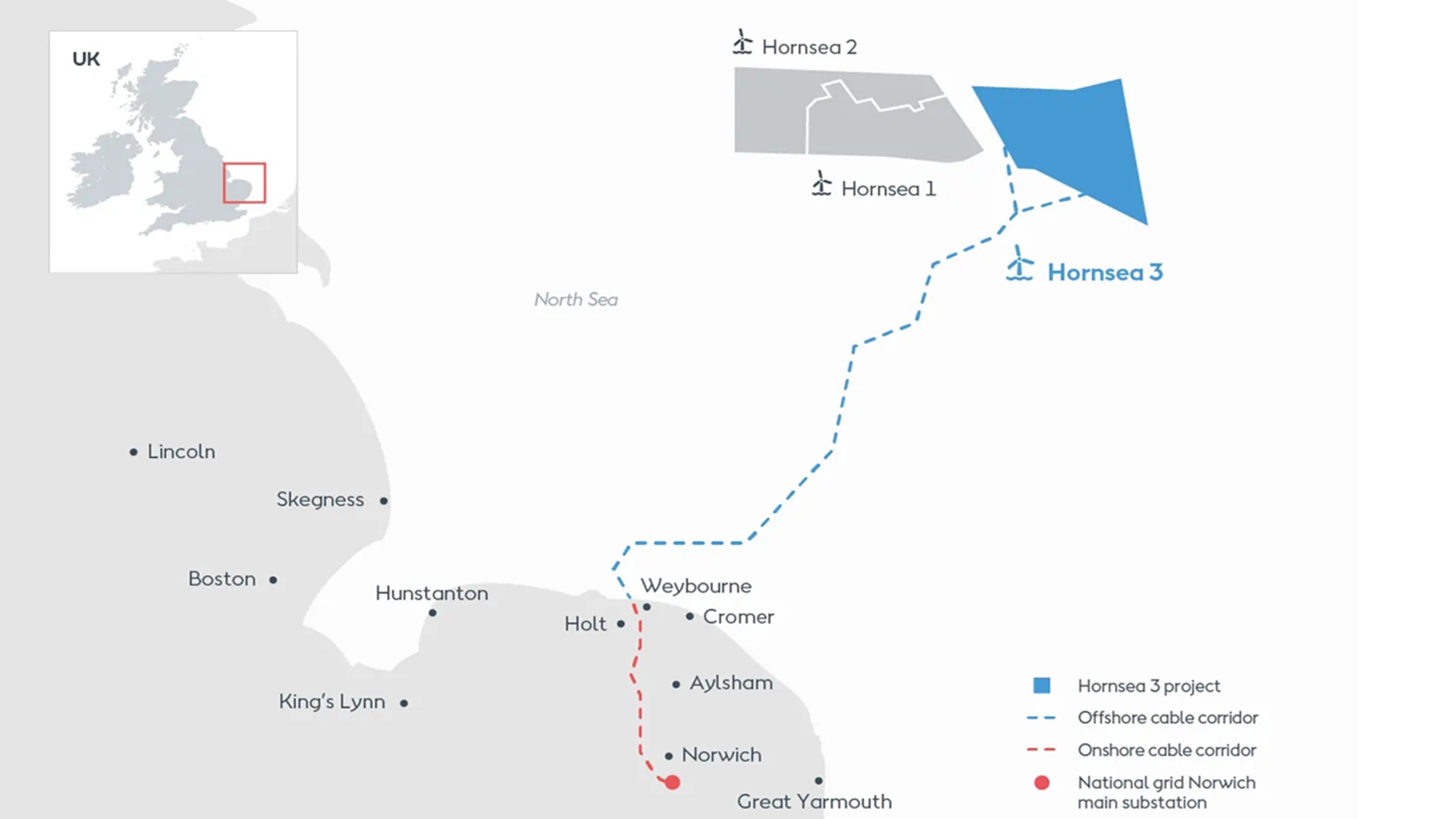
Located in the North Sea, approximately 75 miles off the Norfolk coast and about 100 miles off the Yorkshire coast in the UK, the Hornsea 3 offshore wind farm will have a capacity of 2.9 gigawatts (GW).
“Once completed, Hornsea 3 will become the single largest offshore wind farm in the world, with a total capacity of 2.9 GW, capable of powering more than 3.3 million UK homes with renewable energy,” Cadeler disclosed.
The newly installed structure is the first of 197 monopile foundations that Cadeler will transport and install as part of the project’s full transportation and installation (T&I) contract. It is the first time the firm has handled the complete transport and installation scope for offshore monopile foundations on a project of this scale.
“The successful installation of the first complete monopile foundation follows years of planning, engineering, and coordination across teams onshore and offshore,” the company pointed out. “It reflects the coordinated execution of multiple specialized offshore scopes across vessels and project partners.”
Cadeler also said that the monopile was installed using their purpose-built A-class installation vessel, Wind Ally. It was specially designed to transport and install XXL monopile foundations for advanced offshore wind farms.
Meanwhile, another vessel, Wind Orca, handled the installation of secondary steel structures. In turn, the Danish service operation vessel Esvagt Froude carried out the commissioning scope.
In addition, offshore services firm Boston Energy completed the post-installation commissioning work for the foundation. Cadeler intends to deploy three of its specialist vessels throughout the wider Hornsea 3 installation campaign.
Bradley Scott, Cadeler project director, described the installation as a major step for the firm’s offshore expansion. “Delivering projects at this scale requires close collaboration, detailed planning, and strong execution across every phase of the operation,” Scott revealed in a press release.
Hornsea 3 forms part of the wider Hornsea Zone in the North Sea. It has become one of the world’s most important offshore wind development regions. It comes after the UK adopted a strategy aimed at cutting carbon emissions, strengthening energy security, and cutting reliance on fossil fuels.
Spanning more than 1,826 square miles (4,730 square kilometers), the Hornsea Zone includes the operational Hornsea 1 and Hornsea 2 projects, as well as the current under-construction Hornsea 3. it will also include the planned Hornsea 4 wind farm.
“We are proud to support Ørsted on Hornsea 3 and grateful to all teams offshore and onshore whose commitment and collaboration have contributed to reaching this point safely and successfully,” Scott concluded.
Hornsea 3 will create up to 5,000 construction jobs and an additional 1,200 long-term roles, and will be operated from Grimsby.

Get the latest in engineering, tech, space & science - delivered daily to your inbox.
Based in Skopje, North Macedonia. Her work has appeared in Daily Mail, Mirror, Daily Star, Yahoo, NationalWorld, Newsweek, Press Gazette and others. She covers stories on batteries, wind energy, sustainable shipping and new discoveries. When she's not chasing the next big science story, she's traveling, exploring new cultures, or enjoying good food with even better wine.
此内容由惯性聚合(RSS阅读器)自动聚合整理,仅供阅读参考。 原文来自 — 版权归原作者所有。