








Archaeologists uncovered a nearly complete, six-foot-tall statue of Athena at the West Theater in Laodicea, once a Roman city so prosperous and famous that it was even mentioned in the Bible.
Culture and Tourism Minister Nuri Ersoy announced this remarkable discovery on social media, describing it as an exemplary work of art featuring a distinct style, according to Turkiye Today.
Ironically, the cloaked and armored marble statue of the goddess was found face down in the rubble near the outer wall of the stage. Although it is headless, the statue’s body remains exceptionally well-preserved, showcasing strikingly deep folds that create a high-definition effect of light and shadow.
As inscriptions found at the ancient cultural center indicate, the statue honors the deity as a patron of craft—a fitting tribute, as Laodicea was renowned for textile production. Standing in a theater, it even evokes the Shakespearean line, “What a tangled web we weave,” as Athena is also a warrior. She even vouched for Odysseus, who will enter our story later to add a touch of dramatic suspense.
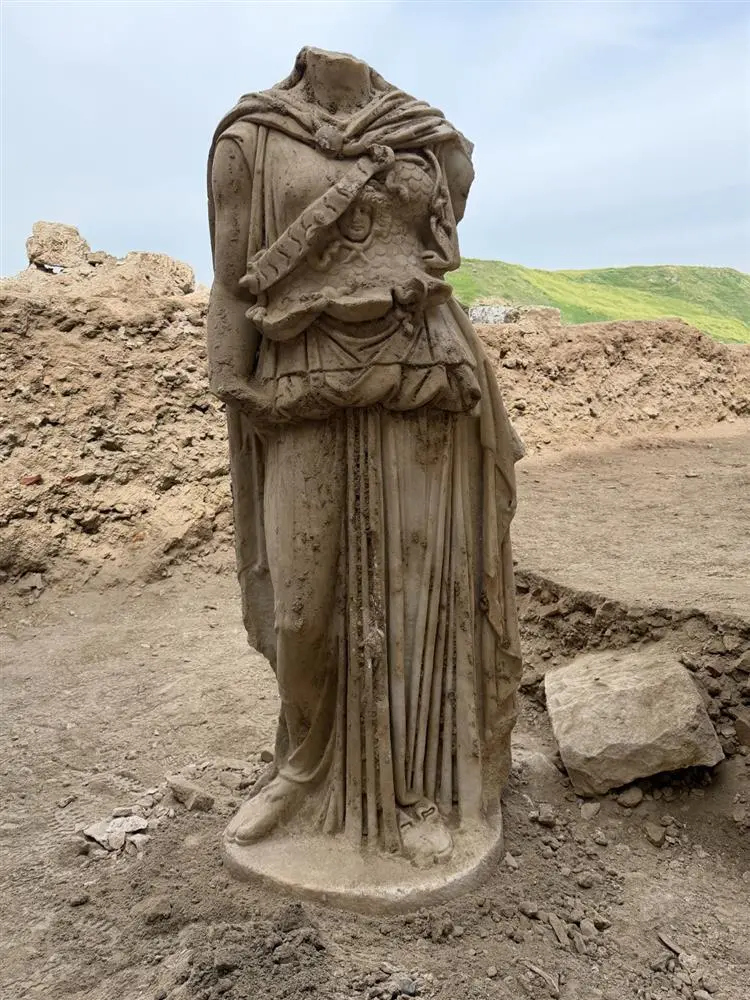
Once the towering statue was righted, the drapery and the aegis on her chest depicting the head of Medusa helped identify the headless goddess as Athena. Standing on a circular base, her long peplos falls in both deep and shallow folds; it was meticulously sculpted by a single artist, rather than a workshop, to appear lifelike with natural depth and contour.
Stylistically, the sculpture belongs to the school of naturalism and hails from the reign of Augustus, dating between 27 BCE and 14 CE. It appears the goddess has tucked her robe over a waist belt, as if to prevent it from dragging on the ground. The cloak, or chlamys, that she wears is fixed at the neck, which may indicate a local variation in style.
Interestingly, the Medusa on her chest looks worn, suggesting “a sense of intensity,” as Heritage Daily described, perhaps indicating it was touched by those who passed it, much like the breast of the statue of Juliet in Verona.
Additionally, variations in her appearance were noted, such as the strap across her chest. Her left arm would likely have held a spear, while her right hand may have rested on a shield or held a representation of victory.
According to Archaeology Magazine, the back of the statue was left unfinished. The sculptor, a classicist, saw no value in expending energy for the sake of “art” alone; that is a modern problem. The statue was intended to be displayed between architectural columns, so the back would never be seen.
Each of the three stories of the West Theater was surrounded by 16 columns, between which statues of gods were displayed, often depicting scenes from Homer’s epics. And so, Odysseus returns as promised.
Athena served as the central divine guardian and guide in the great epic, The Odyssey. Previous excavations in the area have uncovered figures such as Scylla and the cave of the giant Polyphemus.
This emblematic find is part of the “Heritage for the Future” project, which aims to preserve historical artifacts for future generations, as reported by Turkiye Today. The statue exemplifies Turkey’s artistic and cultural legacy, highlighting the economic prosperity that local craftsmen achieved alongside their works of art.

Get the latest in engineering, tech, space & science - delivered daily to your inbox.
Originally from LA, Maria Mocerino has been published in Business Insider, The Irish Examiner, The Rogue Mag, Chacruna Institute for Psychedelic Plant Medicines, and now Interesting Engineering.
此内容由惯性聚合(RSS阅读器)自动聚合整理,仅供阅读参考。 原文来自 — 版权归原作者所有。