


Researchers at Princeton University have developed a 3-dimensional device that merges living brain cells with advanced electronics to perform computational tasks.
In this new work, advanced fabrication was used to create a 3D mesh of microscopic metal wires and electrodes.
As per the study authors, these 3D biological neural networks serve a dual purpose. Beyond unlocking the brain’s computational mysteries, it provides a powerful new tool for understanding and developing treatments for neurological diseases.
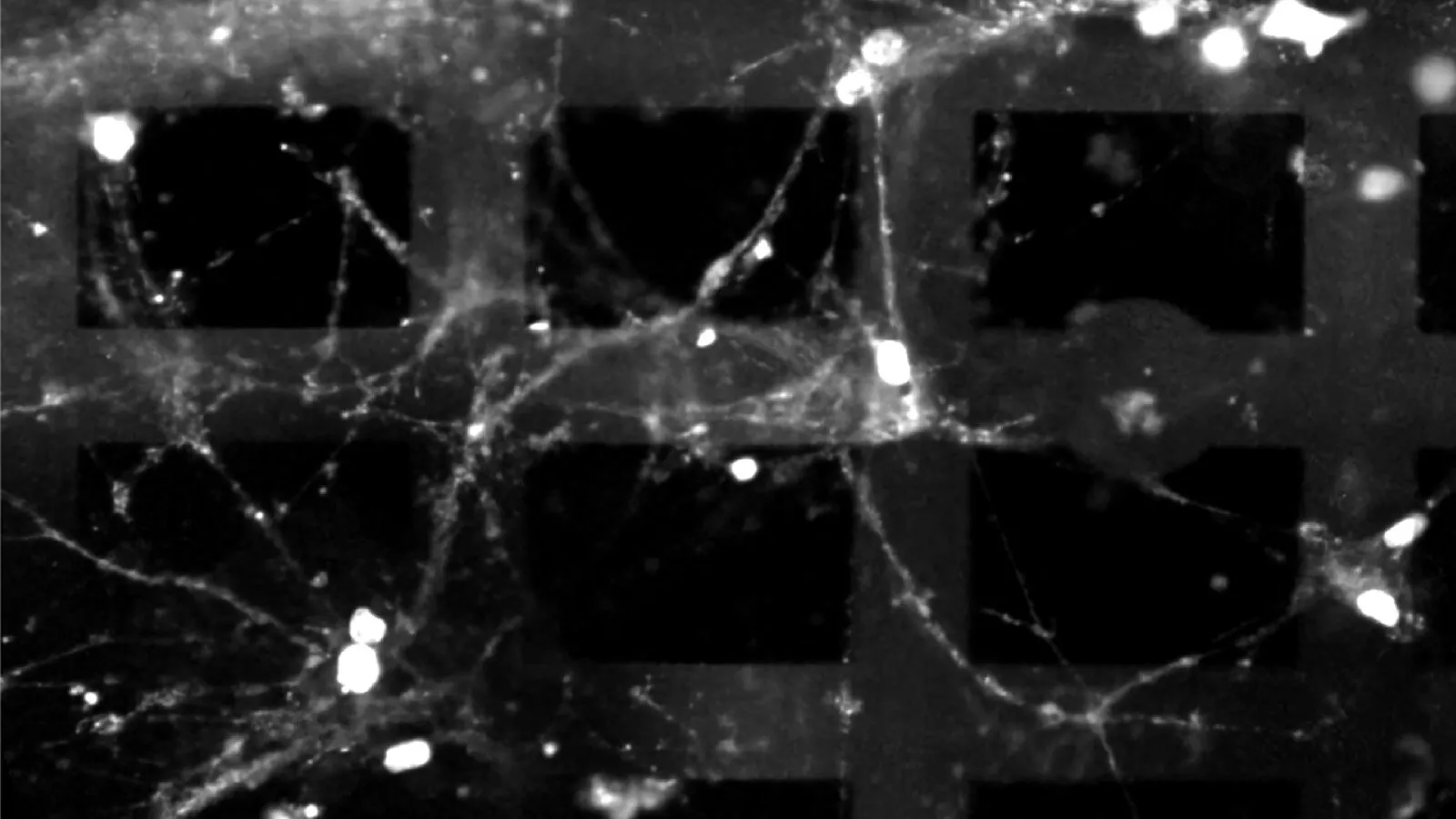
The research team employed advanced fabrication techniques to construct a 3D mesh consisting of microscopic metal wires and electrodes. This structure is supported by an ultra-thin, flexible epoxy coating that mimics the soft, delicate texture of actual brain tissue.
Using the mesh as a scaffold, tens of thousands of neurons were grown directly, and allowed the electronics to interface with the biological network from the inside.
Remarkably, the system remained stable for over six months. The “inside-out” architecture allows the electronics to record and stimulate the cells, transforming a vast 3D cluster of living neurons into a programmable system capable of computation.
This long-term evolution culminated in the training of an algorithm capable of accurately interpreting and recognizing complex patterns of electrical pulses within the system.
Interestingly, it demonstrated its computational prowess by successfully distinguishing between distinct spatial sources (i.e., the locations where signals originate) and temporal electrical patterns (the timing of electrical pulses). These tests confirmed that the hybrid device can process both the where and when of incoming data, much like a natural brain.
“The system correctly distinguished among the patterns in both tests. The researchers said they hope to scale the system to the point where it can do increasingly complex tasks,” the researchers noted.
Although originally designed for neuroscience research, the project has applications in solving the energy crisis in modern AI.
Data centers are consuming massive amounts of electricity to run the math required for digital intelligence. Researchers hope to solve the massive energy drain slowing down AI technology.
The human brain is the most efficient computer in the known universe. It performs complex reasoning and pattern recognition while operating on a million times less power than digital computers. Using actual biological cells, the Princeton team is looking for a shortcut to ultra-low-power computing.
Princeton’s discovery is part of a fast-growing field called “Wetware Computing.” While other scientists have tried similar things, this new 3D design is latest in the line.
Most attempts to harness brain cells for computing happen in flat petri dishes, which are 2D, fragile, and monitored from a distance. In 2022, a startup called Cortical Labs created “DishBrain,” a flat, 800,000-neuron layer that learned to play the arcade game Pong in 5 minutes. While impressive, DishBrain was limited by its 2D geometry.
Instead of just sitting on top of the new device, the cells actually grew through the mesh and tangled with it. As the sensors are tucked right inside the cell cluster, researchers can detect their neuron signals more clearly than ever before.
The study was published in the journal Nature Electronics on April 23.

Get the latest in engineering, tech, space & science - delivered daily to your inbox.
Mrigakshi is a science journalist who enjoys writing about space exploration, biology, and technological innovations. Her work has been featured in well-known publications including Nature India, Supercluster, The Weather Channel and Astronomy magazine. If you have pitches in mind, please do not hesitate to email her.
此内容由惯性聚合(RSS阅读器)自动聚合整理,仅供阅读参考。 原文来自 — 版权归原作者所有。