

惯性聚合 高效追踪和阅读你感兴趣的博客、新闻、科技资讯
阅读原文 在惯性聚合中打开

推荐订阅源

Threat Intelligence Blog | Flashpoint
W
WeLiveSecurity
O
OpenAI News
N
News and Events Feed by Topic
K
KPMG report finds enterprise disconnect between AI and its ROI | CIO
cs.CV updates on arXiv.org
Webroot Blog
Webroot Blog
Google Online Security Blog
云风的 BLOG
云风的 BLOG
N
News | PayPal Newsroom
H
Hacker News: Front Page
博客园_首页
Exploit-DB.com RSS Feed
The Last Watchdog
The Last Watchdog
钛媒体:引领未来商业与生活新知
钛媒体:引领未来商业与生活新知
H
Heimdal Security Blog
cs.AI updates on arXiv.org
S
Schneier on Security
宝玉的分享
宝玉的分享
H
Hackread – Cybersecurity News, Data Breaches, AI and More
Recent Commits to openclaw:main
Y
Y Combinator Blog
Cyberwarzone
Cyberwarzone
Microsoft Security Blog
C
CXSECURITY Database RSS Feed - CXSecurity.com
GbyAI
GbyAI
Cloudbric
Cloudbric
TaoSecurity Blog
TaoSecurity Blog
人人都是产品经理
人人都是产品经理
P
Palo Alto Networks Blog
M
MIT News - Artificial intelligence
G
GRAHAM CLULEY
C
Check Point Blog
Apple Machine Learning Research
Last Week in AI
Last Week in AI
T
Troy Hunt's Blog
L
Lohrmann on Cybersecurity
www.infosecurity-magazine.com
P
Proofpoint News Feed
Blog — PlanetScale
Blog — PlanetScale
量子位
博客园 - 聂微东
S
Securelist
博客园 - 三生石上(FineUI控件)
F
Full Disclosure
G
Google Developers Blog
L
LINUX DO - 热门话题
P
Proofpoint News Feed
AI
AI
PCI Perspectives
PCI Perspectives

Interesting Engineering

US firm to scale laser-based nuclear fusion ‘breakthrough’ with new partnership Military Archives - Interesting Engineering World’s first non-nuclear lead-cooled reactor to generate electricity begins installation US scientists devise new process to turn sewage sludge into 99% pure natural gas US firm unveils submarine-hunting drone with 9,200-mile-range, 35 mph top speed Military Archives - Interesting Engineering Supercomputer finds lithium-titanium tweak to boost sodium-ion batteries for grids Lockheed Martin demonstrates vertical launch missile system for mobile drone defense China’s 1116 MWe Taipingling Unit 1 reactor goes online, set to generate 9bn kWh yearly ChatGPT Images 2.0 update combines reasoning, research, and design with 2K output US Navy tests plug-and-play laser system on USS Bush carrier, downs drones at sea China’s CATL reveals 621-mile EV battery, under-7-minute charging to challenge BYD US uses world’s first exascale supercomputer to model supernovae, fusion reactors AI and Robotics Archives - Interesting Engineering First-in-human study confirms safety of graphene-based brain interface Tesla’s Optimus humanoid robot greets runners, poses for photos at Boston Marathon Interlocking materials offer high strength and flexibility for robotics, infrastructure US redeploys 100,000-ton nuclear-powered aircraft carrier in Red Sea after repairs US scientists unveil concept for ‘world’s first neutrino laser’ to unlock breakthroughs New military tech can maintain communication in contested electronic warfare environments Got a dark personality? Psychologists can help you choose your career wisely Humidity boosts performance of 3D-printed nanogenerator instead of degrading it China demonstrates microwave beam that recharges drones in flight, continues power delivery Scientists run compact free-electron laser for eight hours, cracks FEL stability problem China’s PLA considers to use minelaying underwater drones to enforce Taiwan blockade: Report 1-ton sharks may struggle for survival in waters exceeding 62.6°F, study suggests US firm’s thorium nuclear fuel bundles move to manufacturing for commercial reactors Tesla hits 0% charge in remote Chilean desert as YouTuber uses hood-mounted solar Humanoid robot surpasses human world record in Beijing half-marathon, clocking 50:26 mins New method extracts maximum work from unknown quantum states using symmetry tricks US scientists’ new method can measure rare-earth elements in plants without destroying them 1,800-year-old feces reveal disease and hygiene linked to Roman Empire in Bulgaria Tankers come under fire as Iranian forces close Strait of Hormuz over US blockade Iran announces opening of Strait of Hormuz, Donald Trump says blockade to continue US scientists confirm altermagnetism in rust, unlock faster, low-power electronics Chinese scientists hit record 63 K in nickel superconductors without extreme pressure Songbird study reveals potential paths for human brain’s self-repair, neurogenesis US dumping ground that stores hundreds of drums with nuclear waste set to be cleaned up Chinese scientists’ diamond-based coating to boost data center cooling efficiency by 80% US’ 100,000-ton nuclear warship sets record with longest deployment since Vietnam War World-first eVTOL two-way transition flight test completed by Vertical Aerospace New electrolyte design improves solid-state battery conductivity by 2.7 times 50-year-old prediction confirmed as scientists spot darkness moving faster than speed of light Uncrewed underwater vehicle enters service in Australia, can boost autonomous warfare power Quasi-solid-state battery hits 99.98% efficiency, stops dendrites, and boosts cycle life France plugs Lucy photonic quantum system into supercomputer for hybrid computing US Army CH-47F Chinook helicopter makes first autonomous landing without human input 300-million-year-old German Basin could hold one of Europe’s largest lithium resources ‘World’s first’: AGIBOT G2 humanoid robots run tablet testing on live factory line Google in talks with Pentagon to deploy Gemini AI after Claude limits dispute US tests spin-polarized fuel in 180-million-degree Fahrenheit tokamaks for fusion power US unveils AI-powered drone with 66-mile reach, modular payload transforms operations Anthropic launches Opus 4.7 with 13% higher vision resolution and stronger coding Germany airdrops 5 ton ‘mini tank’ from aircraft in first airborne test trial US nuclear firm submits plan for 240 MW small modular reactor to power 1.5 million homes China turns on largest AI science hub in 2 months, using no US chips at all Relic black holes from cosmic ‘bounce’ may be dark matter shaping our Universe China releases first detailed map locating seabed minerals in eastern seabed China’s humanoid robot masters real-time tennis rallying with 90.9% return accuracy 10,000 suns: Black hole ‘dancing jets’ clocked at instantaneous power in a first US chemists turn natural gas into liquid fuel without high heat and pressures Australia’s major refinery burns for 13 hours, raises fresh fears over petrol supply crisis US firm can help faster, real time tracking of high-speed threats with infrared camera US Army trials unmanned Hunter Wolf robot with gun, radar in combat drills Massive cosmic test shows Newton and Einstein still explain gravity accurately Mondelez-backed startup debuts ‘world’s first’ chocolate bars made with cultured cocoa China trials deep sea actuator for cutting cables and pipelines at 3,500m depth ‘Missing house’: Exact location of Shakespeare’s only London property identified Boston Dynamics robot Spot now uses Gemini AI for reason-driven decision-making tasks 1,000x faster growth: China advances wafer-scale 2D chips with ultra-fast synthesis technique Chinese automaker’s new EV offers dual rear motors, 800V fast-charging capability Engineered wood converts sunlight into heat, supplies solar power even in darkness US to boost production of submarine-detection devices that could decide battle outcome Your roommate can change your gut: Study finds living together could change your biome China develops crystal that could enable GPS-free navigation for submarines, missiles Electric aircraft motor achieves 1,000 hp output with mere 207 pound weight China’s Geely touts methanol’s ’10x higher’ energy density over ‘too heavy’ lithium EVs Over 150 mergers reveal three distinct black hole origins, challenging unified model German firm’s car integrated with high-pressure hydrogen chambers that deliver 466-mile range 2,000-year-old wall paintings in Roman Hispania reveal ingenious house painters A reimagined Paul trap could help labs worldwide study antimatter beyond CERN China’s BYD debuts electric SUV with up to 590-mile range capability, 130.15 kWh battery Rare 2,000-hp Japanese WWII aircraft lifted out of ocean 80 years after combat Autonomous underwater mine warfare could become easier with French firm’s AI-powered system China showcases Y-30 plane to outperform ‘world’s best tactical transport aircraft in service’ NASA Artemis II crew splashes down safely on Earth after 694,000-mile roundtrip to moon UK firm to boost US Army’s battle firepower with new cannons for 155mm Howitzer Can defects boost light? Study shows flaws boost energy flow in organic semiconductors China could test floating rocket launch platform in South China Sea open waters: Reports Physicists unlock way to measure quantum entanglement inside real-world materials China ramps up new sodium-ion EV battery cathodes as cells survive 572°F safety tests US authorizes Mach 5+ Dark Eagle hypersonic missile for rapid global strike missions Solid-state nuclear battery claims 100-year power for ultra-low energy devices South Korea clears Saeul 3 nuclear reactor for criticality after fuel, heat tests Fake birds, real impact: Robotic decoys aim to revive grouse populations in US Faster, safer solid-state EV batteries unlocked with new US-made super polymer Microsoft out: France moves to replace Windows with Linux to cut reliance on US tech World’s first commercial-ready deep borehole nuclear waste disposal inches closer to reality New dual-frequency trap captures electrons and ions, pushing antihydrogen beyond CERN Military Archives - Interesting Engineering
Dark modes no longer block quantum effects as scientists switch them on demand
Rupendra Bra · 2026-04-26 · via Interesting Engineering

In the strange world of quantum physics, some effects are not just hard to control—they are completely hidden. These so-called dark modes quietly sit inside quantum systems, refusing to interact with external signals and, worse, shutting down the very behaviors scientists want to harness. 

Now, a new study from researchers at Japan’s RIKEN Center for Quantum Computing presents a clever way to overcome this problem. By briefly turning these invisible modes visible, they have unlocked a path to control elusive quantum effects that were previously out of reach.

Our “study maps a general path towards generating a profoundly different topological quantum resource with immunity against both dark modes and dark states,” the study authors note

This development could transform how future quantum devices store and transmit information, especially in systems that deal with light and sound at the smallest scales.

The dilemma due to dark modes 

To understand the breakthrough, it is important to know the setting. The researchers were working with non-Hermitian systems—a class of quantum systems that can exchange energy with their surroundings. 

These systems have become a hot topic because they can host unusual topological effects. In simple terms, topology here refers to properties that remain stable even when a system is slightly disturbed, making them attractive for robust quantum technologies.

In such systems, particles like photons (light) or phonons (vibrations of sound) can be guided in controlled ways—for example, forced to move only in one direction.

“Topological operations allow for various weird and fascinating phenomena, such as the buildup of chiral phases and the movement of phonons in one direction,” Franco Nori, one of the study authors and a scientist at RIKEN, explained.
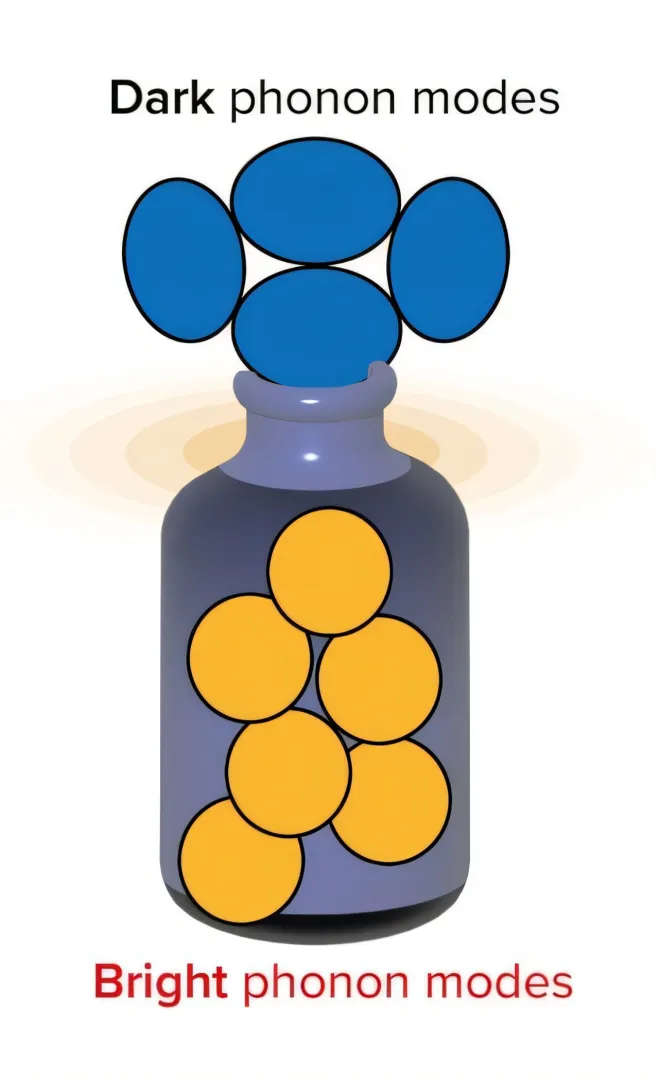
An illustration of a quantum system with the two phonon modes. Source: RIKEN Center for Quantum Computing

However, there’s a catch. Quantum systems don’t just have one mode of motion or excitation—they have many. Some of these are bright modes, which interact with external signals and can be controlled. 

Others are dark modes, which are completely decoupled. They don’t respond to the driving field at all—almost like hidden gears in a machine that you cannot touch.

These dark modes create a serious problem. When they are present, “both conversion between different modes and the topological transfer of phonons break down, and these effects can’t be restored by the usual measures,” Nori explained.

This means no controlled transfer of energy, no directional motion, and no useful quantum operations. Traditional fixes—like tweaking the system’s parameters—don’t work because the dark modes remain fundamentally disconnected.

The way to outsmart dark modes

The RIKEN team took a different approach. Instead of trying to eliminate dark modes, they decided to reprogram them. They introduced carefully designed artificial quantum information into the system. 

While the term sounds abstract, the idea is straightforward. They added specific quantum inputs that change how different modes interact. This engineering effectively forces dark modes to temporarily couple with the system—turning them into bright modes.

Once this happens, the previously blocked topological effects come back to life. Phonons can once again move in controlled ways, and different modes can exchange energy as intended. Crucially, this transformation is not random—it is precise and controllable.

“We were thrilled. Such engineered transitions make topological operations possible–something which was previously inaccessible due to dark modes,” Deng-Gao Lai, one of the study authors and a postdoc researcher at RIKEN, said

What surprised the researchers most was how robust the method turned out to be. Even under conditions where they expected the system to fail, the engineered transitions held strong. This suggests the approach is not just a theory but something that could work in real devices.

“Our work paves the way for constructing scalable quantum devices and discovering novel topological phenomena,” Lai said.

The study is published in the journal Nature Communications.

The Blueprint

Get the latest in engineering, tech, space & science - delivered daily to your inbox.

Rupendra Brahambhatt is an experienced writer, researcher, journalist, and filmmaker. With a B.Sc (Hons.) in Science and PGJMC in Mass Communications, he has been actively working with some of the most innovative brands, news agencies, digital magazines, documentary filmmakers, and nonprofits from different parts of the globe. As an author, he works with a vision to bring forward the right information and encourage a constructive mindset among the masses.