


Using even the most advanced rocket propulsion technologies available today, it would take billions of dollars and hundreds of thousands of years to reach our nearest star system, Alpha Centauri.
The solution to this problem may come in the form of light propulsion.
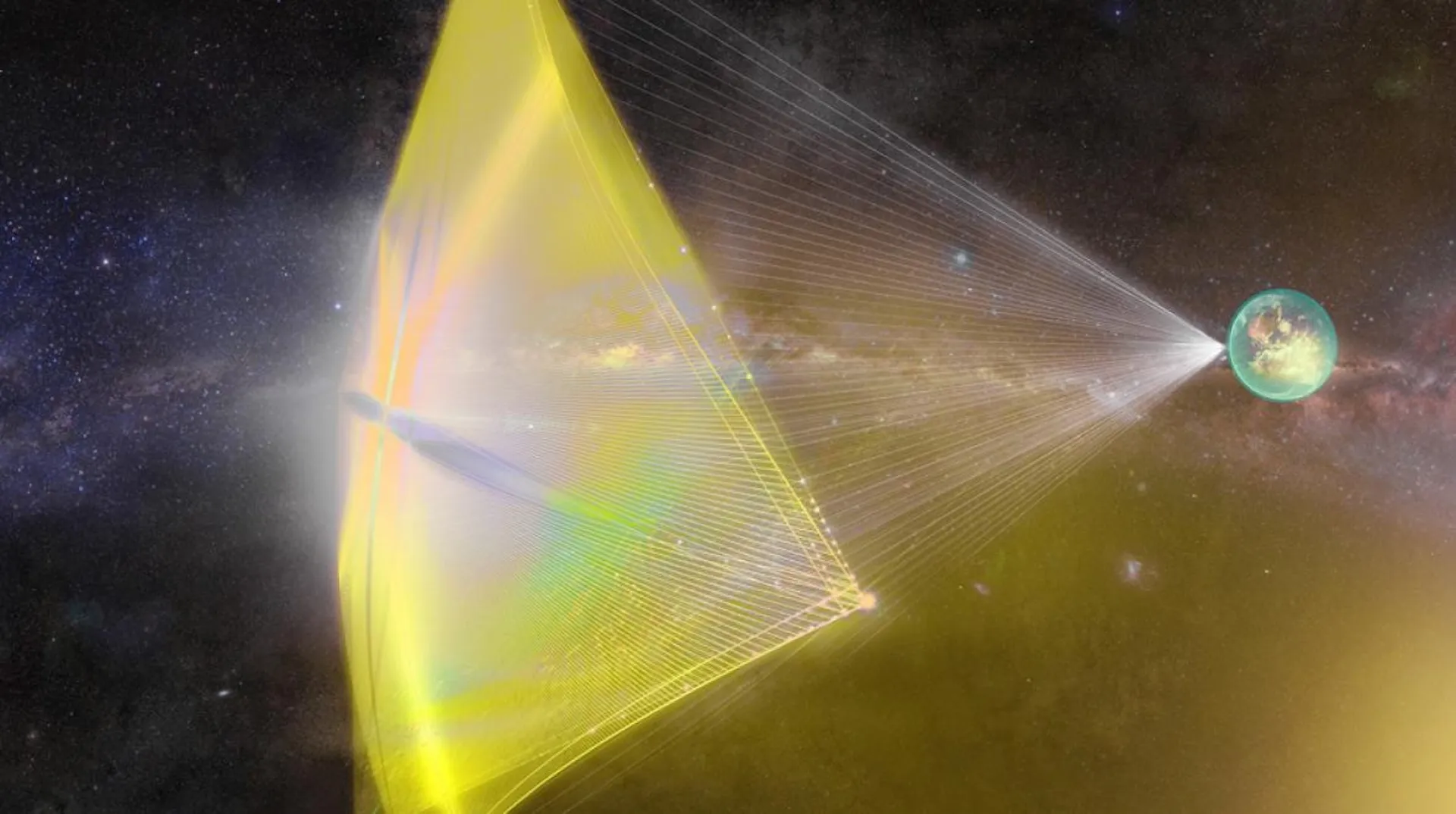
One international research project, Breakthrough Starshot, announced in 2016 that it would build a lightsail probe capable of reaching Alpha Centauri within our lifetimes.
Powered by millions of lasers, it could fly near the speed of light, reaching our nearest star in 20 years.
While that initiative ran into funding problems—despite an initial $100 million backing by Mark Zuckerberg and others—the idea of light propulsion isn’t going away.
Now, a team of scientists at Texas A&M University has demonstrated a new approach to light propulsion. Their system can lift and steer objects in multiple directions with no physical contact.
The researchers believe it is more scalable than other methods, and it could one day enable a mission similar to the one proposed by Breakthrough Starshot.
The team introduced their work in a new paper titled ‘Optical propulsion and levitation of metajets’. In it, they explained how micron-scale devices called “metajets” can generate controlled motion with the help of laser beams.
The team’s metajets are composed of metasurfaces. These are ultrathin materials etched with tiny patterns. In a similar fashion to a lens, these shapes allow scientists to control the behavior of light bouncing off the devices.
By carefully designing these structures, the scientists were able to control the transfer of momentum from light to an object. This allowed the object to move, showcasing a novel form of light propulsion.
In a press statement, Dr. Shoufeng Lan, assistant professor and director of the Lab for Advanced Nanophotonics, compared the effect to ping pong balls bouncing off a table. Lan, who led the team, said the light acts like a ball, transferring a small but measurable force onto the object.
Impressively, the metajets demonstrate full three-dimensional maneuverability. This is a capability that has never been achieved before in optical propulsion systems.
Employing nanoscale precision, the team fabricated the metasurfaces at the Texas A&M AggieFab Nanofabrication Facility, supported by the Texas A&M Engineering Experiment Station (TEES).
They tested the devices by conducting experiments in a fluid environment that helped to offset the effects of gravity.
The metajets differ from other systems in one key aspect; while other methods control objects by shaping the light, this approach builds control directly into the material itself.
According to the Texas A&M team, this allows for more flexible force generation and better scalability.
It’s worth noting that the team’s devices are only tens of microns in size, meaning they are smaller than the width of human hair.
However, as the force generated by metajets is dependent on the power of the light rather than the size of the device, the researchers believe their method could also apply to larger, non-microscopic systems.
Of course, all of this will be largely dependent on providing sufficient optical power, as well as the funding that would be required.
In the case of Breakthrough Starshot, efforts to build the technologies required for light propulsion were seemingly paused due to a lack of funding.
However, in 2019, The Planetary Society’s LightSaill 2 mission proved fuel-free light propulsion is a viable form of space travel for small spacecraft.
The Texas A&M team is now pursuing external funding to test their method in space. If all goes to plan, they could provide a scalable alternative to conventional light propulsion methods.
A long journey lies ahead, but their work may one day enable an even longer journey—an epic 4.37 light-year trip to our neighboring star.

Get the latest in engineering, tech, space & science - delivered daily to your inbox.
Chris Young is a journalist, copywriter, blogger and tech geek at heart who’s reported on the likes of the Mobile World Congress, written for Lifehack, The Culture Trip, Flydoscope and some of the world’s biggest tech companies, including NEC and Thales, about robots, satellites and other world-changing innovations.
此内容由惯性聚合(RSS阅读器)自动聚合整理,仅供阅读参考。 原文来自 — 版权归原作者所有。