


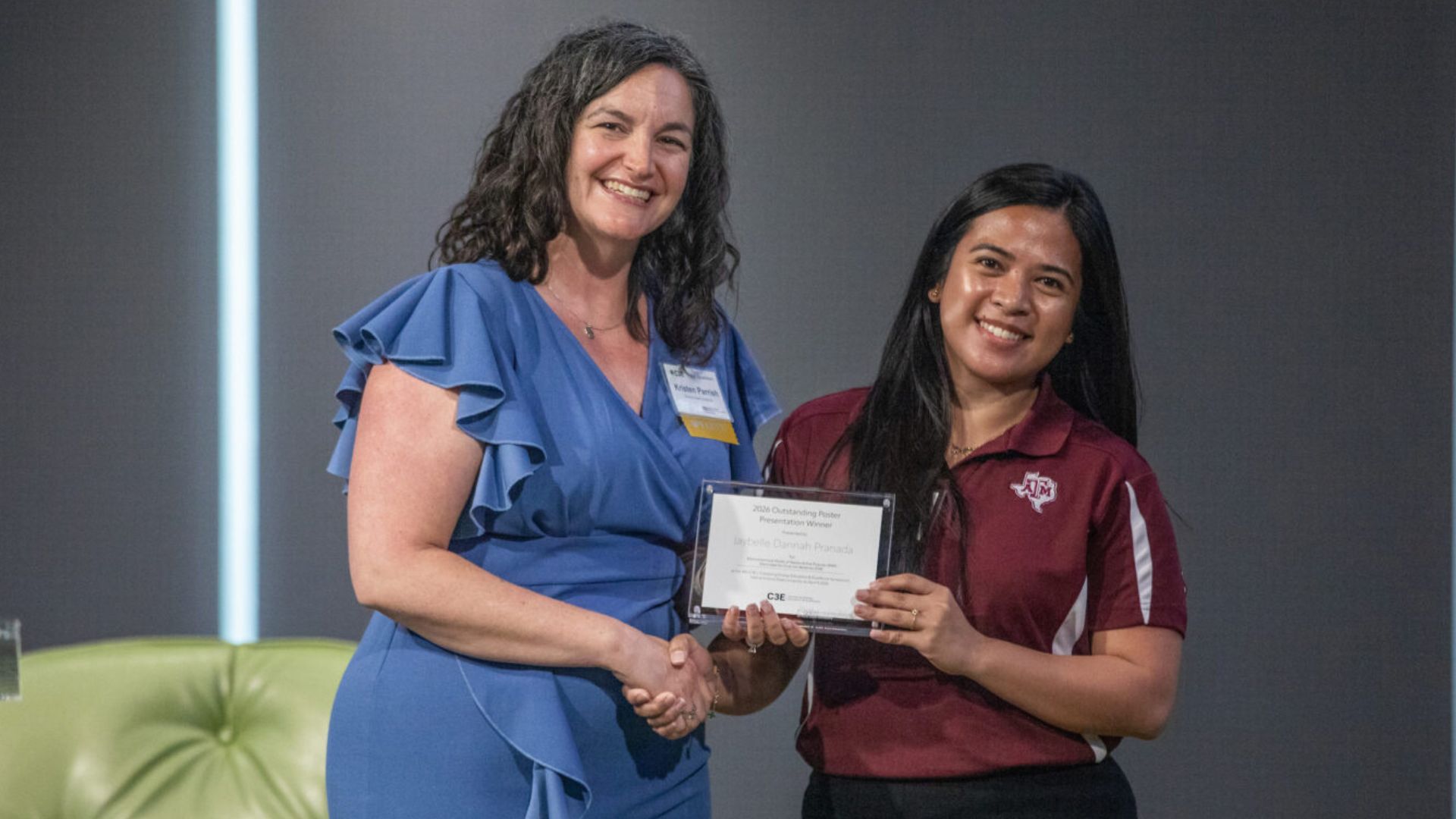
A Ph.D. student has proposed developing a temperature-resistant battery for applications ranging from space exploration to electric vehicles. Jaybelle Pranada from Texas A&M University attended the Catalyzing Energy Education and Excellence (C3E) Symposium at Arizona State University.
The Symposium, held in April this year, was created by the US Department of Energy to select students across the country working on clean energy solutions. Pranada proposed alternative battery chemistries designed to withstand low-temperature operation.
Of the nearly 100 submissions from across the country, Pranada’s project was placed in the top five. The research focuses on developing computational models to explore alternative battery chemistries that may be better suited for extremely cold environments.
Temperature-resistant batteries are going to be a game-changer if the world has to shift away from the dependence on fossil fuels. To achieve this, Pranada’s team began the project by examining traditional lithium-ion batteries.
The major issue with lithium batteries is that they fail to deliver at the expected levels when temperatures fall below 32 degrees Fahrenheit (0° Celsius) or go above 212 degrees Celsius (100° Celsius).
As the temperature drops below 32 degrees Fahrenheit, the electrochemical processes that enable energy storage and delivery in lithium cells slow down. In extreme cold environments, performance can drop to the point that the cells stop working. Therefore, they cannot be trusted with missions involving space, in which they could be exposed to the harsh conditions.
To fix this, Pranada’s project is investigating both organic and inorganic energy-storage systems. The goal is to identify cell designs that can perform under harsh thermal conditions.
The computational models developed help the team understand the benefits and limitations of the emerging solutions. It further allows them to evaluate the future applications and identify the methods by which these can be improved.
Pranada’s team believes that the limitations of lithium batteries can be solved by replacing them with new materials. They propose using alternative polymers that can operate at temperatures as low as −50 degrees Celsius.
“These batteries, known as polymeric batteries, are developed from synthetic materials that can be readily synthesized and studied in the laboratory,” a press release from the university said.
These materials were then tested in environments ranging from the coldest winter in Alaska to the hottest summer in Arizona. Pranada intends to focus her career on finding energy storage solutions because they in some way shape each aspect of modern life.
The resulting technologies from the research, once delivered, could benefit electric vehicles, defense, the energy storage sector, and the obvious field of space exploration.
“You look around and realize how much of modern life depends on energy storage,” Pranada said. “What is stopping us from developing these energy materials and fully harnessing our capabilities to create technologies that will change our lives?”
Abhishek brings a wealth of experience in covering diverse stories across different beats. Having contributed to renowned wire agencies and Indian media outlets like ANI and NDTV, he is keenly interested in Tech, Business and Defense coverage.
此内容由惯性聚合(RSS阅读器)自动聚合整理,仅供阅读参考。 原文来自 — 版权归原作者所有。