








An international team has demonstrated a new method for producing the most intense light ever generated in a laboratory.
The research offers a practical pathway to explore Quantum Electrodynamics (QED) — the fundamental study of how light and matter interact at the most basic level.
Researchers from the University of Oxford, Queen’s University Belfast, and global partners used the Gemini laser to “compress” light using clouds of charged particles called plasma.
This development may lead to more advanced experiments that test the fundamental laws of physics by forcing light to collide directly with the quantum vacuum.
“The discoveries we have made so far are fascinating and it feels like we are just getting started in terms of understanding the rich and complex physics of this mechanism. The simulations suggest that we may have made the most intense source of coherent light ever,” said Dr Robin Timmis, lead author from the Department of Physics, University of Oxford.
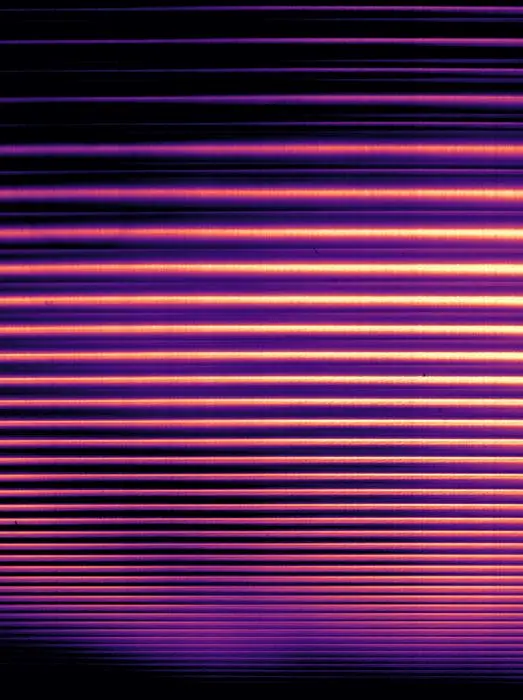
The discovery hinges on two sophisticated techniques: Relativistic Harmonic Generation and a Coherent Harmonic Focus.
Using the Gemini laser to fire intense pulses into a plasma mirror moving at relativistic speeds, researchers have successfully demonstrated relativistic harmonic generation.
Because this mirror moves at relativistic speeds toward the light source, the reflected light is compressed and boosted to much higher energies (similar to the Doppler effect).
Then the team concentrated these light waves through a Coherent Harmonic Focus.
Just as a magnifying glass focuses sunlight to burn paper, this technique concentrates multiple wavelengths of high-energy light into a single microscopic point. This acts like a “quantum magnifying glass,” creating an unprecedented concentration of energy.
This breakthrough provides a practical toolkit for directly probing quantum electrodynamics and observing the fundamental, extreme interactions between light and the quantum vacuum.
Why this matters is that, for decades, probing the deep laws of Quantum Electrodynamics required smashing particle beams into lasers — a process as messy and complicated as analyzing a car crash by watching footage from 10 different moving cameras.
This new method also integrates the entire interaction within the laser system itself.
With direct observation, it eliminates the need for complex mathematical conversions and finally bridges a 20-year gap between theoretical predictions and experimental results.
The result is a much clearer, more streamlined approach that simplifies how we study the most extreme laws of the universe.
Spanning 2024 and 2025, this research was a global effort involving high-field physics experts from the UK’s AWE plc, the University of Michigan, and Germany’s University of Jena.
The project was rooted in the doctoral work of Dr. Robin Timmis, whose research was backed by the Oxford Center for High Energy Density Science and the Oxford-Berman-Physics Scholarship until her thesis submission in 2024.
“This work is a blend of laser technology, plasma physics, and ultrafast materials science finely tuned to resolve a persistent mismatch between theory and experiment that has frustrated the field for more than two decades,” said co-author Professor Brendan Dromey from Queen’s University Belfast.
This is a practical advance that could enable testing of the laws of physics under conditions previously thought impossible to replicate in a lab.
The results were published in the journal Nature on 22 April.

Get the latest in engineering, tech, space & science - delivered daily to your inbox.
Mrigakshi is a science journalist who enjoys writing about space exploration, biology, and technological innovations. Her work has been featured in well-known publications including Nature India, Supercluster, The Weather Channel and Astronomy magazine. If you have pitches in mind, please do not hesitate to email her.
此内容由惯性聚合(RSS阅读器)自动聚合整理,仅供阅读参考。 原文来自 — 版权归原作者所有。