


惯性聚合 高效追踪和阅读你感兴趣的博客、新闻、科技资讯
阅读原文 在惯性聚合中打开

推荐订阅源

T
Tailwind CSS Blog
博客园 - 【当耐特】
奇客Solidot–传递最新科技情报
奇客Solidot–传递最新科技情报
博客园 - Franky
小众软件
小众软件
酷 壳 – CoolShell
酷 壳 – CoolShell
博客园 - 三生石上(FineUI控件)
B
Blog
有赞技术团队
有赞技术团队
J
Java Code Geeks
云风的 BLOG
云风的 BLOG
Recent Announcements
Jina AI
Jina AI
Vercel News
Vercel News
博客园 - 叶小钗
Hugging Face - Blog
Hugging Face - Blog
H
Hackread – Cybersecurity News, Data Breaches, AI and More
F
Fortinet All Blogs
The Cloudflare Blog
V
V2EX
Cyber Security Advisories - MS-ISAC
freeCodeCamp Programming Tutorials: Python, JavaScript, Git & More
博客园_首页
腾讯CDC

Interesting Engineering

US firm to scale laser-based nuclear fusion ‘breakthrough’ with new partnership Military Archives - Interesting Engineering World’s first non-nuclear lead-cooled reactor to generate electricity begins installation US scientists devise new process to turn sewage sludge into 99% pure natural gas US firm unveils submarine-hunting drone with 9,200-mile-range, 35 mph top speed Military Archives - Interesting Engineering Supercomputer finds lithium-titanium tweak to boost sodium-ion batteries for grids Lockheed Martin demonstrates vertical launch missile system for mobile drone defense China’s 1116 MWe Taipingling Unit 1 reactor goes online, set to generate 9bn kWh yearly ChatGPT Images 2.0 update combines reasoning, research, and design with 2K output US Navy tests plug-and-play laser system on USS Bush carrier, downs drones at sea China’s CATL reveals 621-mile EV battery, under-7-minute charging to challenge BYD US uses world’s first exascale supercomputer to model supernovae, fusion reactors AI and Robotics Archives - Interesting Engineering First-in-human study confirms safety of graphene-based brain interface Tesla’s Optimus humanoid robot greets runners, poses for photos at Boston Marathon Interlocking materials offer high strength and flexibility for robotics, infrastructure US redeploys 100,000-ton nuclear-powered aircraft carrier in Red Sea after repairs US scientists unveil concept for ‘world’s first neutrino laser’ to unlock breakthroughs New military tech can maintain communication in contested electronic warfare environments Got a dark personality? Psychologists can help you choose your career wisely Humidity boosts performance of 3D-printed nanogenerator instead of degrading it China demonstrates microwave beam that recharges drones in flight, continues power delivery Scientists run compact free-electron laser for eight hours, cracks FEL stability problem China’s PLA considers to use minelaying underwater drones to enforce Taiwan blockade: Report 1-ton sharks may struggle for survival in waters exceeding 62.6°F, study suggests US firm’s thorium nuclear fuel bundles move to manufacturing for commercial reactors Tesla hits 0% charge in remote Chilean desert as YouTuber uses hood-mounted solar Humanoid robot surpasses human world record in Beijing half-marathon, clocking 50:26 mins New method extracts maximum work from unknown quantum states using symmetry tricks
US Navy gets 26-foot drone submarine with 1,243 mile-rang...
Chris Young · 2026-05-04 · via Interesting Engineering

Australian firm C2 Robotics has delivered a large uncrewed submarine, the Speartooth Large Uncrewed Undersea Vehicle (LUUV), to the United States. The development highlights the growing importance of unmanned warfare systems.

It also marks a notable step in bilateral defense cooperation on autonomous maritime systems. Rather than a traditional dignitary-led champagne smash, C2 Robotics used a robotic arm to smash a symbolic bottle during a formal commissioning ceremony for the Speartooth LUUV.

C2 Robotics’ uncrewed sub

The robotic bottle smash served as a not-so-subtle nod to the uncrewed vehicle’s core design. As the firm noted in a press statement, the Speartooth LUUV was designed to operate autonomously while conducting intelligence, surveillance, reconnaissance, and strike missions. Though it can operate without a crew, it will require sustained human oversight for key decisions. 

The delivery of the new vessel to the U.S. confirms the nation as the first publicly identified export customer, following an unannounced international sale in late 2025.

“This is a proud and important step for our company,” said Troy Duggan, CEO of C2 Robotics. “We don’t typically conduct christening ceremonies for all of our boats, but this moment reflects the maturity of the Speartooth program and the strength of our partnership with the United States.”
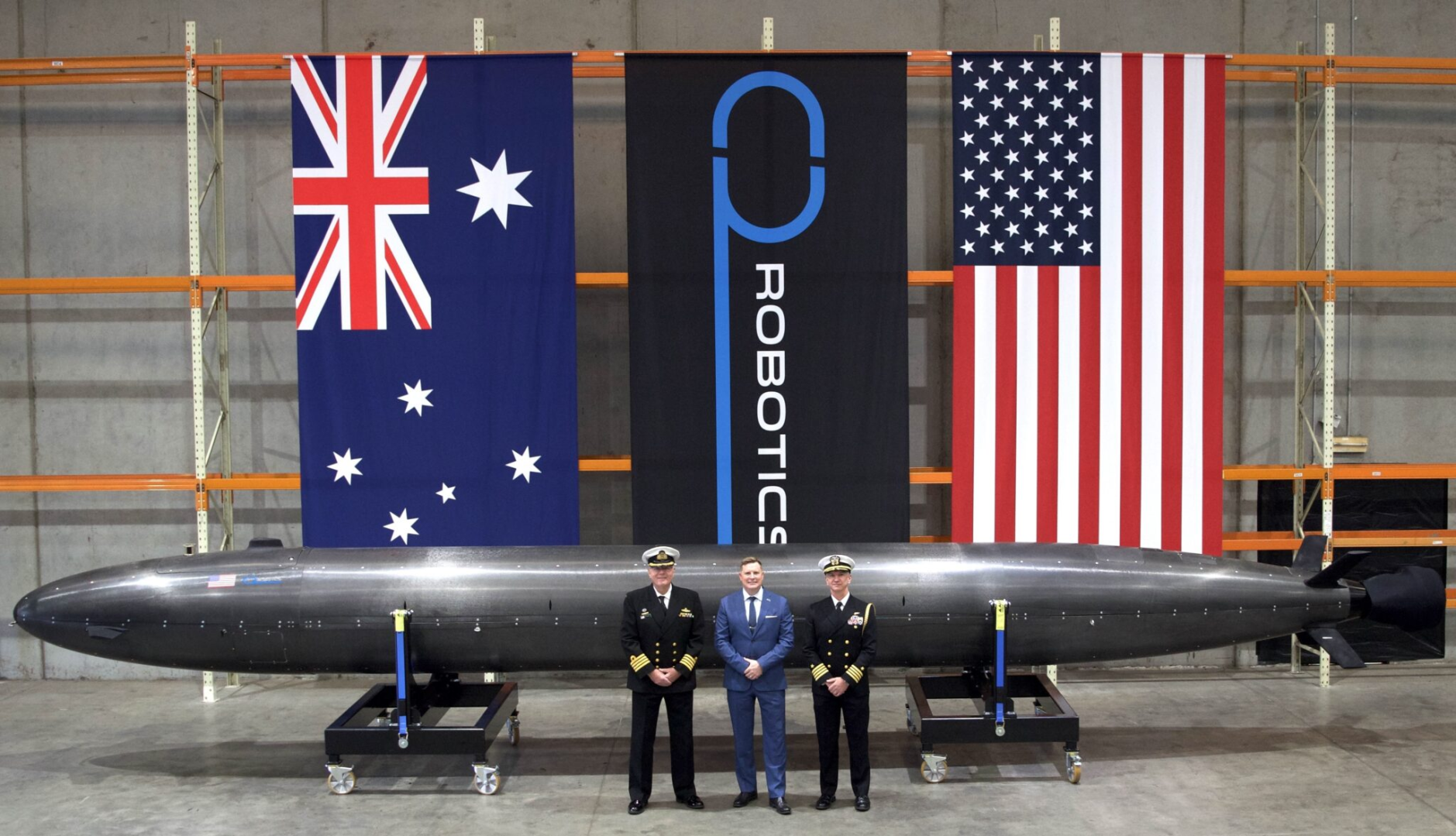
The Speartooth LUUV at the commissioning and christening ceremony. Image source: C2 Robotics

Duggan added that the Speartooth LUUV was built on the principle of “Small, Smart, Many”. The vessel differs from traditional large, high-cost submarines with its scalable, compact design. Its 8-meter (26 feet) composite hull includes modular payload bays for sensors, munitions, and other equipment.

According to Defence Post, the submarine’s propulsion system combines a hybrid lithium-ion and diesel engine with an electric propeller. This enables operations to a depth of 2,000 meters (6,560 feet) and a range of 2,000 kilometers (1,243 miles).

European Speartooth LUUV sales to be announced soon

Duggan also highlighted the fact that the Speartooth LUUV program is evolving rapidly, with expanding payload options and mission roles. The company developed the submarine in close collaboration with the Australian Department of Defence.

Another partner, Thales Australia, integrated its sovereign sonar technology, produced at its Sydney facility, to improve the vessel’s autonomous navigation reliability. The Speartooth LUUV participated in the Royal Australian Navy’s Exercise Autonomous Warrior 23, where it demonstrated logistics support and precision effects delivery.

The delivery of the Speartooth LUUV aligns with broader US military interest in rapid prototyping and field testing of autonomous systems. As for C2 Robotics, the company noted in its statement that an official announcement will be made soon regarding additional sales to its European partner, Eurobotics GmbH.

The Speartooth represents growing momentum in undersea autonomy. Its modular design and lower unit cost aim to provide commanders with greater flexibility and presence where traditional vessels face high risk. As programs like this mature, they could reshape maritime operations by enabling distributed, attritable capabilities alongside larger platforms.