





Boeing subsidiary Aurora Flight Sciences has begun installing the wings on the X-65, an experimental drone developed under DARPA’s Control of Revolutionary Aircraft with Novel Effectors (CRANE) program.
The installation brings DARPA and Aurora a step closer to flying the unconventional uncrewed aircraft, which was designed to test flight control using only bursts of pressurized air instead of conventional moving surfaces.
The X-65’s key innovation lies in its active flow control (AFC) system. Fourteen AFC effectors embedded across the aircraft’s lifting surfaces use jets of high-pressure air to manage roll, pitch, and yaw.
This will either replace or supplement traditional flaps and rudders. The X-65 incorporates both systems to establish performance baselines before transitioning to AFC-only operation. Essentially, it will allow researchers to flight test the technology while minimizing risk.
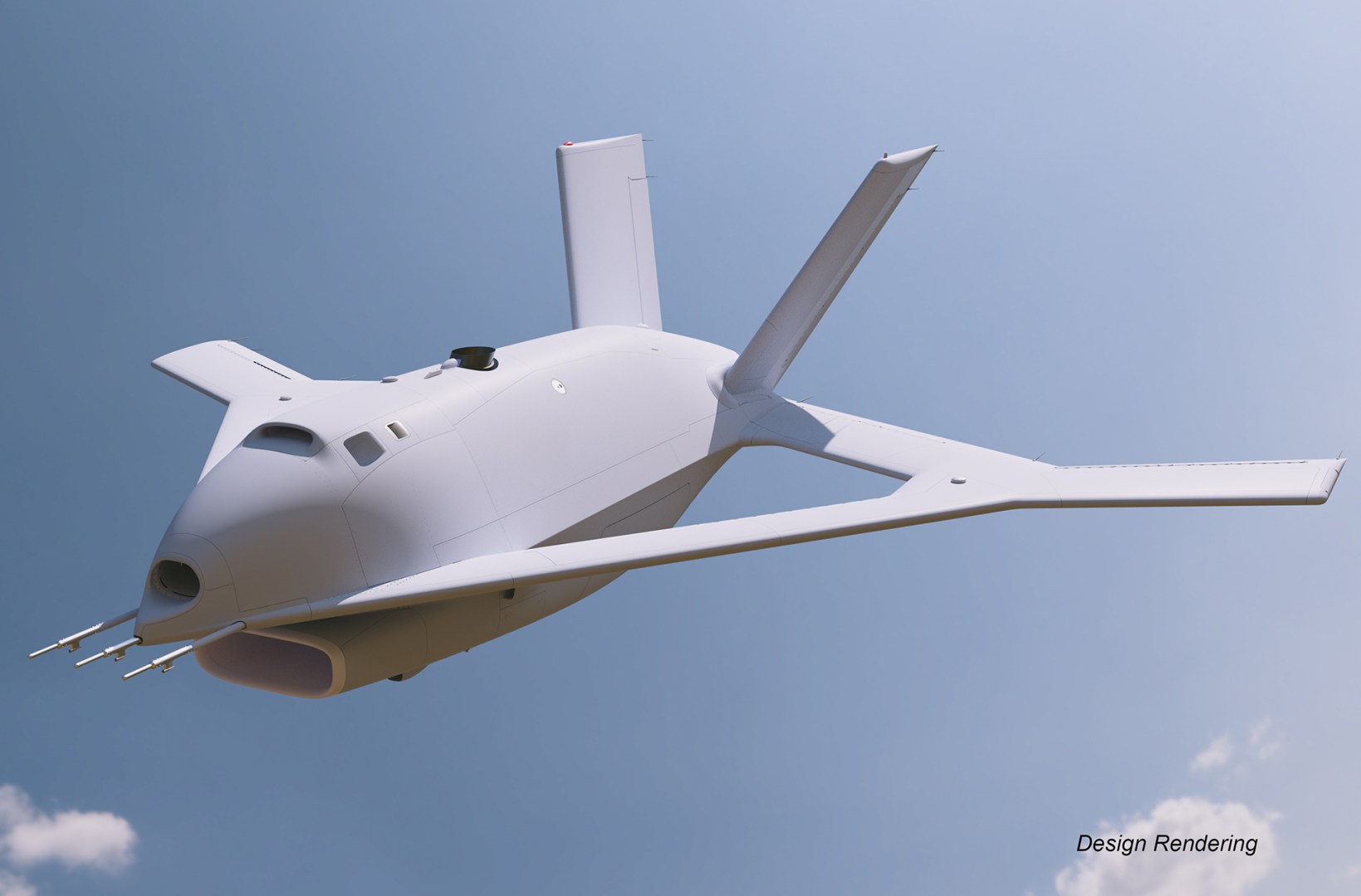
“The X-65 conventional surfaces are like training wheels to help us understand how AFC can be used in place of traditional flaps and rudders,” Dr. Richard Wlezien, former CRANE program manager at DARPA, said in a 2024 press statement. Sensors will compare the two approaches to evaluate potential benefits.
Aurora Flight Sciences announced the wing’s arrival on social media, noting that the components were built at its West Virginia facility. Integration is underway in Virginia, with the first flight now targeted for 2027.
The X-65 features a co-planar joined wing configuration with triangular wing sections on each side that merge at the tips, plus small extensions for a total wingspan of 30 feet.
The triangular wings support testing across multiple sweep angles and feature modular, swappable sections for future AFC configurations.
The aircraft also includes a twin vertical tail, a chin air intake, and a single exhaust. The uncrewed aircraft has a gross weight of approximately 7,000 lbs.
DARPA kick-started the CRANE program in 2020. Though Aurora has advanced to the detailed design and fabrication phases, the program has encountered delays and cost overruns, as reported by The War Zone.
Original flight plans for 2025 slipped after higher-than-expected prototype costs and supply chain issues. Pentagon funding for the effort since fiscal year 2024 has reached nearly $63 million.
Eliminating moving control surfaces could yield multiple advantages. Removing moving parts could result in improved aerodynamics and efficiency, particularly at high altitudes. Reduced mechanical complexity also offers potential weight savings, lower maintenance demands, and greater reliability. For military applications, such systems could have enhanced survivability against battle damage.
The technology holds particular promise for stealth aircraft. Traditional control surfaces create gaps and protrusions that increase radar cross-section and require constant adjustments in fly-by-wire systems. AFC effectors embedded flush with the airframe could help maintain smoother external contours and lower observability.
As Aurora vice president Larry Wirsing stated last year: “The X-65 platform will be an enduring flight test asset, and we’re confident that future aircraft designs and research missions will be able to leverage the underlying technologies and flight test data.”
Chris Young is a journalist, copywriter, blogger and tech geek at heart who’s reported on the likes of the Mobile World Congress, written for Lifehack, The Culture Trip, Flydoscope and some of the world’s biggest tech companies, including NEC and Thales, about robots, satellites and other world-changing innovations.
此内容由惯性聚合(RSS阅读器)自动聚合整理,仅供阅读参考。 原文来自 — 版权归原作者所有。