











Researchers from Osaka University have used supercomputer simulations to solve the mystery of how dolphins achieve such high speeds and agility. The research team identified specific propulsion mechanisms by analyzing the complex, turbulent water patterns generated by a dolphin’s tail.
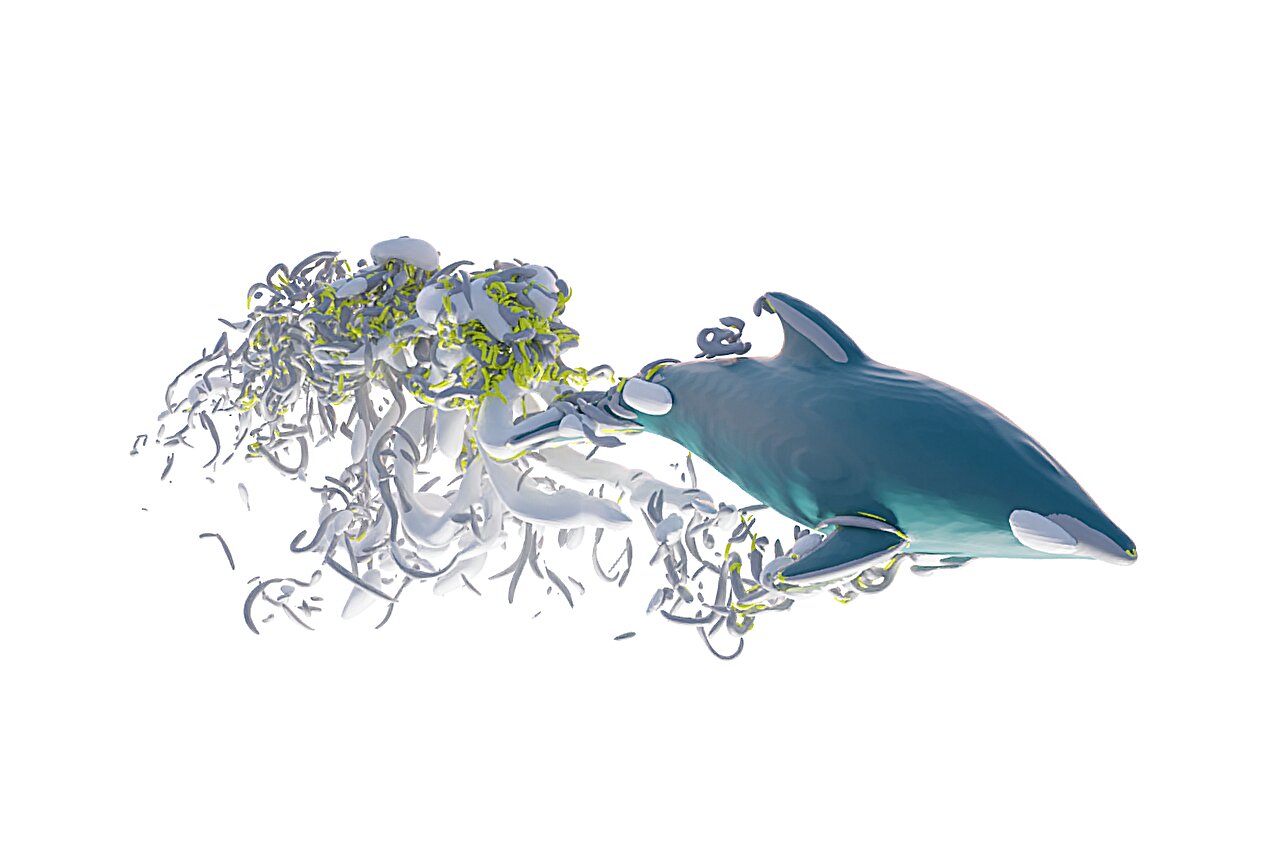
Interestingly, supercomputer simulations revealed that a dolphin’s propulsion is driven by the formation of massive, powerful vortex rings.
“Our goal is to understand which parts of the turbulent flow help dolphins swim so quickly. Using a supercomputer, we can simulate and decompose the flow to determine which components play dominant roles,” said Yutaro Motoori, lead author.
Experts have long known that dolphins are fast, but the specific source of their propulsion has been difficult to track.
For decades, “Gray’s Paradox” suggested that dolphin muscles were mathematically incapable of overcoming water resistance, leading to the incorrect theory that their skin possessed unique anti-drag properties. This study finally resolves the paradox by demonstrating that the secret lies in fluid dynamics rather than in biology alone.
Dolphins propel themselves by oscillating their tails in a powerful vertical kicking motion, which drives water backward and creates a wake of complex, turbulent currents. This movement generates a “hierarchy of vortices”—a mixture of large, energy-rich swirls and smaller, chaotic ripples.
The sheer complexity of these overlapping water patterns made it nearly impossible for scientists to pinpoint which specific part of the flow was responsible for the dolphin’s legendary speed.
It turns out, it was hidden within the complex, bubbling turbulence generated by their powerful movements. Using large-scale numerical simulations, the Osaka team discovered that the dolphin’s kick generates powerful, large-scale vortex rings. The study reveals that only the largest of these vortices provides the actual thrust needed for speed.
“The numerical simulations revealed that the dolphin’s oscillating tail produces strong, large-scale vortex rings that push water backward and generate thrust. Then, these large vortices create smaller ones in a process known as the energy cascade. Although these smaller vortices are numerous, they contribute little to the dolphin’s forward motion,” the researchers noted.
Using high-powered simulations, the researchers achieved a level of detail in observing fluid motion that is virtually impossible to replicate in physical experiments. The flexibility of this digital approach enabled easy testing of various scenarios, confirming that the dolphin’s propulsion mechanism remains remarkably consistent across swimming speeds.
Notably, this computational study provided a clear, controlled view of complex physics that real-world trials simply couldn’t capture.
These insights into dolphin propulsion offer a promising blueprint for the future of marine engineering, particularly in the development of faster, more energy-efficient underwater robots and advanced turbulence-control systems.
In particular, researchers can now apply these biological “shortcuts” to human-made technology by isolating the specific mechanisms that generate thrust.
Although these practical applications are still on the horizon, the study highlights how physics can explore the natural world to solve long-standing mysteries.
The findings were published in the journal Physical Review Fluids.

Get the latest in engineering, tech, space & science - delivered daily to your inbox.
Mrigakshi is a science journalist who enjoys writing about space exploration, biology, and technological innovations. Her work has been featured in well-known publications including Nature India, Supercluster, The Weather Channel and Astronomy magazine. If you have pitches in mind, please do not hesitate to email her.
此内容由惯性聚合(RSS阅读器)自动聚合整理,仅供阅读参考。 原文来自 — 版权归原作者所有。