


A 3,330-year-old hoard of jewelry recently discovered in a Bronze Age hotspot reveals the religious practices of a changing world.
Weighing 1.8 pounds, beyond their monetary value, the hoard from Dresden highlights remarkable creativity and craftsmanship. Featuring distinct forms and notable decorations, these pieces express identity, aesthetics, and wealth during a crucial period of change.
Trade during the Bronze Age significantly influenced the structures of early societies. These wearable forms of currency or value illustrate the inseparable relationship between economy, community, and artistry. And, of course, belief.
Similar hoards have been uncovered across Central Europe. Archaeologists believe this jewelry was buried as part of a ritualistic event. This suggests that Bronze Age individuals relinquished pieces of their wealth as a sacred offering.
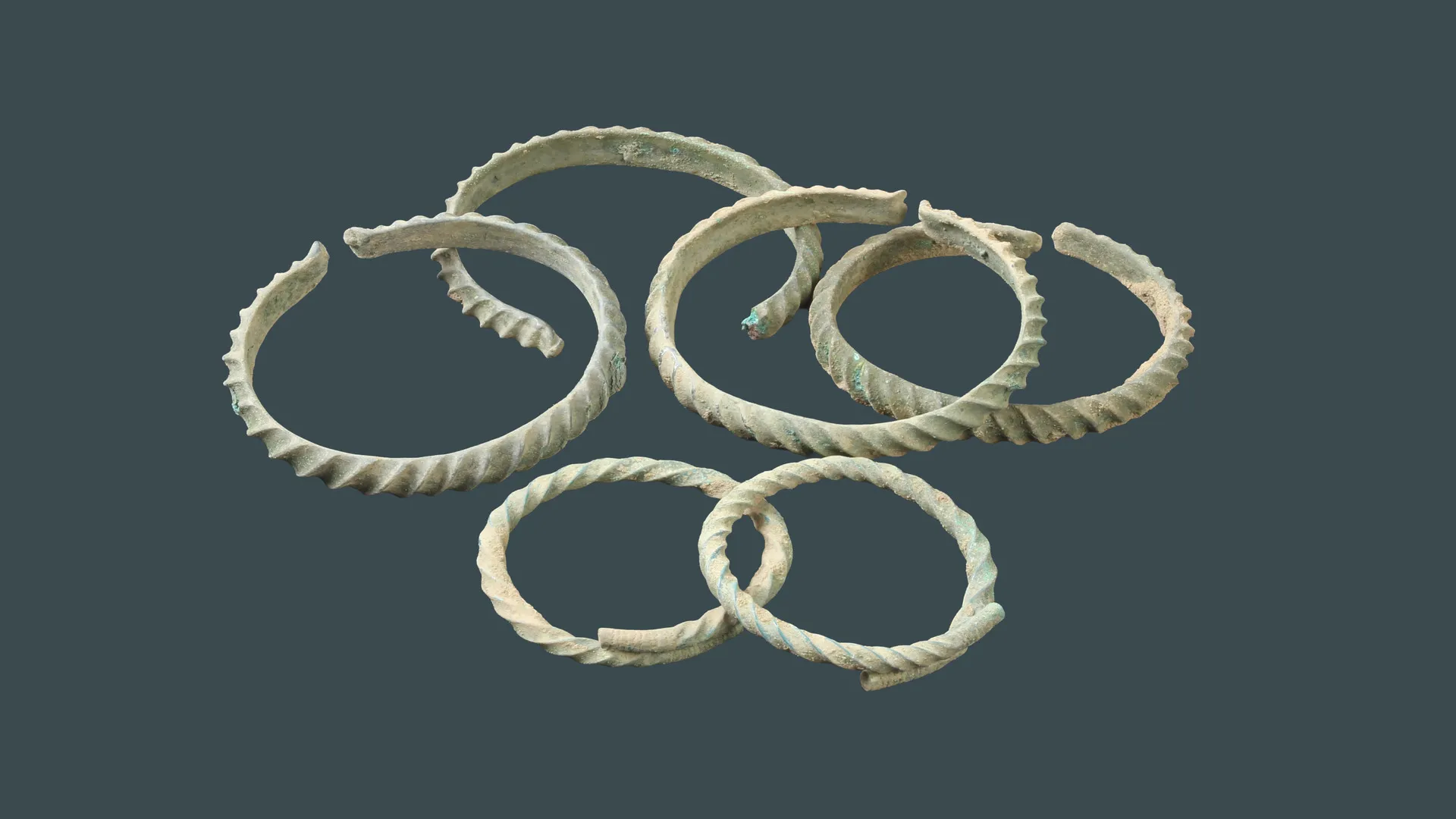
Hoards are one of archaeology’s most fascinating discoveries. Unassuming metal detectorists usually find them in areas that don’t normally attract tourists. This priceless treasure lay buried in a field outside Wilschdorf, a village in Germany.
Ronald Meißner, a registered with the State Office for Archaeology of Saxony, discovered the artifacts. He followed the proper protocol. He left the hoard undisturbed and promptly notified the authorities. They rushed to the scene to examine the 3,000-year-old find under controlled conditions.
Described as a “classic Bronze Age hoard,” archaeologists concluded that the Dresden find was not hastily buried. Some hoards represent political instability—a stash stashed away and never recovered. Others, like the extraordinary Dresden lot, appear to hold religious or sacrificial purpose. The exact reason remains vague, but some widespread cultural practice occurred across Central Europe. These hoards follow similar arrangements. The Dresden hoard was not simply tossed aside or lost; it was deliberately deposited with ceremonial intent.
“The fact that numerous comparable bronze hoards, some with a regular composition, have been found in Central Europe suggests that these were deliberate, ritually defined offerings – possibly to deities unknown to us today,” as per a press release.
Twisting bands of open ends and overlapping ends, two of the rings were armbands. The other four were worn around the leg. The motifs indicate a Late Bronze Age date of 1300 to 1100 BCE. “Their terminals are straight and marked with small engraved circles,” as noted by Heritage Daily.
Archaeologists are currently preparing the jewelry for further restoration and research.
Bronze, a raw material, was skillfully manipulated to create objects that not only carried weight but also meaning. The discovery, seemingly insignificant to the layman observer, holds more profound implications for the modern era.
“During the Bronze Age, the knowledge of metal deposits, metal production, and the control of trade routes led to the formation of new hierarchies and centers of power, transforming society,” a press release stated.
Technology and trade advanced. New social hierarchies emerged. Researchers intend to study the Dresden hoard to deepen their understanding of how these developments impacted religious practices. The hoard even represents the idea that facets of social life are interwoven and connected.
“This discovery provides an important opportunity to deepen our understanding of the Bronze Age in Saxony and to place it within the broader context of this key period,” stated Dr. Regina Smolnik, the State Archaeologist of Saxony, in Arkeonews. Perhaps it might encourage the current world to examine what shapes our belief systems from an intriguing angle: trade.

Get the latest in engineering, tech, space & science - delivered daily to your inbox.
Originally from LA, Maria Mocerino has been published in Business Insider, The Irish Examiner, The Rogue Mag, Chacruna Institute for Psychedelic Plant Medicines, and now Interesting Engineering.
此内容由惯性聚合(RSS阅读器)自动聚合整理,仅供阅读参考。 原文来自 — 版权归原作者所有。