





The researchers carried out 98 dives with China’s Fendouzhe submersible to map the ecosystems.

Chinese scientists have challenged long-held beliefs about life in the deepest part of the ocean and uncovered an unknown ecosystem between 19,700 and 35,750 feet below sea level.
The effort was carried out by researchers at the Institute of Deep-Sea Science and Engineering (IDSSE), of the Chinese Academy of Sciences (CAS), under the Global Hadal Exploration Program (GHEP). It aims to broaden the understanding of the Hadal Zone.
The zone takes its name from Hades, the Greek god of the underworld. It extends from a depth of 4.7 to 6.8 miles (6,000 to 11,000 meters) and is made up primarily of widely separated ocean trenches and troughs.
It was once believed to be completely lifeless due to crushing pressure, darkness, and freezing temperatures. Now, the Chinese team debunked those beliefs after spotting tiny organisms living on rocky surfaces across multiple Pacific trenches.
Life in ocean trenches
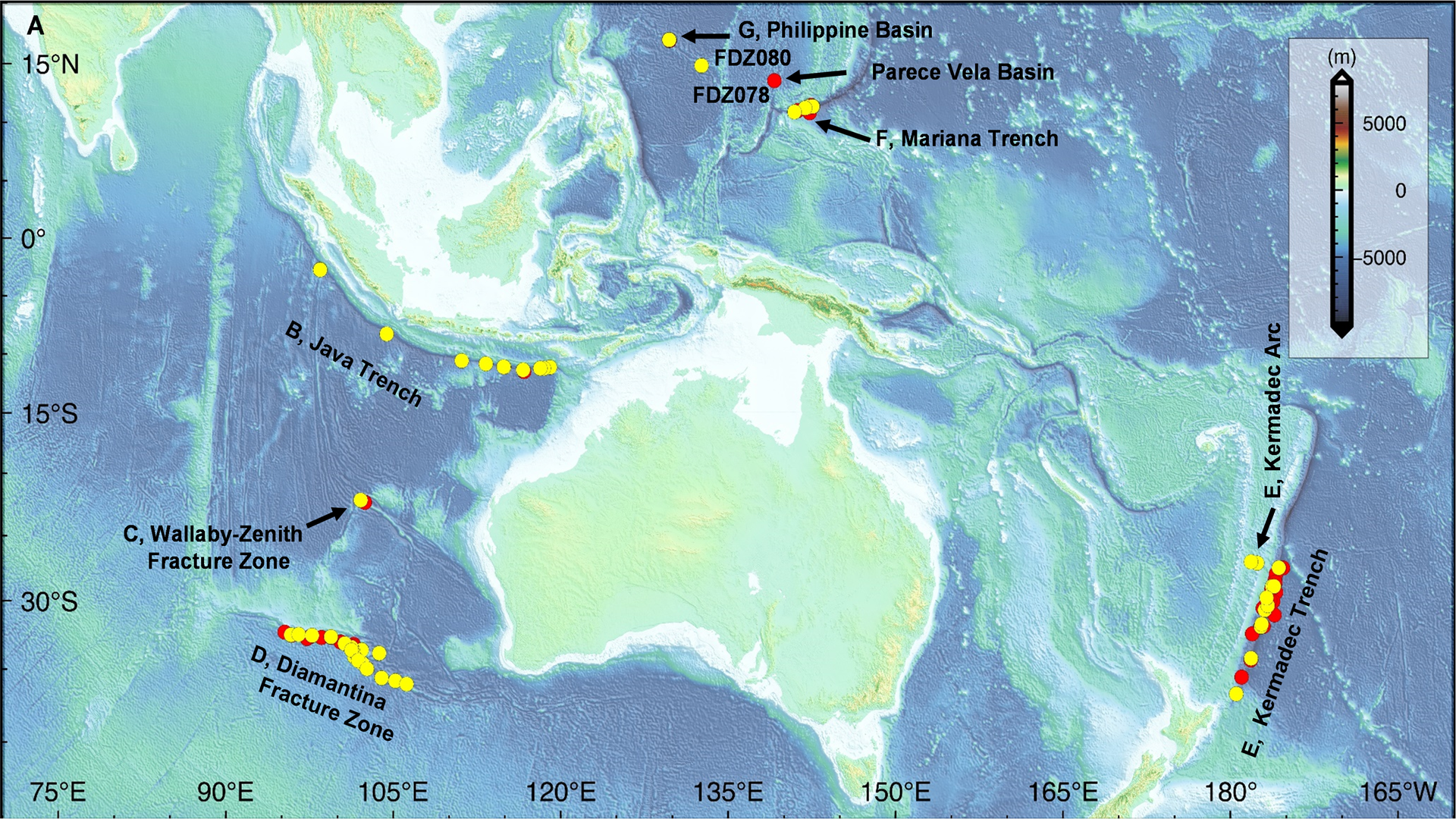
The researchers used the crewed submersible Striver (Fendouzhe) to complete 98 dives across seven hadal regions, including the Mariana and Kermadec trenches, between 2020 and 2024. The vessel can accommodate three crew members and is designed to reach depths of more than 6.2 miles (10,000 meters).
They were stunned to discover thriving ecosystems made up of millimeter-sized organisms clinging to exposed rock surfaces in near-freezing darkness. The team recorded a total of 32 species from six phyla in this faunal region, most of which new to science.
“The most unexpected components, however, were four new and much smaller (millimeter‑scale) species that occurred in high densities and dominated the hard‑substrate Kermadec Trench assemblages,” Peng Xiaotong, PhD, a professor at the Institute of Deep‑Sea Science and Engineering, said.
The discovery included a new family of unilocular (single-chambered) foraminifera (Plumettidae) and a novel family of bryozoans (Pierrellidae). At the same time, the dominant life forms were identified as agglutinated foraminifera (rock feathers).
These tiny life forms can appear thread-like, tubular, or dome-shaped. They form dense colonies. The habitat density was as high as 4,300 organisms per square decimeter, roughly a hand-sized patch of rock.
Scientists had reportedly struggled to classify these organisms for ages, due to their tiny size and simple structures. They now finally confirmed their biological identity through genetic and metagenomic analysis.
New species uncovered
Additionally, the findings overturned a previous theory about how these deep-sea organisms survive. Scientists had suspected that the trench fauna depended on chemosynthesis, a process used by organisms living near hydrothermal vents that derive energy from chemicals rather than sunlight.
Instead, they found partially digested pine pollen grains in the organisms. This showed that they actually ‘eat dust,’ meaning they are heterotrophs that feed on organic debris.
The trench topography also helps sustain the ecosystem as V-shaped trench walls funnel organic matter downward while powerful underwater sediment flows scour exposed rock surfaces. The rock feather organisms mainly colonize vertical rocky outcrops where sediment burial is less likely. It allows them to efficiently capture nutrient particles carried upward by currents.
Credit: IDSSE
Similar hard-substrate communities were also observed on rocks in the Aleutian, Kuril‑Kamchatka, Atacama, Puysegur, Atacama, and Mussau trenches. It suggests the ecosystem could be widespread across the world’s deepest ocean trenches.
These sessile foraminifera could contribute between two and 11 percent of total eukaryotic biomass carbon in the hadal zone. It potentially makes them a deep-sea carbon hotspot. “Our results suggest that hadal hard‑substrate faunas form an important carbon pool,” Peng concluded.
The expedition set new depth records for several marine groups. These included the deepest-known bryozoan species at 32,746 feet (9,981 meters), as well as scyphozoan polyps at 32,749 feet (9,982 meters).
The study has been published in the journal Science.
Recommended Articles

Get the latest in engineering, tech, space & science - delivered daily to your inbox.
Based in Skopje, North Macedonia. Her work has appeared in Daily Mail, Mirror, Daily Star, Yahoo, NationalWorld, Newsweek, Press Gazette and others. She covers stories on batteries, wind energy, sustainable shipping and new discoveries. When she's not chasing the next big science story, she's traveling, exploring new cultures, or enjoying good food with even better wine.