









Researchers at MIT have created an unusual oxygen-rich molecule that scientists have tried to isolate for decades. The breakthrough could eventually support cleaner industrial chemistry, advanced manufacturing, and even future carbon-capture systems.
The newly discovered compound belongs to a rare family of peroxide-like molecules that contain boron. Scientists call the structure a dioxaborirane. Until now, researchers mostly considered these molecules too unstable to survive long enough for direct observation.
What makes the discovery stand out is the reaction itself. The molecule formed almost instantly at room temperature after a specially engineered boron compound interacted with oxygen gas.
Chemists usually need extremely cold temperatures or high-pressure environments to stabilize highly reactive oxygen structures. Those harsh conditions often make experiments difficult and limit practical applications.
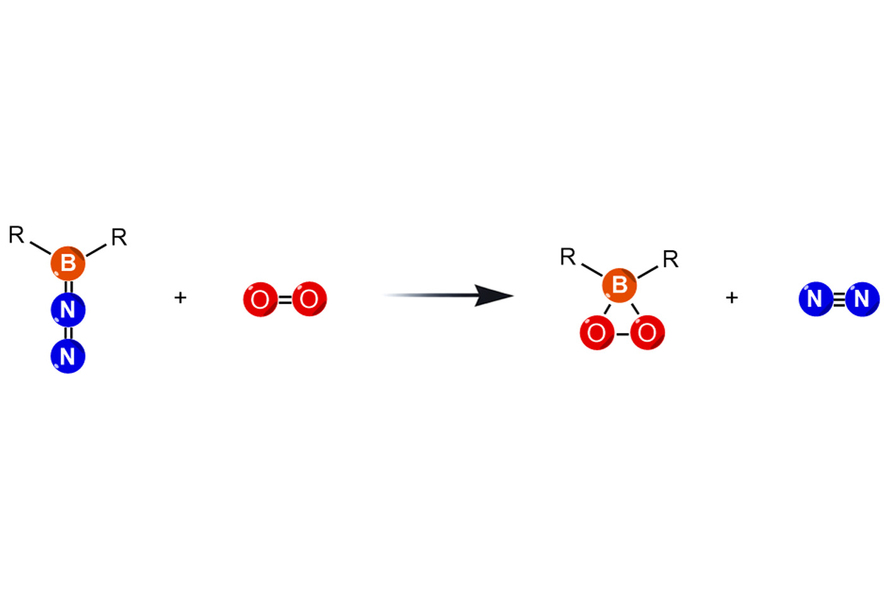
The MIT-led team bypassed those barriers. Researchers used crystallography and advanced computer modeling to confirm the molecule’s structure. Their analysis revealed a tightly strained ring containing one boron atom and two oxygen atoms.
That tiny three-member ring carries significant internal stress. Scientists often compare such strained molecules to compressed springs because they store large amounts of chemical energy.
Many similar oxygen-rich compounds break apart before researchers can study them in detail. The successful isolation of dioxaborirane, therefore, marks a notable step for inorganic and synthetic chemistry.
The new molecule also showed two dramatically different behaviors during testing. In one role, it acted as an oxygen donor. The compound transferred oxygen atoms to other molecules, similar to how industrial peroxides support chemical manufacturing and pharmaceutical production.
That capability could eventually help chemists design new oxidation reactions under milder and safer conditions. In another role, the molecule reacted with carbon dioxide. Researchers say that property may offer a new pathway for capturing or transforming greenhouse gases into useful chemical products.
Scientists continue searching for efficient ways to manage carbon dioxide emissions. Most existing carbon-capture systems require large amounts of energy or expensive infrastructure.
The newly discovered boron-based compound will not solve climate problems on its own. However, researchers believe it could inspire new reaction systems that handle carbon dioxide more efficiently. The molecule’s dual behavior also surprised researchers because highly reactive compounds usually specialize in only one type of chemistry.
“By showing that these compounds can be generated under mild conditions, our work opens the door to entirely new types of chemistry,” lead author Chonghe Zhang said. He added that the findings may eventually support new oxidation methods and materials science technologies.
The discovery adds momentum to a growing field centered on boron chemistry. Researchers already study boron compounds for applications involving batteries, catalysts, and advanced materials.
Oxygen-heavy boron structures, however, have remained especially difficult to produce and analyze because of their instability. This latest breakthrough suggests scientists may finally have a reliable route for exploring them.
Researchers now plan to study how dioxaborirane behaves in larger chemical systems and whether related compounds can perform useful industrial reactions at scale.
Commercial applications still remain years away. Even so, the successful creation of this long theorized molecule gives chemists an entirely new platform for designing reactive oxygen chemistry under practical laboratory conditions.
The study is published in the journal Nature Chemistry.

Get the latest in engineering, tech, space & science - delivered daily to your inbox.
Aamir is a seasoned tech journalist with experience at Exhibit Magazine, Republic World, and PR Newswire. With a deep love for all things tech and science, he has spent years decoding the latest innovations and exploring how they shape industries, lifestyles, and the future of humanity.
此内容由惯性聚合(RSS阅读器)自动聚合整理,仅供阅读参考。 原文来自 — 版权归原作者所有。