







A new US military drone with hybrid-electric propulsion made its first flight in April 2026. This marks an important step toward developing quieter combat and surveillance aircraft.
Northrop Grumman and its subsidiary, Scaled Composites, designed the unmanned XRQ-73, which made its first flight at Edwards Air Force Base. The Defense Advanced Research Projects Agency later confirmed the flight and called it a key milestone for hybrid-electric military aviation.
Images released later suggest the aircraft’s first flight happened on April 14, 2026. DARPA announced the achievement weeks afterward, showing how secretive the program is.
DARPA developed the aircraft as part of its Series Hybrid Electric Propulsion Aircraft Demonstration, known as the SHEPARD program. This project also builds on the earlier XRQ-72 Great Horned Owl project, which was not widely known.
The XRQ-73 uses a very quiet electric propulsion system powered by a gas turbine. This design aims to reduce both noise and heat, making the aircraft harder to detect during surveillance missions.
According to Northrop Grumman, the drone weighs about 1,250 pounds (555 kilograms). It is classified as a Group 3 Uncrewed Aircraft System by the U.S. Department of Defense. Drones in this group usually fly up to 18,000 feet and can reach speeds of about 288 mph (250 knots).
DARPA officials said the aircraft’s importance goes beyond a single demonstration flight. “This milestone is not just about a single flight,” said Lieutenant Colonel Clark McGehee, SHEPARD program manager.
“The architecture proven by the XRQ-73 paves the way for new types of mission systems and delivered effects. We look forward to advancing this technology through the flight test program and delivering new capabilities for our warfighters.”
Initial plans reportedly targeted a first flight in 2024, but the aircraft missed that schedule. Officials have not explained the delay.
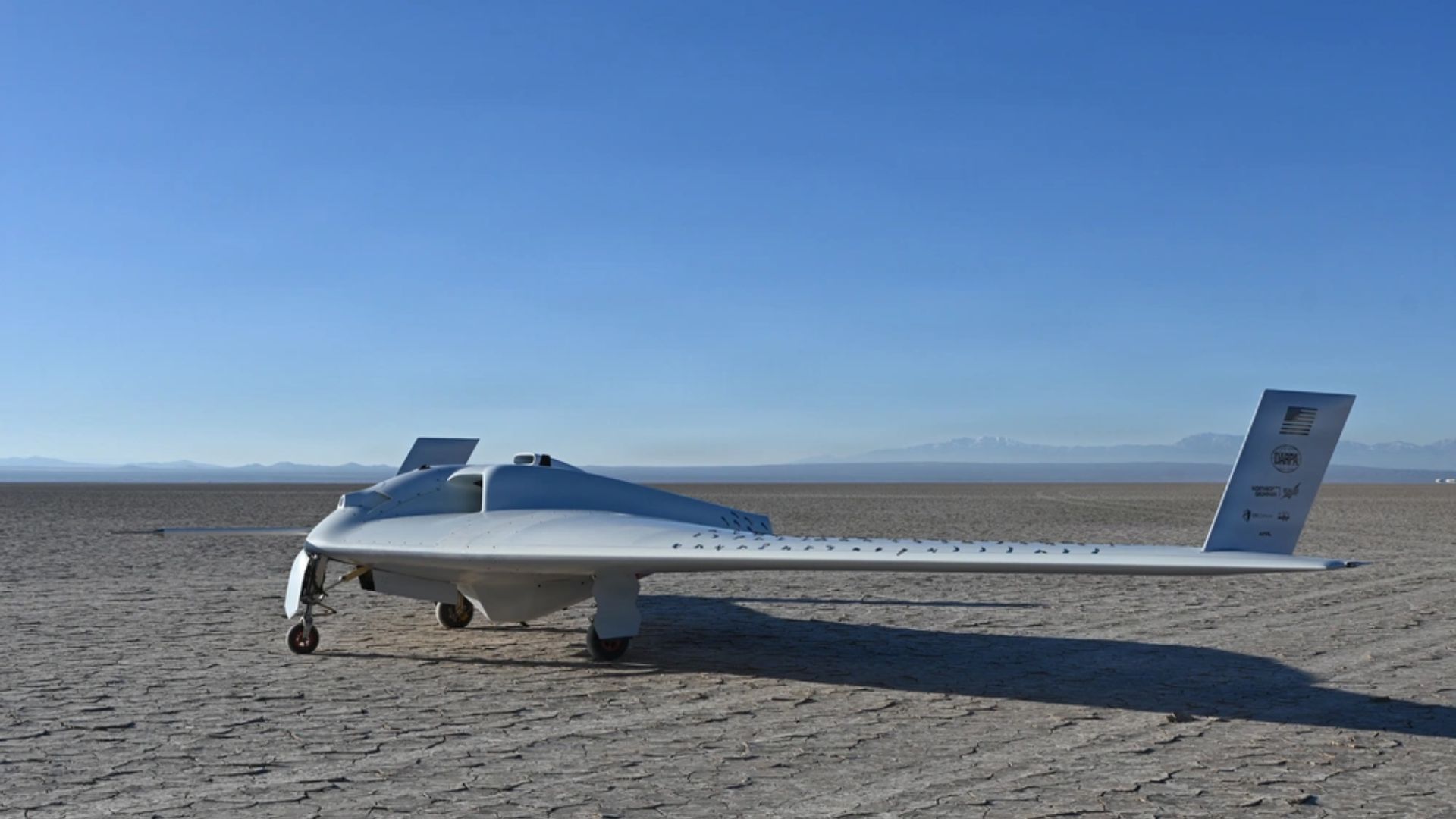
Newly released images show that the XRQ-73 has undergone several design changes since it was first shown to the public in July 2024.
The aircraft now has vertical stabilizers at the ends of its wings, but it is not clear whether these will remain. Engineers also added a new air inlet on top and blade antennas.
Between the two main intakes, images show a new device with a forward-facing opening. This part may hold cameras or other systems for controlling and navigating the aircraft.
Black strips seen on the wings are airflow indicators used during flight tests. They help engineers study how air moves over the wings and will likely be removed later in testing.
The XRQ-73 still has its large lower fuselage fairing, which is probably meant to carry intelligence, surveillance, and reconnaissance equipment. Officials have not shared details about the exact payload.
Its flying-wing shape, quieter propulsion, and possibly lower heat signature could make the aircraft well-suited for covert intelligence, surveillance, and reconnaissance missions at lower altitudes.
Photos released by DARPA also show the drone parked on Rogers Dry Lake at Edwards Air Force Base, not on a regular runway or taxiway. The dry lake bed has a history of supporting experimental aviation and was used for testing the North American X-15 and the Space Shuttle.
DARPA is expected to continue testing the XRQ-73, but most details will likely remain out of public view as the flight program moves forward.

Get the latest in engineering, tech, space & science - delivered daily to your inbox.
A versatile writer, Sujita has worked with Mashable Middle East and News Daily 24. When she isn't writing, you can find her glued to the latest web series and movies.
此内容由惯性聚合(RSS阅读器)自动聚合整理,仅供阅读参考。 原文来自 — 版权归原作者所有。