




Trapping particles that demand opposite conditions was impossible—until a device ran two worlds at once.
For decades, physicists have chased the goal of bringing together the building blocks of antimatter and watching them form something stable. However, nature hasn’t made it easy.
The particles needed to fulfil this goal, like antiprotons and positrons, behave so differently that trapping them in the same place has been nearly impossible.
Looks like a team of researchers has finally found a way to solve this problem. They’ve built a new kind of radiofrequency trap that can handle particles with wildly different needs. In early tests, the device successfully captured either electrons or calcium ions—proxies for positrons and antiprotons—in the same setup.
This might sound incremental, but it tackles a core bottleneck in antimatter research. If scientists can trap both particle types together, they could assemble antihydrogen outside facilities like CERN—a shift that could open antimatter experiments to labs around the world.
“Antihydrogen is a kind of Holy Grail in antimatter research. Its uniquely simple makeup—just one antiproton and a positron—means we can generate it relatively easily compared to other antimatter,” Hendrik Bekker, one of the researchers and a senior scientist at the Helmholtz Institute Mainz, said.
Trapping opposites in one cage
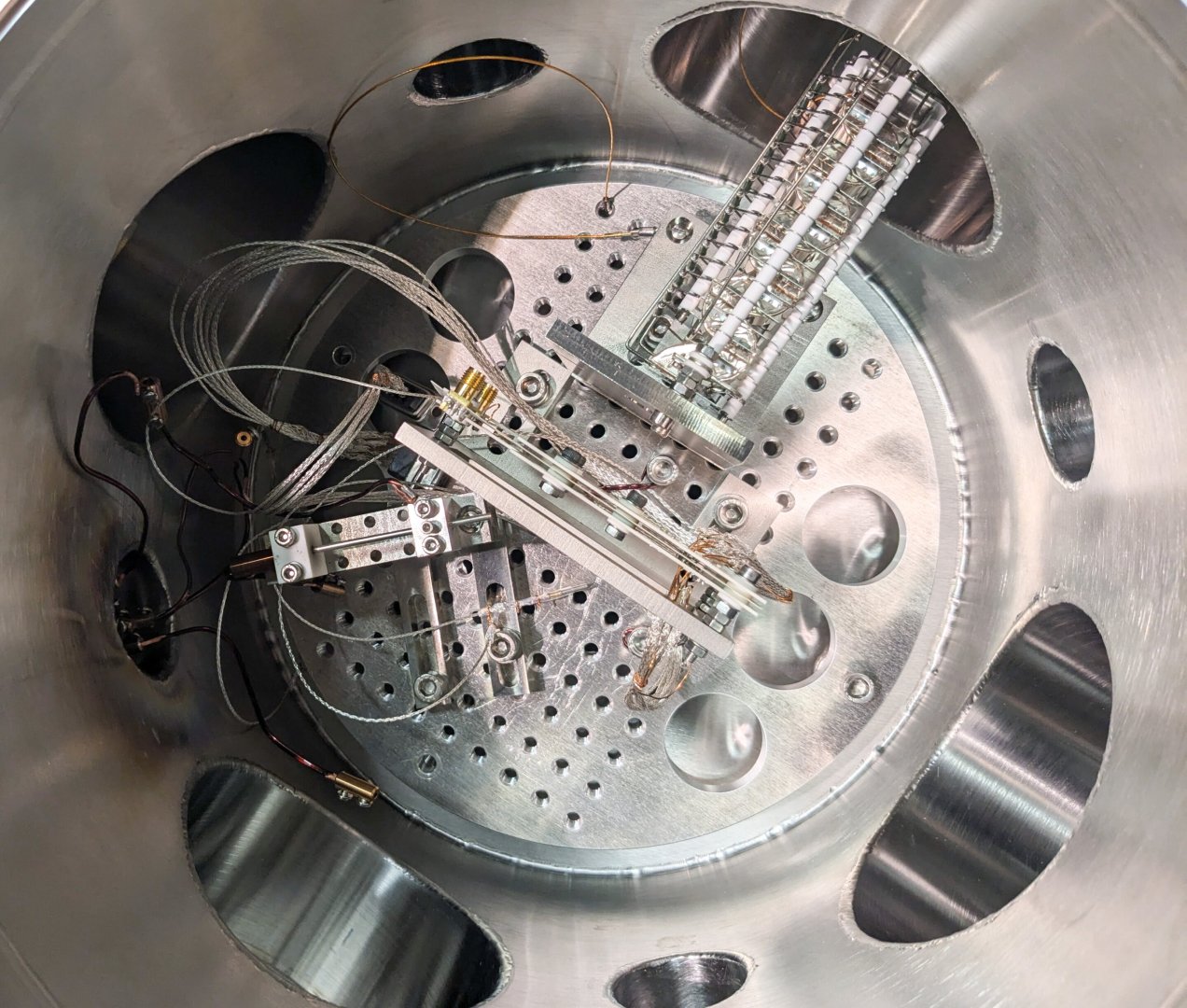
In their study, the researchers focused on a tool called a Paul trap, a workhorse of modern physics. These traps use oscillating electric fields to confine charged particles.
“Radiofrequency Paul traps are one of the most common traps in the field of atomic and molecular physics due to their reliability and excellent optical access,” the study authors note.
However, they usually operate at a single frequency—fine for one type of particle, but useless when you need two that behave very differently.
For instance, light particles like positrons (or electrons, in this experiment) need extremely fast oscillations, gigahertz (GHz) frequencies, to stay confined. Heavier particles like antiprotons (or calcium ions) prefer much slower megahertz (MHz) fields.
Traditionally, you had to choose one or the other. Interestingly, the study authors didn’t choose. They built both into the same device.
Their design stacks three printed circuit boards with ceramic spacers. The middle layer carries a coplanar waveguide resonator, a special structure that produces the high-frequency (GHz) field needed to trap electrons.
The top and bottom layers contain electrodes that generate the lower-frequency (MHz) field for ions.
Testing the device and its limits
To test the setup, the researchers first created charged particles from neutral calcium atoms using a two-step laser process (with 423 nm and 390 nm light). These particles were then fed into the trap and held for durations ranging from milliseconds to several seconds before being released and detected.
“We find that tens of electrons or ions can be trapped for up to ten milliseconds, and a small fraction remains trapped even after hundreds of milliseconds,” the study authors note.
In separate runs, the system worked. It could store electrons or ions, showing that the device can support both types of particles. However, keeping them together remains the real challenge.
Electrons, for instance, turned out to be extremely sensitive to the low-frequency field used for ions. Increase that field too much, and the electrons escape. The ions, meanwhile, didn’t care about the high-frequency field at all. This imbalance is one of the main hurdles still standing.
“During dual-frequency operation, we find that while the number of trapped electrons rapidly decreases with the increase of the field amplitude, the number of trapped ions shows no dependence,” the study authors added.
There are also engineering challenges. Tiny imperfections, including surface roughness, slight misalignments, and stray electrical charges, can destabilize the trap.
The team is already working on next-generation versions with smoother, laser-etched components and better thermal stability.
Taking antimatter out of CERN
Right now, the world’s supply of antiprotons comes from the CERN Antimatter Factory, limiting who can work on antimatter experiments.
This could change. For instance, Dmitry Budker, one of the study authors, suggests that “the recent success in transporting antiprotons using a truck has shown that delivering antiprotons to researchers far from CERN is feasible.”
If paired with traps like this one, scientists elsewhere could start assembling antihydrogen themselves, and this would be a game-changer.
This is because antihydrogen is one of the cleanest systems for testing the laws of physics. It mirrors ordinary hydrogen almost perfectly, making it ideal for probing questions—like why the universe favors matter over antimatter.
Still, this new trap isn’t there yet. Simultaneous confinement remains unstable, and the hardware needs refinement. Still, even in its current form, it opens doors to experiments that were previously out of reach.
The study is published in the journal Physical Review A.
Recommended Articles

Get the latest in engineering, tech, space & science - delivered daily to your inbox.
Rupendra Brahambhatt is an experienced writer, researcher, journalist, and filmmaker. With a B.Sc (Hons.) in Science and PGJMC in Mass Communications, he has been actively working with some of the most innovative brands, news agencies, digital magazines, documentary filmmakers, and nonprofits from different parts of the globe. As an author, he works with a vision to bring forward the right information and encourage a constructive mindset among the masses.