





Researchers from the Universities of Birmingham and Warwick, alongside the University of Vienna, have unlocked a “toolbox” for the next generation of technology.
In particular, it could help build electronic components from molecular-scale electronic “nanoribbons” with atomic precision.
The potential uses are many, ranging from smart clothing to quantum computing.
“This research creates a new toolbox for building electronic materials with atomic precision. Building nanoribbons directly on a metal surface can produce perfectly defined structures, which is difficult to achieve using traditional chemistry,” said James Lawrence, who co-led much of this work as a PhD student at the University of Warwick.
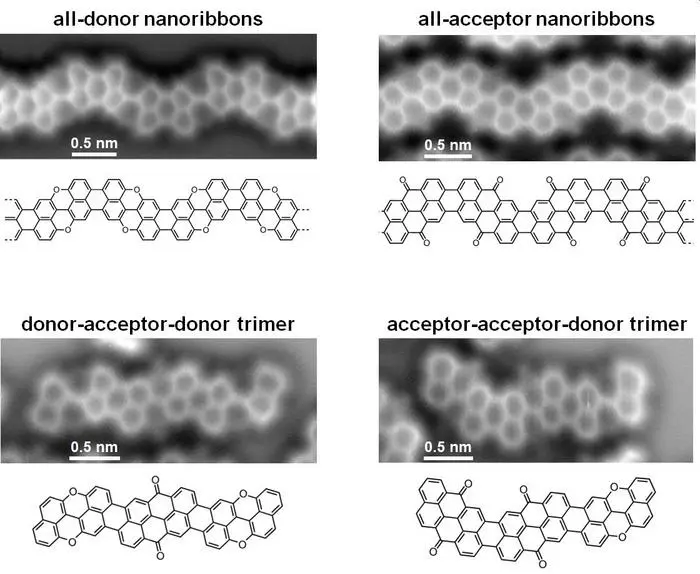
In this development, donor–acceptor (D–A) chemistry was used to build nanoribbons with atomic precision.
The material’s electronic behavior can be programmed before assembly by precisely alternating molecules that “give” and “take” electrons in specific sequences and lengths.
“While atomically precise nanoribbons have been explored before, this is the first time they have been built by directly combining electron donor and acceptor units,” said Professor Giovanni Costantini from the School of Chemistry and the School of Physics and Astronomy at the University of Birmingham.
“Because we can choose exactly where these units appear, we can design their electronic properties in advance and realize them with atomic precision,” Costantini added.
Interestingly, the project successfully produced perfectly defined donor-only, acceptor-only, and mixed molecular chains.
Advanced microscopy enabled visualization of individual atoms and chemical bonds, allowing detection of tiny irregularities and measurement of electron behavior within the nanoribbons.
“By embedding donor–acceptor concepts into these on-surface fabrication strategies it became possible to prepare extended nanoribbon structures that are otherwise difficult to make in solution,” said Davide Bonifazi from the University of Vienna.
This approach addresses the limitations of graphene-based nanoribbons to shrink electronics. But graphene is stubborn. It doesn’t naturally want to be a semiconductor.
Moreover, the study revealed that lengthening “all-D” or “all-A” ribbons enhanced respective donating or accepting strengths, while mixed ribbons derived their unique properties from specific molecular sequences.
These findings established a theoretical model that enables the creation of customized materials with application-specific electronic properties by precisely controlling subunit composition.
“From a modeling perspective, these nanoribbons show how atomic-scale design can be used to fine-tune real-world electronic properties. Capturing the effects of the supporting surface and local environment will be key to guiding this approach further,” said Gabriele Sosso from the University of Warwick in the press release.
The researchers are already moving toward the next step: applying this atomic-scale design to create more efficient solar cells and advanced sensors.
Future developments enabled by this technique include flexible organic electronics that can be printed or painted directly onto materials, such as smart clothing.
Moreover, the technology could support the creation of ultra-small circuits for Internet of Things (IoT) devices and highly precise bioelectronics suitable for human or animal implants.
The research findings were published in the journal Nature Communications on April 23.

Get the latest in engineering, tech, space & science - delivered daily to your inbox.
Mrigakshi is a science journalist who enjoys writing about space exploration, biology, and technological innovations. Her work has been featured in well-known publications including Nature India, Supercluster, The Weather Channel and Astronomy magazine. If you have pitches in mind, please do not hesitate to email her.
此内容由惯性聚合(RSS阅读器)自动聚合整理,仅供阅读参考。 原文来自 — 版权归原作者所有。