









By harnessing eddy currents created by spinning magnets, this build delivers heat without relying on fuel or electrical conversion.
In a small workshop setting, one builder has taken a familiar problem and approached it from a completely different angle. Instead of relying on fuel or electricity, he focused on motion itself as the source of heat.
The result is a compact, mechanically driven water heater that produces heat using magnetic fields and copper tubing. Built by Greenhill Forge, the system draws from earlier generator work but shifts the goal from electricity to direct thermal output.
It is a simple idea in concept, but the execution leans heavily on careful design and precise construction.
Copper coil for heating
The core of the system sits between two spinning magnet rotors. Sandwiched between them is a flat disc made entirely from copper tubing. The tubing is wound into a tight spiral and soldered into one continuous conductor. Water flows through the inside of that tube during operation.
As the magnets rotate past the copper, they create eddy currents inside the metal. These currents generate heat within the tubing walls. Instead of wasting that heat, the system captures it immediately.
The moving water absorbs the heat directly as it passes through the coil. There is no conversion into electricity and no secondary heating element. The process stays direct and efficient.
Built around precision
The build process starts with a steel jig designed to hold everything in place. This ensures the copper coil forms evenly and maintains consistent spacing.
The tubing, about 8 mm thick, is wrapped carefully to create a uniform spiral. Clamps secure the structure, while soldering bonds the entire coil together.
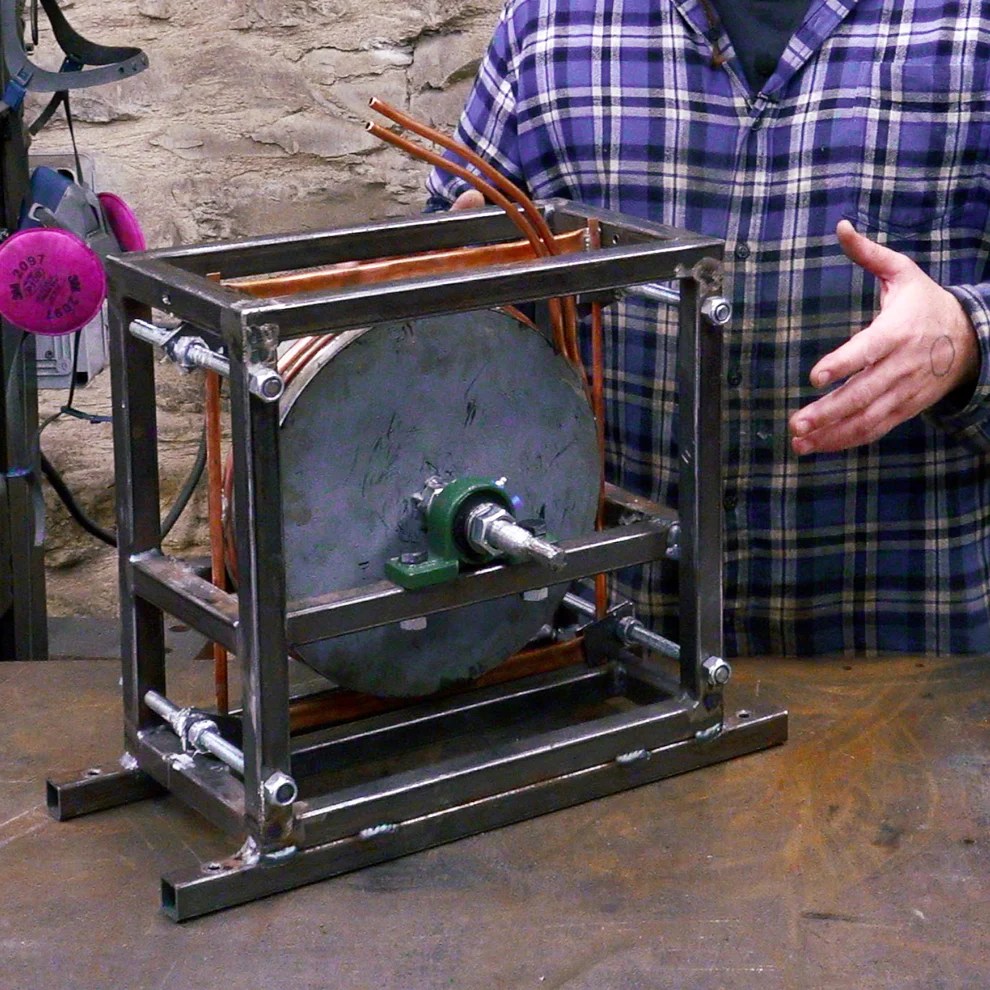
After cleaning, the stator is mounted into a square frame. The magnet rotors sit on either side, held in alignment by bearings and lock nuts. Smooth rotation is essential. Even small deviations can reduce performance or create instability. Water movement is driven by a compact submersible pump. It pushes around 600 liters per hour while drawing just 10 watts.
Output scales with RPM
Testing used a corded drill to drive the system. At about 400 RPM, the heater processed 1.5 liters of water. The temperature rose from 46.2°F to 75.9°F in three minutes. Water exiting the system reached 83.1°F. That translates to roughly 575 watts of heat output.
Performance depends heavily on rotational speed. The relationship is not linear. Output increases with the square of RPM. Doubling the speed results in four times the heat. At 2,000 RPM, the system could reach close to 14.5 kW under ideal conditions.
During the test, the copper temperature stayed close to the water temperature. This showed strong transfer efficiency. The drill motor overheated before the heater itself showed stress.
The system works best when paired with direct mechanical input. A wind turbine or small hydropower setup can drive the rotors without conversion losses. Heat begins as soon as the system spins and stops when rotation ends. This makes it well-suited for variable energy sources.
It also avoids many common issues tied to heating systems. There is no fuel storage, no exhaust, and no traditional heating element to fail. For off-grid users, the design offers a practical alternative. It turns available motion into usable heat with minimal complexity and fewer points of failure.

Get the latest in engineering, tech, space & science - delivered daily to your inbox.
Aamir is a seasoned tech journalist with experience at Exhibit Magazine, Republic World, and PR Newswire. With a deep love for all things tech and science, he has spent years decoding the latest innovations and exploring how they shape industries, lifestyles, and the future of humanity.