







Electric cars have charging networks along every major road, but the maritime industry still lacks a viable offshore charging network.
Norwegian researchers at SINTEF and the shipbuilder Vard have developed an inductive (magnetic) charging system designed to power electric vessels directly at sea.
The project addresses the harsh environmental challenges of offshore charging by using encapsulated magnetic coils rather than metal plugs.
Initially aimed at Service Operation Vessels (SOVs) for wind farms and Platform Supply Vessels (PSVs) for the oil industry, Vard envisions this technology eventually forming a charging infrastructure along the entire Norwegian coast.
“We’ve looked at a lot of solutions here,” said Giuseppe Guidi, a senior research scientist at SINTEF.
“And we’ve tested a possible solution that works almost like a regular electrical contact. But we can avoid all the problems because we transfer the power inductively by encapsulating the plug itself in materials that can withstand just about anything,” Guidi added.
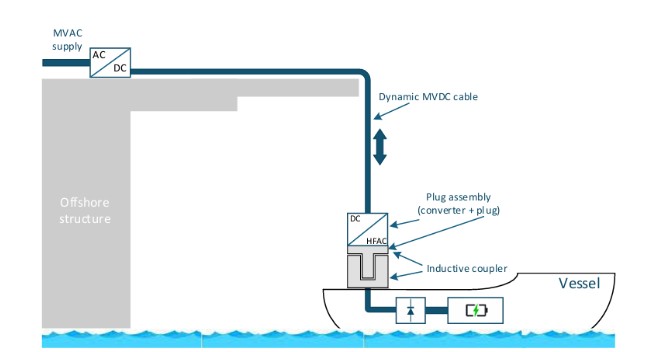
Standard plug-based systems suffer from mechanical wear, saltwater corrosion, and high maintenance costs, making them unreliable at sea.
The Ocean Charger project simplifies offshore charging by replacing vulnerable metal plugs with a “plug-and-play” magnetic system. This inductive technology allows electric vessels — such as wind farm service ships and oil supply boats — to recharge directly at sea via encapsulated coils that resist salt and corrosion.
“Movement and wear make charging at sea challenging when using a classic plug-based connection. Mechanical wear and tear, corrosion, and demanding maintenance increase the risk and costs,” said Håvard Vollset Lien at Vard, who heads the large Ocean Charger project.
It eliminates the need for electric ships to make long, battery-draining trips back to port for power, and makes maritime charging as practical and efficient as refueling a car on a highway.
Using magnetic fields, this system enables power transfer to electric ships without physical metal contact, shielding vital components from nature’s corrosive elements. The design features waterproof, encapsulated coils on both the charging station and the ship that remain unaffected by salt or algae.
This “cup in a cup holder” approach ensures a protected connection that overcomes the risks of maritime hardware degradation.
“It won’t be necessary to be precise when lowering the plug into the receiver hole. It’s almost like putting a cup in a cup holder. It will fit no matter which way it is turned. Very plug and play,” said Guidi.
While the wireless concept seems simple, it relies on a complex technical chain that converts power through multiple stages.
Electricity undergoes multiple conversions, moving from high-voltage direct current into high-frequency magnetic fields before being captured and stabilized on board. This multi-stage process ensures that energy is delivered to the ship’s battery both safely and efficiently.
Until now, battery-powered offshore vessels faced a Catch-22. To recharge, these vessels had to sail back to a coastal port. Often, the energy required just to make that trip would drain a large portion of the battery they just filled.
The Ocean Charger changes the industry’s geometry by installing these magnetic “cup holders” directly onto offshore wind turbines or Offshore Substation (OSS) hubs, so ships can juice up exactly where they work.
Researchers have focused specifically on electromagnetic design, optimizing coil winding and materials to deliver high power to electric ships through a compact surface. In addition, an intelligent management system coordinates the process to ensure peak efficiency and minimal energy loss.

Get the latest in engineering, tech, space & science - delivered daily to your inbox.
Mrigakshi is a science journalist who enjoys writing about space exploration, biology, and technological innovations. Her work has been featured in well-known publications including Nature India, Supercluster, The Weather Channel and Astronomy magazine. If you have pitches in mind, please do not hesitate to email her.
此内容由惯性聚合(RSS阅读器)自动聚合整理,仅供阅读参考。 原文来自 — 版权归原作者所有。