




惯性聚合 高效追踪和阅读你感兴趣的博客、新闻、科技资讯
阅读原文 在惯性聚合中打开

推荐订阅源

小众软件
小众软件
B
Blog
Cyber Security Advisories - MS-ISAC
N
News and Events Feed by Topic
S
Security Affairs
奇客Solidot–传递最新科技情报
奇客Solidot–传递最新科技情报
Cloudbric
Cloudbric
Google DeepMind News
B
Blog RSS Feed
Microsoft Azure Blog
cs.CV updates on arXiv.org
N
News and Events Feed by Topic
Jina AI
Jina AI
罗磊的独立博客
GbyAI
GbyAI
I
InfoQ
aimingoo的专栏
aimingoo的专栏
Attack and Defense Labs
O
OpenAI News
H
Hackread – Cybersecurity News, Data Breaches, AI and More
雷峰网
雷峰网
让小产品的独立变现更简单 - ezindie.com
MyScale Blog
MyScale Blog
cs.AI updates on arXiv.org
U
Unit 42
H
Heimdal Security Blog
SecWiki News
SecWiki News
云风的 BLOG
云风的 BLOG
PCI Perspectives
PCI Perspectives
V
Visual Studio Blog
Last Week in AI
Last Week in AI
Microsoft Security Blog
OSCHINA 社区最新新闻
OSCHINA 社区最新新闻
V
V2EX
博客园 - 司徒正美
W
WeLiveSecurity
TaoSecurity Blog
TaoSecurity Blog
Application and Cybersecurity Blog
AI
AI
K
KPMG report finds enterprise disconnect between AI and its ROI | CIO
S
Security @ Cisco Blogs
V2EX - 技术
V2EX - 技术
Schneier on Security
N
News | PayPal Newsroom
S
Secure Thoughts
Exploit-DB.com RSS Feed
Recent Commits to openclaw:main
T
Troy Hunt's Blog
C
CXSECURITY Database RSS Feed - CXSecurity.com
V
Vulnerabilities – Threatpost

Interesting Engineering

US firm to scale laser-based nuclear fusion ‘breakthrough’ with new partnership Military Archives - Interesting Engineering World’s first non-nuclear lead-cooled reactor to generate electricity begins installation US scientists devise new process to turn sewage sludge into 99% pure natural gas US firm unveils submarine-hunting drone with 9,200-mile-range, 35 mph top speed Military Archives - Interesting Engineering Supercomputer finds lithium-titanium tweak to boost sodium-ion batteries for grids Lockheed Martin demonstrates vertical launch missile system for mobile drone defense China’s 1116 MWe Taipingling Unit 1 reactor goes online, set to generate 9bn kWh yearly ChatGPT Images 2.0 update combines reasoning, research, and design with 2K output US Navy tests plug-and-play laser system on USS Bush carrier, downs drones at sea China’s CATL reveals 621-mile EV battery, under-7-minute charging to challenge BYD US uses world’s first exascale supercomputer to model supernovae, fusion reactors AI and Robotics Archives - Interesting Engineering First-in-human study confirms safety of graphene-based brain interface Tesla’s Optimus humanoid robot greets runners, poses for photos at Boston Marathon Interlocking materials offer high strength and flexibility for robotics, infrastructure US redeploys 100,000-ton nuclear-powered aircraft carrier in Red Sea after repairs US scientists unveil concept for ‘world’s first neutrino laser’ to unlock breakthroughs New military tech can maintain communication in contested electronic warfare environments Got a dark personality? Psychologists can help you choose your career wisely Humidity boosts performance of 3D-printed nanogenerator instead of degrading it China demonstrates microwave beam that recharges drones in flight, continues power delivery Scientists run compact free-electron laser for eight hours, cracks FEL stability problem China’s PLA considers to use minelaying underwater drones to enforce Taiwan blockade: Report 1-ton sharks may struggle for survival in waters exceeding 62.6°F, study suggests US firm’s thorium nuclear fuel bundles move to manufacturing for commercial reactors Tesla hits 0% charge in remote Chilean desert as YouTuber uses hood-mounted solar Humanoid robot surpasses human world record in Beijing half-marathon, clocking 50:26 mins New method extracts maximum work from unknown quantum states using symmetry tricks US scientists’ new method can measure rare-earth elements in plants without destroying them 1,800-year-old feces reveal disease and hygiene linked to Roman Empire in Bulgaria Tankers come under fire as Iranian forces close Strait of Hormuz over US blockade Iran announces opening of Strait of Hormuz, Donald Trump says blockade to continue US scientists confirm altermagnetism in rust, unlock faster, low-power electronics Chinese scientists hit record 63 K in nickel superconductors without extreme pressure Songbird study reveals potential paths for human brain’s self-repair, neurogenesis US dumping ground that stores hundreds of drums with nuclear waste set to be cleaned up Chinese scientists’ diamond-based coating to boost data center cooling efficiency by 80% US’ 100,000-ton nuclear warship sets record with longest deployment since Vietnam War World-first eVTOL two-way transition flight test completed by Vertical Aerospace New electrolyte design improves solid-state battery conductivity by 2.7 times 50-year-old prediction confirmed as scientists spot darkness moving faster than speed of light Uncrewed underwater vehicle enters service in Australia, can boost autonomous warfare power Quasi-solid-state battery hits 99.98% efficiency, stops dendrites, and boosts cycle life France plugs Lucy photonic quantum system into supercomputer for hybrid computing US Army CH-47F Chinook helicopter makes first autonomous landing without human input 300-million-year-old German Basin could hold one of Europe’s largest lithium resources ‘World’s first’: AGIBOT G2 humanoid robots run tablet testing on live factory line Google in talks with Pentagon to deploy Gemini AI after Claude limits dispute US tests spin-polarized fuel in 180-million-degree Fahrenheit tokamaks for fusion power US unveils AI-powered drone with 66-mile reach, modular payload transforms operations Anthropic launches Opus 4.7 with 13% higher vision resolution and stronger coding Germany airdrops 5 ton ‘mini tank’ from aircraft in first airborne test trial US nuclear firm submits plan for 240 MW small modular reactor to power 1.5 million homes China turns on largest AI science hub in 2 months, using no US chips at all Relic black holes from cosmic ‘bounce’ may be dark matter shaping our Universe China releases first detailed map locating seabed minerals in eastern seabed China’s humanoid robot masters real-time tennis rallying with 90.9% return accuracy 10,000 suns: Black hole ‘dancing jets’ clocked at instantaneous power in a first US chemists turn natural gas into liquid fuel without high heat and pressures Australia’s major refinery burns for 13 hours, raises fresh fears over petrol supply crisis US firm can help faster, real time tracking of high-speed threats with infrared camera US Army trials unmanned Hunter Wolf robot with gun, radar in combat drills Massive cosmic test shows Newton and Einstein still explain gravity accurately Mondelez-backed startup debuts ‘world’s first’ chocolate bars made with cultured cocoa China trials deep sea actuator for cutting cables and pipelines at 3,500m depth ‘Missing house’: Exact location of Shakespeare’s only London property identified Boston Dynamics robot Spot now uses Gemini AI for reason-driven decision-making tasks 1,000x faster growth: China advances wafer-scale 2D chips with ultra-fast synthesis technique Chinese automaker’s new EV offers dual rear motors, 800V fast-charging capability Engineered wood converts sunlight into heat, supplies solar power even in darkness US to boost production of submarine-detection devices that could decide battle outcome Your roommate can change your gut: Study finds living together could change your biome China develops crystal that could enable GPS-free navigation for submarines, missiles Electric aircraft motor achieves 1,000 hp output with mere 207 pound weight China’s Geely touts methanol’s ’10x higher’ energy density over ‘too heavy’ lithium EVs Over 150 mergers reveal three distinct black hole origins, challenging unified model German firm’s car integrated with high-pressure hydrogen chambers that deliver 466-mile range 2,000-year-old wall paintings in Roman Hispania reveal ingenious house painters A reimagined Paul trap could help labs worldwide study antimatter beyond CERN China’s BYD debuts electric SUV with up to 590-mile range capability, 130.15 kWh battery Rare 2,000-hp Japanese WWII aircraft lifted out of ocean 80 years after combat Autonomous underwater mine warfare could become easier with French firm’s AI-powered system China showcases Y-30 plane to outperform ‘world’s best tactical transport aircraft in service’ NASA Artemis II crew splashes down safely on Earth after 694,000-mile roundtrip to moon UK firm to boost US Army’s battle firepower with new cannons for 155mm Howitzer Can defects boost light? Study shows flaws boost energy flow in organic semiconductors China could test floating rocket launch platform in South China Sea open waters: Reports Physicists unlock way to measure quantum entanglement inside real-world materials China ramps up new sodium-ion EV battery cathodes as cells survive 572°F safety tests US authorizes Mach 5+ Dark Eagle hypersonic missile for rapid global strike missions Solid-state nuclear battery claims 100-year power for ultra-low energy devices South Korea clears Saeul 3 nuclear reactor for criticality after fuel, heat tests Fake birds, real impact: Robotic decoys aim to revive grouse populations in US Faster, safer solid-state EV batteries unlocked with new US-made super polymer Microsoft out: France moves to replace Windows with Linux to cut reliance on US tech World’s first commercial-ready deep borehole nuclear waste disposal inches closer to reality New dual-frequency trap captures electrons and ions, pushing antihydrogen beyond CERN Military Archives - Interesting Engineering
Europe's first superconducting X-ray spectrometer uses 248 sensors
Georgina Jedikovska · 2026-06-18 · via Interesting Engineering

The detector is installed at the BESSY II UE52-SGM beamline in Germany.

Researchers in Germany have brought Europe’s first and only superconducting TES-array X-ray spectrometer online at the BESSY II synchrotron, a leading 3rd-generation synchrotron light source.

The instrument was developed within a collaboration between the Helmholtz-Zentrum Berlin (HZB), the Max Planck Institute for Chemical Energy Conversion (MPICEC), and US’ National Institute of Standards and Technology (NIST).

It relies on a 248-sensor detector array that can detect X-ray photons far more efficiently than conventional X-ray emission spectroscopy (XES) and resonant inelastic X-ray scattering (RIXS) systems. Its photon detection efficiency is 100 to 1,000 times higher than that of traditional wavelength-dispersive X-ray emission spectrometers.

According to the team, it will be used to investigate the electronic properties of atomically thin layers, nanostructures, and highly diluted atomic and molecular samples. The team expects the instrument to enable many new groundbreaking experiments.

The first TES spectrometer

Synchrotron facilities such as BESSY II generate intense beams of X-rays that allow researchers to probe the structure and properties of matter. However, techniques such as XES and RIXS require the detection of photons emitted by a sample after it interacts with incoming X-rays. This makes them highly photon-hungry.

These methods have traditionally been limited to large or highly concentrated samples. The Transition Edge Sensor (TES) spectrometer will enable studies of atomically thin layers, nanostructures, impurities, and highly diluted molecular systems.
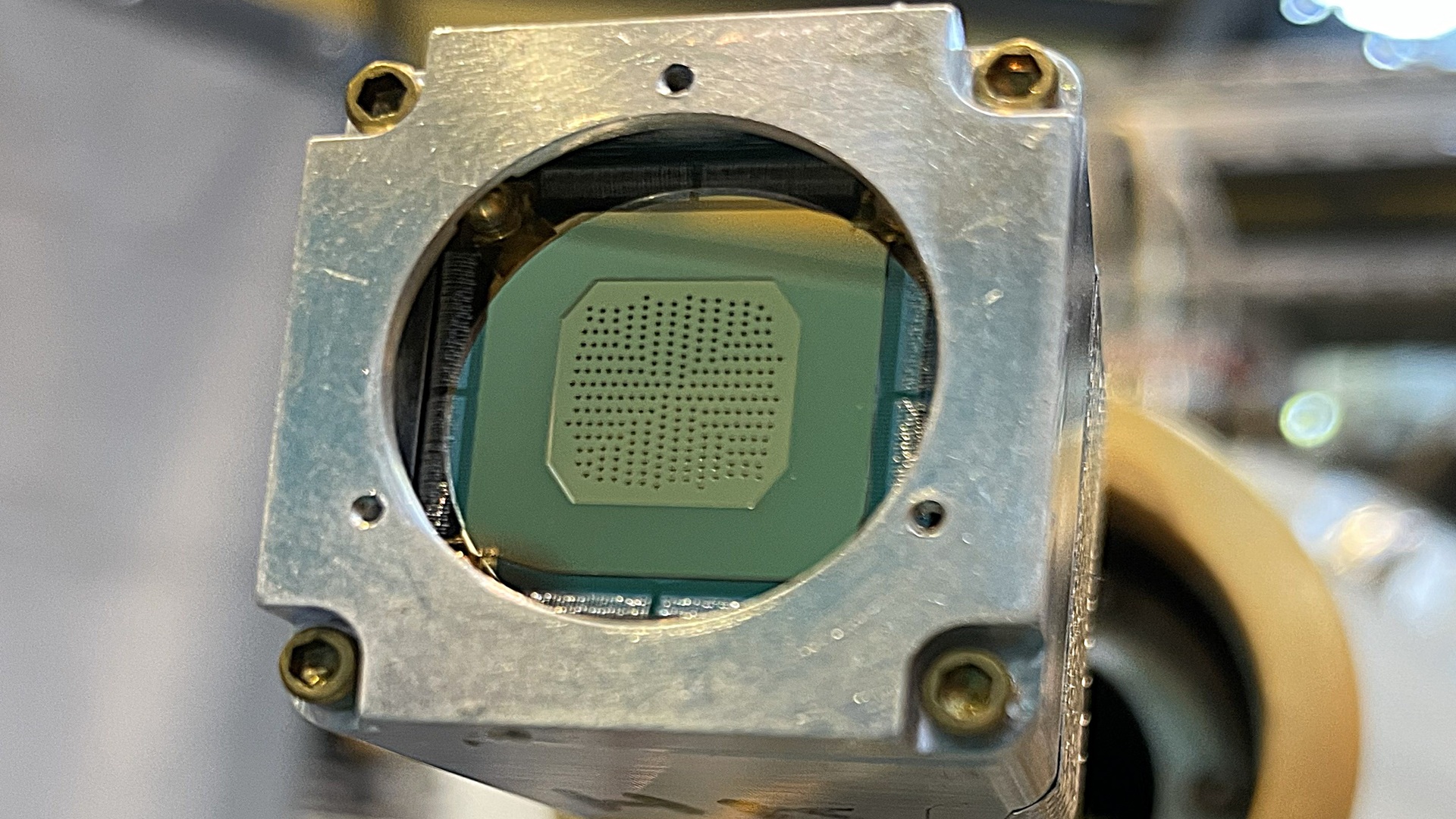
The detector array contains 248 sensors.
Credit: Régis Decker / HZB

“The superconducting Transition Edge Sensor (TES) array photon detector that we have now put into operation at BESSY II is around 100 to 1000 times more efficient to detect photons than conventional XES and RIXS spectrometers,” Régis Decker, PhD, a HZB scientist responsible for the new instrument, said.

Decker explained that the system could provide insights into molecular chemistry, molecular biology, and quantum materials. It also complements techniques such as angle-resolved photoemission spectroscopy (ARPES). ARPES is widely used to investigate electronic band structures.

Reshaping X-ray analysis

The instrument could significantly cut experiment times. In practice, this means that measurements that would normally take hours with conventional systems could now be completed in just a few minutes. This would make it possible for scientists to collect data more efficiently and investigate more materials.

HZB pointed out that the TES array spectrometer contains 248 sensors that are superconducting when cooled to 25 millikelvin (mK). This is just a fraction of a degree above absolute zero. It is achieved using a helium-4/helium-3 (He4-He3) dilution refrigerator similar to the cryogenic systems used in quantum computers.

Once X-ray photons emitted by a sample strike one of the sensors, they cause a tiny temperature increase that briefly disrupts the sensor’s superconducting state. This change in electrical resistance is detected through a circuit based on an array of Superconducting Quantum Interference Devices (SQUIDs).

The spectrometer is integrated with a custom ultra-high-vacuum sample chamber that allows researchers to transfer, prepare, and measure samples at temperatures ranging from 10 kelvin (K) to room temperature.

The setup is installed at the BESSY II UE52-SGM beamline, where scientists can also control the polarization of incoming X-rays. “We are looking forward to receiving exciting research proposals from our user community,” Decker concluded in a press release.

Recommended Articles

The Blueprint

Get the latest in engineering, tech, space & science - delivered daily to your inbox.

Based in Skopje, North Macedonia. Her work has appeared in Daily Mail, Mirror, Daily Star, Yahoo, NationalWorld, Newsweek, Press Gazette and others. She covers stories on batteries, wind energy, sustainable shipping and new discoveries. When she's not chasing the next big science story, she's traveling, exploring new cultures, or enjoying good food with even better wine.