



Iran signaled a temporary easing of a major global chokepoint, saying the Strait of Hormuz is open to commercial traffic during a fragile ceasefire.
The move quickly pushed oil prices lower, reflecting how sensitive energy markets remain to disruptions in the region.
Iranian Foreign Minister Abbas Araghchi said the route is open for now. He wrote: “In line with the ceasefire in Lebanon, the passage for all commercial vessels through [the] Strait of Hormuz is declared completely open for the remaining period of ceasefire, on the coordinated route as already announced by Ports and Maritime Organisation of the Islamic Rep. of Iran.”
In line with the ceasefire in Lebanon, the passage for all commercial vessels through Strait of Hormuz is declared completely open for the remaining period of ceasefire, on the coordinated route as already announced by Ports and Maritime Organisation of the Islamic Rep. of Iran.
— Seyed Abbas Araghchi (@araghchi) April 17, 2026
The strait connects the Persian Gulf to global shipping lanes. It carries a significant share of the world’s oil exports.
Even short disruptions can ripple through U.S. fuel prices and supply chains.
U.S. President Donald Trump responded within minutes on Truth Social. He posted: “IRAN HAS JUST ANNOUNCED THAT THE STRAIT OF IRAN IS FULLY OPEN AND READY FOR FULL PASSAGE. THANK YOU!”
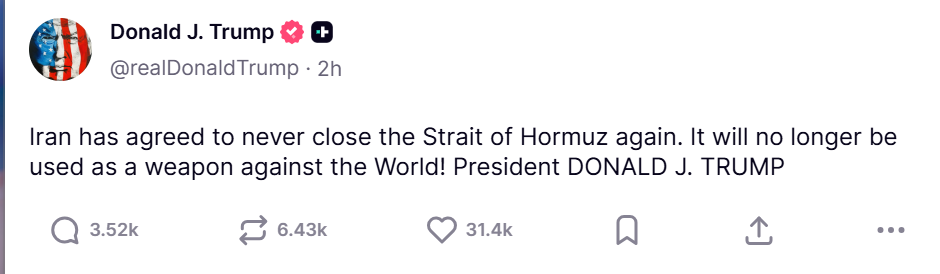
Despite the reopening, Trump said the U.S. naval blockade of Iranian ports will continue.
Washington wants a broader peace agreement before easing pressure. That stance keeps tension high despite the temporary relief.
Markets moved immediately after Iran’s announcement. Brent crude dropped below $90 a barrel after trading above $98 earlier. U.S. benchmark crude also fell sharply.
Prices had surged during the conflict. Brent moved from under $70 before tensions to over $100 in March, peaking above $119. The latest drop shows how quickly sentiment shifts when supply risks ease.
The reopening follows a 10-day ceasefire between Israel and Lebanon. Celebrations broke out in Beirut as the truce began. Still, uncertainty remains around enforcement and duration.
The Strait of Hormuz remains a critical artery for global energy flows. Any renewed disruption could again drive sharp price swings.
此内容由惯性聚合(RSS阅读器)自动聚合整理,仅供阅读参考。 原文来自 — 版权归原作者所有。