


Brembo has started mass production of its new Sensify braking system, becoming the first fully fluid-free brake-by-wire setup to reach production cars. The company confirmed production began in early May for a major global automaker, although the vehicle brand and model remain undisclosed due to non-disclosure agreements.
The Italian braking specialist says the new system removes hydraulic fluid, brake lines, and the traditional master cylinder entirely. Instead, braking commands now travel through electric signals and software, marking a major shift in how modern cars slow down and stop.
Sensify still uses a regular brake pedal, so drivers will not notice a dramatic change in everyday operation. Sensors measure how hard and how quickly the driver presses the pedal. Another unit beneath the footwell recreates the expected pedal resistance, giving the same familiar feeling as a hydraulic setup.
Once the pedal input is detected, digital commands are sent directly to compact control units mounted near each wheel. Electric motors then activate small mechanisms that clamp the brake pads onto the rotor.
The system removes the need for hydraulic tubes, brake fluid reservoirs, and a central master cylinder under the hood. That simplifies the layout and eliminates the risk of fluid leaks or pressure loss.
Each wheel can also react independently. Instead of distributing the same braking pressure across all four wheels, the software continuously adjusts force at every corner of the vehicle. The control system processes data from wheel speed sensors, steering angle, yaw rate, and road conditions to decide how much braking force each wheel requires at any moment.
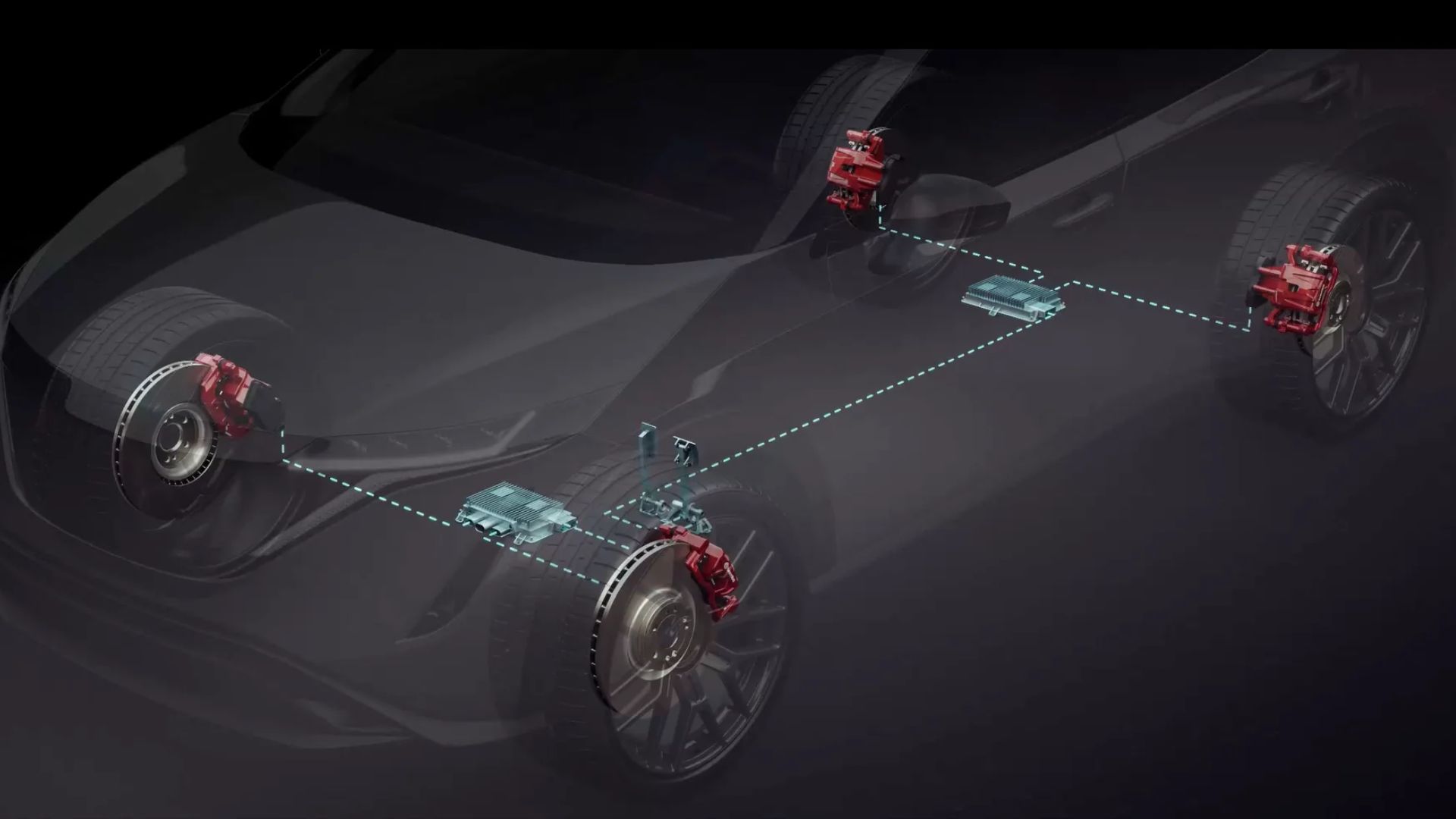
Brembo says the digital setup reacts much faster than conventional hydraulic systems. On snow-covered or wet roads, the software can instantly increase braking force on one wheel while reducing it on another to help keep the vehicle stable and pointed in the intended direction.
The company believes this will noticeably improve cornering control and emergency braking performance. Drivers may also experience smoother brake operation because the system avoids the harsh pedal pulsing commonly associated with older anti-lock braking systems.
The technology also supports advanced vehicle software platforms. Automakers can integrate Sensify into systems controlling adaptive cruise control, stability management, and self-driving features.
Because the braking behavior is software-controlled, updates can be delivered over the air long after the car leaves the factory. Manufacturers could adjust pedal feel, improve braking response, or introduce additional safety functions through future software updates.
The removal of hydraulic hardware could also reduce maintenance demands. Traditional brake systems require periodic fluid replacement and bleeding procedures to remove trapped air from the lines. Sensify eliminates those components completely.
Brembo explained the lighter overall package may improve handling and fuel efficiency by reducing weight at the front of the vehicle. The parking brake is also built directly into the electric motor system, removing the need for separate cables and mechanical levers.
The company designed Sensify to fit a wide range of vehicle platforms, allowing automakers to install it in existing models without major redesigns. Brembo expects the system to eventually reach hundreds of thousands of vehicles annually once the first production models officially launch.
Brake-by-wire technology has existed in limited forms before, mainly as hybrid systems that still relied on hydraulic backups. Sensify represents one of the first attempts to completely replace fluid-based braking with an all-electronic setup in mass-market production vehicles.
The launch also reflects the automotive industry’s growing move toward software-defined vehicles, where mechanical systems are increasingly controlled through code and digital architecture.
If Sensify performs as promised in real-world driving conditions, it could reshape how future vehicles handle braking, safety systems, and software upgrades for years to come.
A versatile writer, Sujita has worked with Mashable Middle East and News Daily 24. When she isn't writing, you can find her glued to the latest web series and movies.
此内容由惯性聚合(RSS阅读器)自动聚合整理,仅供阅读参考。 原文来自 — 版权归原作者所有。