


Nature spent millions of years perfecting the armadillo, the armored mammal. Materials scientists just replicated its shell in a lab with 3D printers, silver nanowires, and heavy-duty paper.
The team from North Carolina State University has created a “robo-armadillo” skin, officially named the Morpho-Interlocking Protective Module (MIPM). Interestingly, it senses danger and instantly curls into a rigid, protective shell.
It is a dynamic suit of armor designed to protect the next generation of fragile tech, especially soft machines.
“There has been a great deal of growth in the fields of soft robotics and flexible electronics, but those devices are often also fragile,” said Yong Zhu, the Andrew A. Adams Distinguished Professor of Mechanical and Aerospace Engineering at the university.
“Our goal was to develop a solution that allows these fragile technologies to function but protects them when necessary,” the corresponding author added.
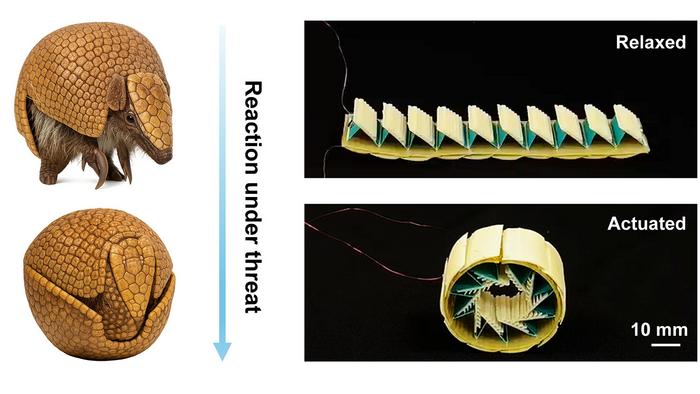
The brilliance of the new protective technology lies in its multi-layered design.
The module structure features a three-layer design to transform from flexible to rigid. Its outer exoskeleton is made of 3D-printed resin scales, while its inner endoskeleton utilizes folded paper ridges to house interlocking polymer scales.
Sandwiched in the middle is a sensing and actuation layer composed of an elastic polymer strain sensor embedded with silver nanowires, a conductive fabric heater, liquid-crystal elastomer, and Kapton tape.
However, when an integrated strain sensor detects a threat — whether a gentle squeeze or a sudden impact — it signals a control unit to send power to an internal heating layer.
This heat triggers a molecular tug-of-war. On one side, a liquid-crystal elastomer contracts. On the other side, a layer of Kapton tape expands. This synchronized movement forces the entire structure to curl inward, wrapping itself into a protective circle, with 3D-printed resin scales facing outward.
But a simple curl isn’t enough to stop a heavy blow. As the module curves, a series of rigid polymer scales attached to a folded paper endoskeleton lock tightly together. This interlocking mechanism transforms a soft, bending material into a highly rigid internal skeleton capable of absorbing forces.
In testing, the system detected strain and triggered its transformation into a protective shell. Moreover, the team found that increasing the number of segmental scales in the inner skeleton boosted the structure’s overall rigidity and strength.
“Through mechanics-guided design, we established a trade-off between endoskeleton segmentation and structural lightweighting,” said Zhu. “As an example, 10 segmental scales were capable of withstanding around 10 newtons of force.
The system can be tuned to respond to different levels of threat. Furthermore, the researchers established a precise math-guided trade-off between the number of scales used and the device’s weight, allowing for customization of the armor based on the payload.
“We could see this technology being used to protect many types of objects – essentially anything it is capable of curving around,” noted Jianyu Zhou, a postdoctoral researcher at NC State and first author of the paper.
From search-and-rescue drones navigating tight rock crevices to flexible medical devices implanted in moving joints, the potential applications are vast.
The NC State team is now actively seeking commercial collaborators to transition their robotic armadillo from the lab bench into the real world.
The findings were published in the journal Science Advances on May 27.

Get the latest in engineering, tech, space & science - delivered daily to your inbox.
Mrigakshi is a science journalist who enjoys writing about space exploration, biology, and technological innovations. Her work has been featured in well-known publications including Nature India, Supercluster, The Weather Channel and Astronomy magazine. If you have pitches in mind, please do not hesitate to email her.
此内容由惯性聚合(RSS阅读器)自动聚合整理,仅供阅读参考。 原文来自 — 版权归原作者所有。