






The method swaps sulfur and tellurium to form entirely new crystal arrangements.
Scientists in the US have rewritten the rules of materials discovery after creating a new revolutionary way to develop superconductors, by swapping elements inside a crystal.
The team from Argonne National Laboratory (ANL) and Northwestern University carefully changed the atomic arrangement within a family of inorganic materials made from barium (Ba), antimony (Sb), and a mix of sulfur (S) and tellurium (Te).
The technique resulted in 10 unique compounds with entirely different structures, even though the ratio of elements remained the same for each compound. As per the team, the discovery could help them tailor materials’ properties and speed up advances in materials science.
“We want to find new families,” Mercouri Kanatzidis, PhD, a materials scientist at ANL and professor at Northwestern University, said. “We’re trying to stay ahead of AI so that if we succeed, AI can be trained on our knowledge.”
New rules of discovery
Many advanced materials, including the first superconductors, which can conduct electricity with zero resistance, were found by chance. Now, rather than relying on accidental progress, the team worked on designing new materials by controlling their atomic structure.
Kanatzidis said that finding materials with quantum properties, like magnets and superconductors, remains a “hot area” in physics. “Superconductivity is probably the biggest prize, but also the most difficult to achieve by design,” he stated.
For the project, the team used barium, antimony, sulfur, and tellurium to create multiple structures from a single formula, BaSbQ3, where Q is sulfur or tellurium. The ratio of Ba:Sb:Q was fixed at 1:1:3.
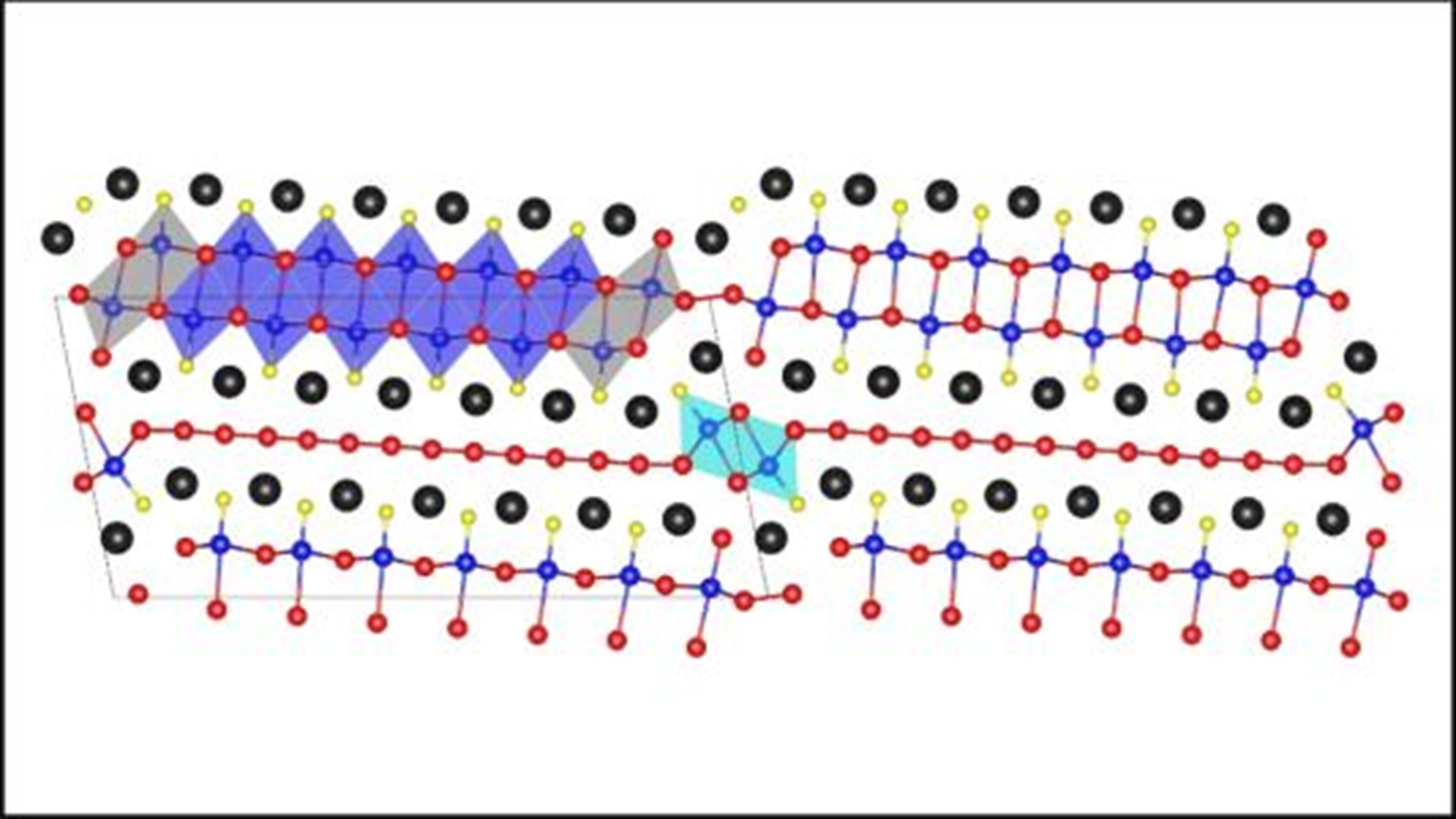
Credit: Argonne National Laboratory
The researchers only changed the number of sulfur and tellurium atoms and their arrangement in the crystal. They began with a Ba-Sb-Te compound and changed some tellurium for sulfur. Despite the similar electron structure, the elements did not form a typical mixed solid solution.
“The surprise was that as we added more sulfur, almost every sample turned out to be a different compound,” Xiuquan Zhou, PhD, a postdoctoral researcher at ANL, said. “Every structure was different, but when we looked closer, we realized they were related by a mathematical relationship that put them all into the same family, called a homologous series.”
Predictable patterns
The change resulted in a whole new sequence of distinct crystal structures, each related to the others, which the scientists referred to as a homologous series. In order to verify the results, they used small-angle X-ray scattering at the DuPont-Northwestern-Dow Collaborative Access Team beamline and high-resolution powder X-ray diffraction at beamline 11-BM.
To verify the materials’ composition, they turned to scanning electron microscopy with energy-dispersive X-ray spectroscopy at the Center for Nanoscale Materials (CNM). They also utilized transmission electron microscopy at the Northwestern University Atomic and Nanoscale Characterization Experimental Center to image the materials at the atomic level and validate the structures.
The scientists identified 10 compounds sharing a 1:1:3 ratio, each with a different structure. “Each compound is new, so each is worth investigating for the original goal of superconductivity, quantum phenomena and other exotic effects,” Hengdi Zhao, PhD, a postdoctoral researcher at ANL, said in a press release.
With AI still relying on existing data the work highlights the continued importance of human intuition, particularly in discovering entirely new material families. Their goal now is to create a clearer framework for discovering materials with electronic properties suited for future technologies.
The study has been published in the journal Science.

Get the latest in engineering, tech, space & science - delivered daily to your inbox.
Based in Skopje, North Macedonia. Her work has appeared in Daily Mail, Mirror, Daily Star, Yahoo, NationalWorld, Newsweek, Press Gazette and others. She covers stories on batteries, wind energy, sustainable shipping and new discoveries. When she's not chasing the next big science story, she's traveling, exploring new cultures, or enjoying good food with even better wine.