







A massive magnet that crossed the Atlantic Ocean has brought one of America’s most ambitious fusion projects a step closer to reality. The U.S. Department of Energy’s Princeton Plasma Physics Laboratory recently received the central magnet bundle for its upgraded spherical tokamak, a compact fusion system designed to test technologies that could shape future power plants.
The delivery marks a critical milestone for the machine’s return to operation. Engineers now enter the final stages of assembly before experiments resume in 2027.
Manufactured by Spain-based Elytt Energy, the component traveled from Bilbao to New Jersey aboard a cargo aircraft before making its final trip by flatbed truck to Princeton. Weighing 23,000 pounds and stretching roughly 20 feet long, the bundle ranks among the most important pieces of the fusion device.
Dave Micheletti, associate laboratory director for engineering and project director, called the arrival “a truly momentous occasion.” He said the team will now focus on completing assembly and preparing the system for scientific use.
The central bundle combines two critical magnet systems into a single structure. The toroidal field magnets generate the primary magnetic fields that confine the plasma. Meanwhile, the ohmic-heating system drives electrical current through the plasma to raise temperatures and support confinement.
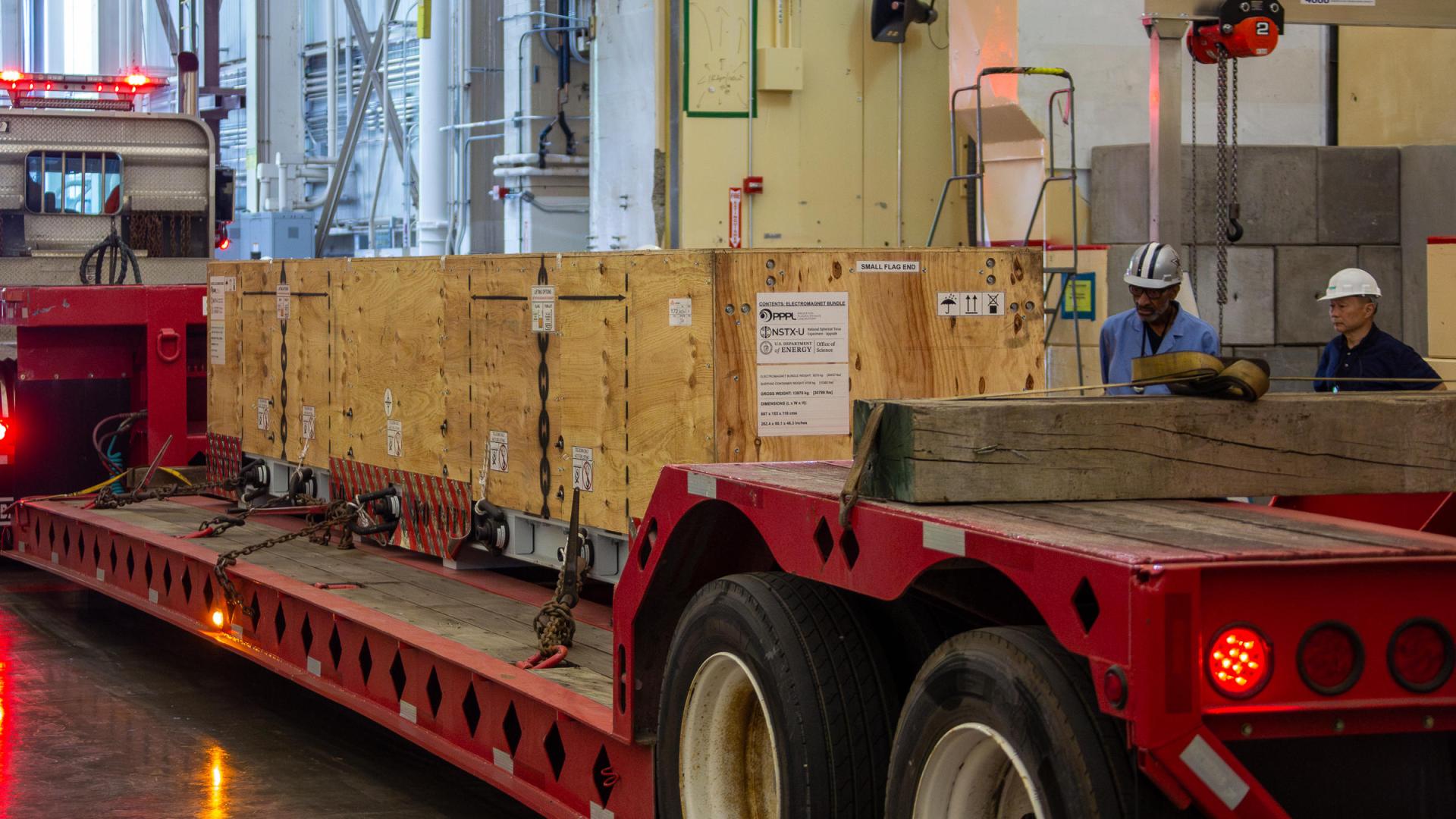
Building the assembly required a complex manufacturing process. Technicians joined 36 copper conductors, each measuring 19 feet long, using fiberglass tape, resin, and vacuum-pressure impregnation techniques.
Engineers then wrapped additional copper coils around the structure to create the ohmic-heating system. They sealed the completed assembly with insulating resin to withstand demanding operating conditions.
Once installed, the magnets will create two magnetic field configurations inside the apple-shaped vacuum vessel. Together, they stabilize and heat the plasma needed for fusion experiments.
Researchers believe spherical tokamaks could offer advantages over conventional designs. Their compact shape may improve efficiency while reducing construction and replication costs. The upgraded system will help scientists evaluate whether the approach can support future commercial fusion plants.
The machine also supports broader national goals. Researchers plan to gather operational data that could train artificial intelligence tools capable of improving fusion performance and control strategies.
Jonathan Menard, the laboratory’s deputy director for research, said the facility will provide new opportunities for scientists and engineers entering the field. He encouraged researchers worldwide to use the platform to advance fusion science.
Engineers have already positioned the magnet bundle near the fusion device using heavy-duty cranes. Over the coming months, teams will rotate the structure upright and prepare it for installation. Workers will lower protective shielding around the assembly before placing it inside the machine’s interior.
Technicians must still connect dozens of flexbus components, cooling lines, and internal systems. They will also complete bakeout procedures and commissioning tests to verify that all systems operate together safely.
Steven Cowley, the laboratory’s director, said the upgraded machine possesses capabilities unavailable elsewhere. He noted that the project could play an important role in determining the future direction of commercial fusion research.
If the remaining work proceeds as planned, the upgraded facility could begin experiments in 2027, giving American researchers a powerful new platform to explore the promise of fusion energy.

Get the latest in engineering, tech, space & science - delivered daily to your inbox.
Aamir is a seasoned tech journalist with experience at Exhibit Magazine, Republic World, and PR Newswire. With a deep love for all things tech and science, he has spent years decoding the latest innovations and exploring how they shape industries, lifestyles, and the future of humanity.
此内容由惯性聚合(RSS阅读器)自动聚合整理,仅供阅读参考。 原文来自 — 版权归原作者所有。