








As an effective blockade chokes the Strait of Hormuz and sends shipping costs soaring, a team of South Korean scientists has found a way to mine for oil in the one place no blockade can reach: the atmosphere.
Researchers at the Korea Research Institute of Chemical Technology (KRICT) have developed a technology that directly captures carbon dioxide (CO2) from industrial emissions and converts it into high-grade gasoline and naphtha.
For this, a proprietary catalyst and a streamlined process were developed that skip intermediate steps, immediately converting CO2 and hydrogen into liquid hydrocarbons.
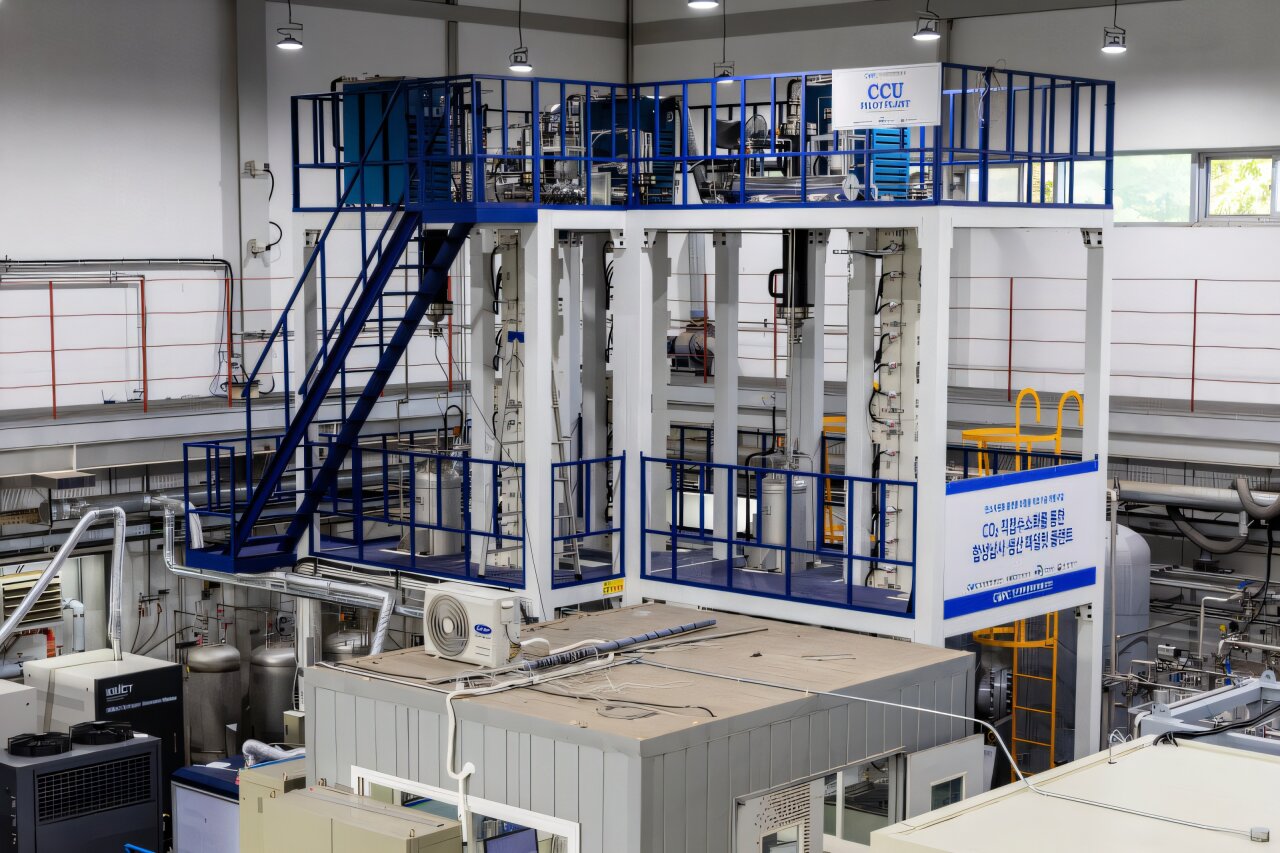
Notably, the new pilot plant is already producing 50 kilograms (110 pounds) of liquid fuel every day.
“Successful commercialization could substantially reduce dependence on imported petroleum and strengthen national energy security by establishing alternative carbon feedstock systems,” the team noted.
Regular carbon dioxide conversion relies on a cumbersome two-stage approach: first, the gas must be heated to over 800°C (1472°F) to drive the reverse water-gas shift reaction and produce carbon monoxide. This intermediate is then processed through Fischer–Tropsch synthesis under high pressure to create liquid fuel.
With these extreme temperature and pressure requirements, the process demands complex, multi-stage facilities that are both energy-intensive and expensive to maintain.
In this development, the team replaces this two-step conversion process with a streamlined direct hydrogenation method.
Using a specialized catalyst, CO2 and hydrogen were converted into liquid hydrocarbons in a single stage at much milder temperatures of around 330°C (626°F). This shortcut reduces energy consumption and complexity.
Moreover, it achieved a 50% synthesis yield of liquid hydrocarbons. It could pave the way for cost-effective, commercial-scale production of sustainable fuels such as gasoline and naphtha.
“The pilot plant’s daily output of 50 kg is roughly equivalent to three 20-liter jerrycans of fuel,” the researchers noted.
The success builds on the initial 5 kg-per-day mini-pilot. Following this, the joint research team successfully launched Korea’s first direct CO2 hydrogenation pilot plant, scaling production to 50 kg daily by late 2025.
This milestone serves as the foundation for the project’s next ambitious phase.
The timing of this breakthrough is no accident. The 2026 Iran War is said to be choking off 20 percent of the world’s oil supply.
With 70% of South Korea’s crude oil flowing through the Strait of Hormuz, the current blockade has triggered a systemic crisis, exposing vulnerabilities in everything from petrochemicals and semiconductors to the national economy.
Three 20-liter jerrycans of fuel a day might seem small, but the roadmap is massive. The joint team — which includes heavyweights GS Engineering & Construction and Hanwha TotalEnergies — is already drafting blueprints for a commercial plant capable of producing 100,000 tons annually.
The development is important for Power-to-Liquids (PtL) systems, which can be integrated with renewable energy. This synergy enables the conversion of renewable electricity, captured CO2, and green hydrogen into carbon-neutral liquid fuels, creating a sustainable, high-efficiency energy cycle.
It could open the path to commercialization by offering a cost-effective, stable alternative to usual petroleum feedstocks for fuels and petrochemicals.
Ultimately, these advancements provide a streamlined, scalable path for replacing crude oil with sustainable, carbon-derived raw materials.
The findings were published in the journal ACS Sustainable Chemistry & Engineering.

Get the latest in engineering, tech, space & science - delivered daily to your inbox.
Mrigakshi is a science journalist who enjoys writing about space exploration, biology, and technological innovations. Her work has been featured in well-known publications including Nature India, Supercluster, The Weather Channel and Astronomy magazine. If you have pitches in mind, please do not hesitate to email her.
此内容由惯性聚合(RSS阅读器)自动聚合整理,仅供阅读参考。 原文来自 — 版权归原作者所有。