






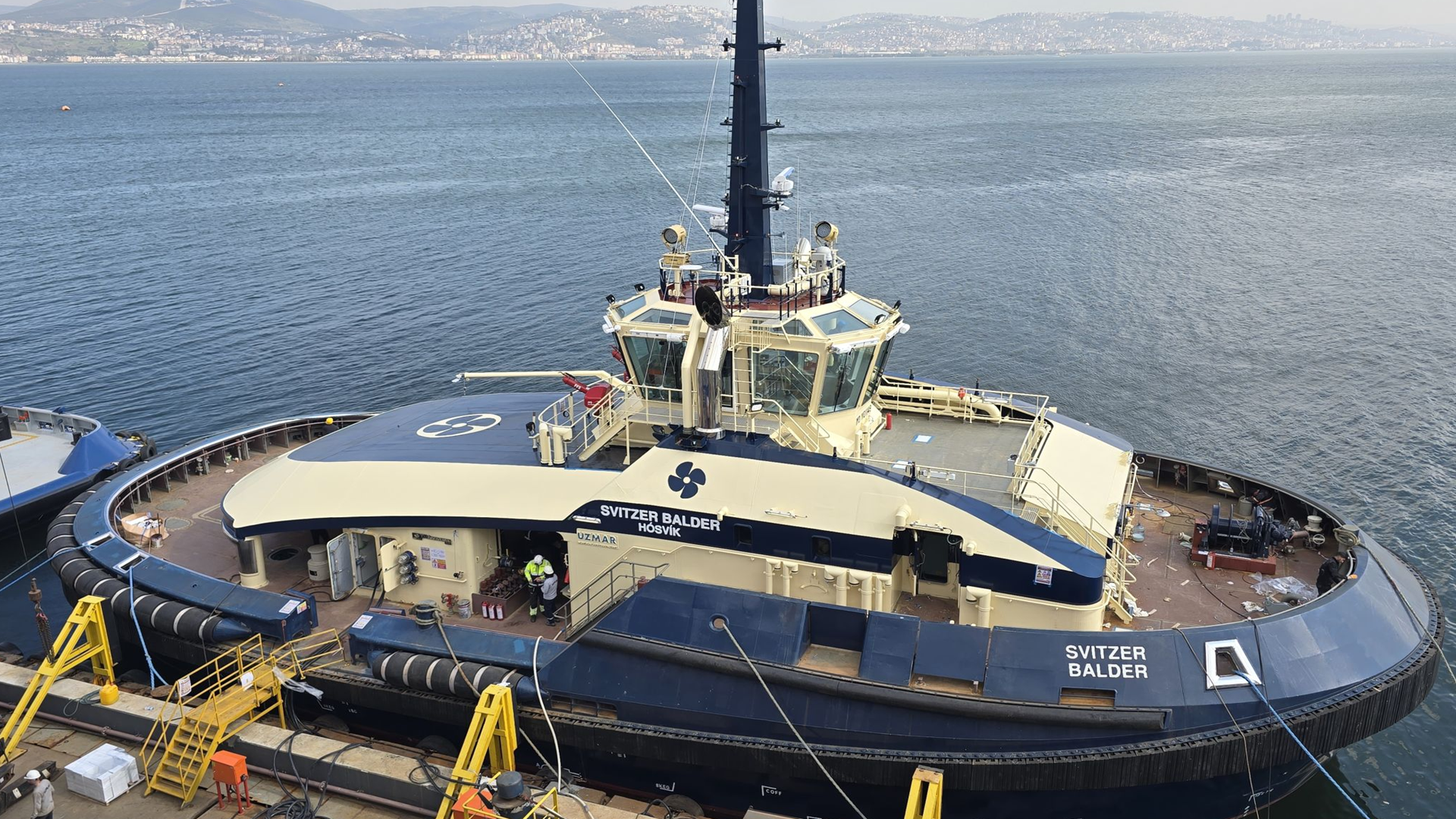
The most powerful electric tugboat in the world has successfully completed sea trials and is not set to enter service to cut towing emissions by up to 90 percent.
Built by the Uzmar shipyard in Türkiye, the Svitzer Balder is hailed as the world’s most powerful escort tug. The vessel is furthermore the first battery-methanol harbor tug ever built.
It is equipped with a six megawatt-hour (MWh) battery system and designed to carry out more than 90 percent of its towing and docking operations using battery-electric power alone.
“I would like to thank Uzmar and Svitzer for trusting AYK to build and deliver this battery system,” Chris Kruger, AYK Energy founder and president, pointed out.
Once delivered to the Port of Gothenburg in Sweden, it will run largely emission-free in daily service in order to support maritime decarbonization. Targets set by the International Maritime Organization aim to bring global shipping to net-zero greenhouse gas (GHG) emissions by around 2050.
According to Andorra-based AYK Energy, which supplied the battery system for the Svitzer Balder, the tugboat can operate in both harbor environments as well as near-open sea conditions. To deliver this, the vessel pairs a large battery with a hybrid backup.
“AYK is proving that battery technology is evolving and becoming more powerful, more advanced and more competitive,” Kruger highlighted. “At a time of volatile oil prices battery power is offering an increasingly attractive safe harbor to vessel operators.”
Kruger elaborated that the secret behind more economically viable batteries lies in the use of lithium-iron-phosphate (LFP) cells, instead of the expensive nickel, manganese, cobalt (NMC) cell technology.
He added that AYK has pioneered LFP adoption in the global maritime market. It is the first manufacturer to secure a type-approved marine battery using LFP.
The vessel’s ABS-certified AriesA battery packs six megawatt-hours with a rated lifespan of roughly 10 years. Its battery is backed by dual-fuel methanol engines for backup and extended range. It is expected to run more than 90 percent of its towing and docking operations with zero emissions.
The Svitzer Balder is an innovative TRAnsverse tug design. Kruger highlighted the importance of the technology. “This project again shows that LFP can provide the energy density and horsepower the industry demands for significantly less cost and it is much safer than the more combustible NMC chemistry.”
AYK Energy revealed that the Svitzer Balder is the fifth Svitzer tug for which the company has provided battery systems. The battery system was produced at a 53,800-square-foot (5,000-square-meter) automated facility in China.
Located in Zhuhai, the automated manufacturing plant opened in 2023. It has a production capacity of 300 megawatt-hours per year with the ability to expand to one gigawatt-hour (GWh).
“The order comes as fast-growing AYK Energy is seeing a surge in demand for its batteries across the maritime industry with the manufacturer supplying ferries, cruise ships, polar vessels, superyachts, fishing vessels, workboats, and even large container vessels as part of their power mix,” AYK Energy concluded in a press release.

Get the latest in engineering, tech, space & science - delivered daily to your inbox.
Based in Skopje, North Macedonia. Her work has appeared in Daily Mail, Mirror, Daily Star, Yahoo, NationalWorld, Newsweek, Press Gazette and others. She covers stories on batteries, wind energy, sustainable shipping and new discoveries. When she's not chasing the next big science story, she's traveling, exploring new cultures, or enjoying good food with even better wine.
此内容由惯性聚合(RSS阅读器)自动聚合整理,仅供阅读参考。 原文来自 — 版权归原作者所有。