







Researchers at the University of Manchester in the UK have directly visualized thorium-thorium bonding, a rarity among heavy elements in the periodic table, for the very first time. Using a method called Hirshfield atom refinement, the researchers showed how thorium atoms share electrons, which had been difficult to prove earlier.
In case you remember your chemistry classes, the basis of chemical bonding is covalency. While atoms of elements have a certain number of electrons in their outermost orbits, when they combine with other elements, they share these electrons to reach a stable state of a full octet without actually losing or gaining electrons.
This is the theory behind chemical reactions, but scientists have found it rather difficult to measure covalency experimentally. The difficulty isn’t in actually measuring covalency but in finding an approach that works reliably in all cases. A direct approach is X‑ray charge density, which can map where electrons sit within a material. However, this requires the use of high-quality crystals and stringent conditions that limit its usage for routine studies.
Hirshfield atom refinement (HAR) is a form of quantum crystallography which combines experimental X-ray data with theoretical calculations to determine a picture of electron density in molecules.
The approach uses the aspherical electron densities computed using quantum mechanics to arrive at accurate determinations of atomic positions. Using X-ray diffraction data, the atomic positions and displacement parameters are further refined and then iterated till parameters and quantum energy converge.
HAR is relatively easier to apply than conventional charge density techniques but has been difficult to apply to heavy elements where electron behaviour is more complex.
A team led by Stephen Liddle a professor of inorganic chemistry at The University of Manchester analyzed two thorium clusters using HAR, The two clusters differed in the number of electrons that were involved in bonding. In one case, a single electron was shared across three atoms, while in another two electrons played this role.
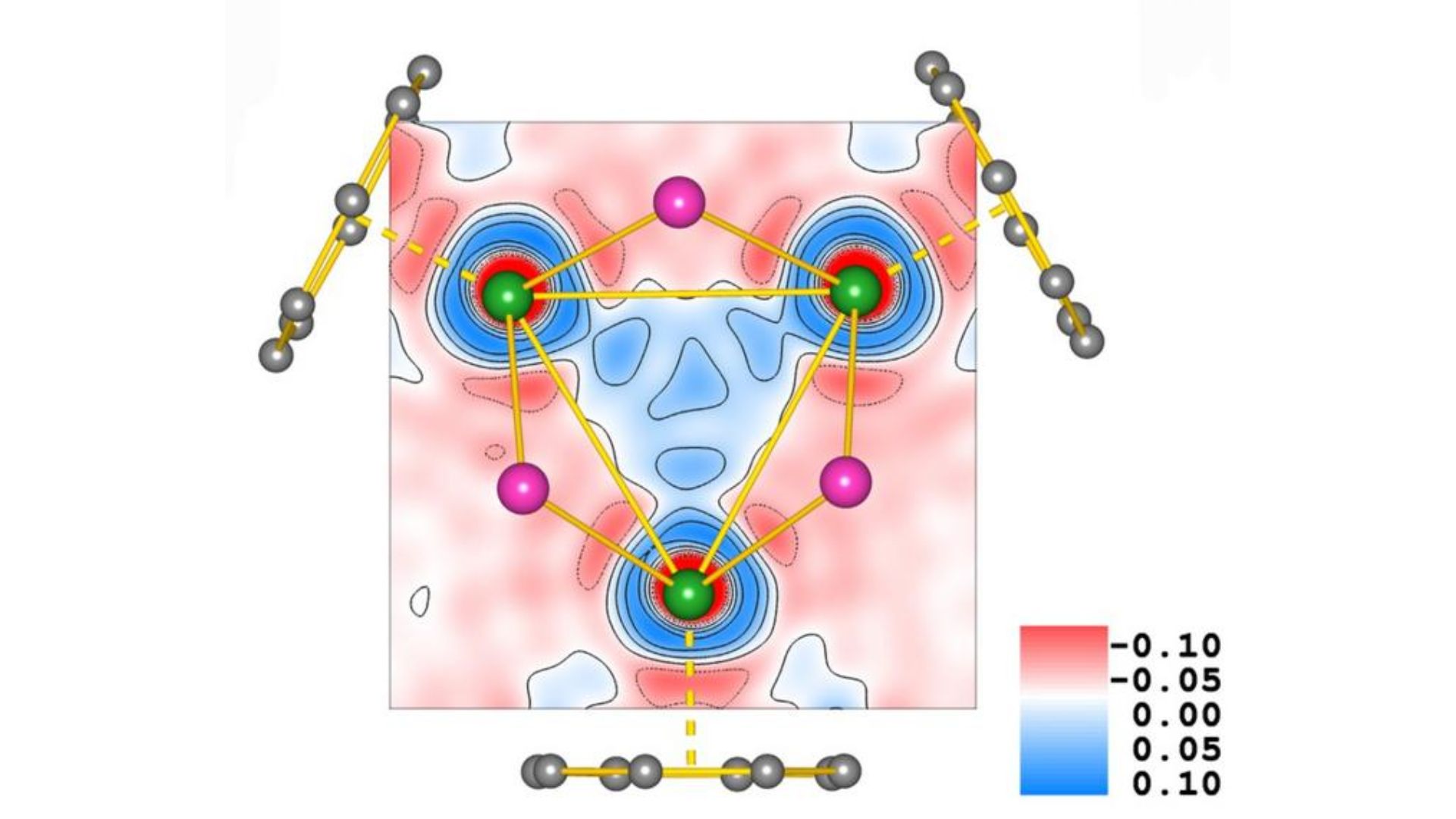
Since the atoms are heavy and closely spaced, the electron distribution is difficult to resolve, thereby making both scenarios extreme test cases. The researchers were, however, able to identify features such as bond critical points by analyzing the electron density using HAR.
The researchers found that the measurements matched theoretical calculations, thereby serving as evidence that thorium atoms can bind with each other. The results were also successful in demonstrating differences between the two clusters and how differences in the number of shared electrons changes the nature of bonding.
Since the method allowed researchers to arrive at these results using standard experimental data, it also suggests that it can be used to study bonding in other complex materials as well.
“Understanding how electrons are distributed in these systems is important because small changes in bonding can affect how materials behave, including their chemical reactivity and physical properties,” said Liddle in a press release.
“By providing a way to directly measure electron sharing, the approach offers a more reliable way to connect experimental observations with theoretical predictions.”
The research findings were published in the journal Chem.
Ameya is a science writer based in Hyderabad, India. A Molecular Biologist at heart, he traded the micropipette to write about science during the pandemic and does not want to go back. He likes to write about genetics, microbes, technology, and public policy.
此内容由惯性聚合(RSS阅读器)自动聚合整理,仅供阅读参考。 原文来自 — 版权归原作者所有。