





The model maps objects as point clouds with key surface points, helping robots generalize tasks across irregular shapes and geometries.

Researchers have unveiled a new method that lets robots handle irregular, curved objects with far greater precision.
The system, developed by researchers from the Swiss Federal Technology Institute of Lausanne (EPFL) and Idiap Research Institute, generates a point-cloud map of an object and identifies key surface reference points, creating a smooth, task-aware representation regardless of shape or size.
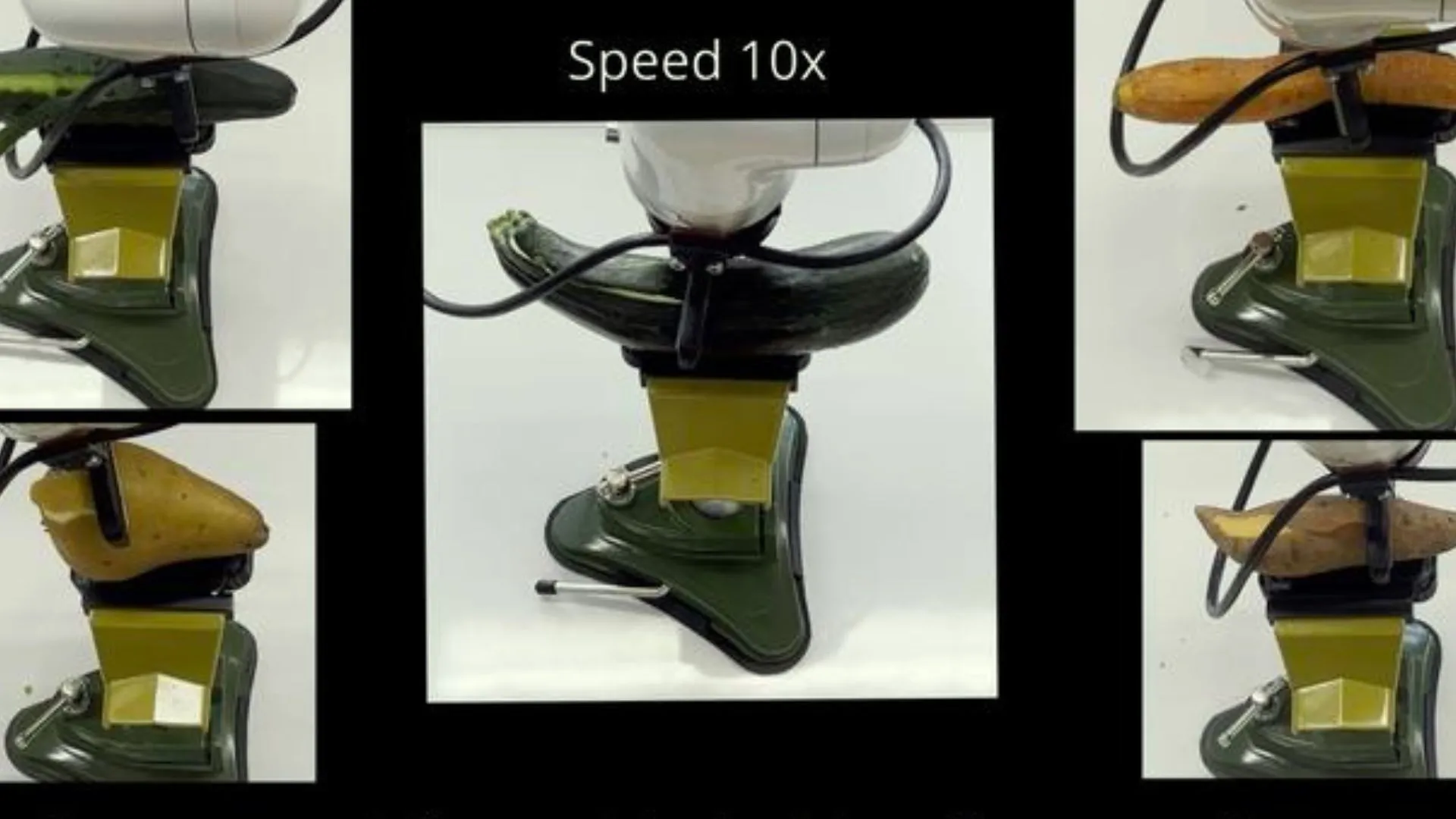
According to the team, the model enables robots to transfer skills across different items, from bananas to sweet potatoes. In tests, robots successfully performed contact-rich tasks like peeling, slicing, and surface probing.
The approach also proved resilient, working even with partial or noisy sensor data and in cluttered environments, marking a step forward in adaptable, real-world robotic manipulation.
Shape-aware manipulation
Humans can seamlessly transfer manipulation skills—such as slicing, peeling, or scrubbing—across objects with very different shapes by relying on a shape-aware, object-centric understanding of surfaces. Robots, however, struggle with this adaptability.
The main issue lies in the wide variability of surface geometry, which makes fixed or pose-based representations unreliable. Many existing approaches either ignore geometric structure altogether or depend heavily on large amounts of training data, limiting their ability to generalize.
A central challenge, therefore, is to develop reusable, geometry-aware representations that accurately capture how a robot interacts with an object’s surface while remaining invariant to differences in shape. Such representations would allow robots to transfer skills across diverse objects without requiring extensive retraining.
The new geometric methods provide a promising alternative to purely learning-based approaches. By leveraging discrete differential geometry, these methods enable task transfer across surfaces. Functional mapping techniques, for instance, can relate similar shapes but are restricted to open-loop motions on clean meshes.
Other approaches—such as signed distance fields, exponential maps, and logarithmic maps—work well in controlled settings but often fail with noisy or incomplete point cloud data and lack compatibility with broader control frameworks.
To overcome these limitations, researchers propose constructing a continuous field of local reference frames guided by surface geometry and keypoints. These orientation fields act as a smooth scaffold for interaction, allowing tasks to be expressed as simple, shape-invariant actions like sliding or probing. This modular framework can integrate with teleoperation, planning, and reinforcement learning systems.
Adaptive robot control
The method enables robots to handle unfamiliar objects by generating an orientation field from real-time vision and depth data, while reusing simple, shape-independent actions.
According to researchers, applying the diffusion (heat) equation, it spreads geometric information across surfaces and works directly with point clouds instead of requiring clean 3D models.
To manage tasks that transition between free space and contact, it combines diffusion with Monte Carlo techniques, allowing fast, grid-free computation. This produces smooth local reference frames that guide actions such as sliding, cutting, or probing.
Experimental results demonstrate reliable transfer of manipulation tasks across objects with different shapes. A robot equipped with vision, depth sensing, and force feedback successfully performed tasks like peeling, slicing, and inspection on new objects using the same action representations.
Tests on 50 randomly deformed objects showed that the approach achieved lower variation in action trajectories than conventional methods, indicating stronger generalization.
The framework also integrates effectively with multiple control strategies, including teleoperation, trajectory optimization, and reinforcement learning. It improves planning efficiency, accelerates convergence, and supports zero-shot transfer of learned behaviors. Additionally, the system remains robust under noisy and incomplete sensor data, confirming its practicality for real-world robotic applications.

Get the latest in engineering, tech, space & science - delivered daily to your inbox.
Jijo is an automotive and business journalist based in India. Armed with a BA in History (Honors) from St. Stephen's College, Delhi University, and a PG diploma in Journalism from the Indian Institute of Mass Communication, Delhi, he has worked for news agencies, national newspapers, and automotive magazines. In his spare time, he likes to go off-roading, engage in political discourse, travel, and teach languages.