










Cosmos 3, humanoid robots and robotaxi tools headline NVIDIA’s latest technology push.

NVIDIA unveiled a broad set of technologies aimed at accelerating the development of physical AI systems, expanding its push into humanoid robots, autonomous vehicles, semiconductor manufacturing, and industrial automation.
Announced at GTC Taipei, the company’s latest releases include Cosmos 3, an open foundation model for physical AI, a new reference humanoid robot built on its Isaac GR00T platform, open-source agent tools for robotics and industrial AI, and new AI-powered semiconductor manufacturing initiatives with TSMC.
Together, the announcements highlight NVIDIA’s strategy to build a full-stack ecosystem for physical AI, covering everything from synthetic data generation and simulation to real-world deployment.
“The big bang of physical AI is just around the corner thanks to breakthroughs in multimodal reasoning language, vision and world models,” said Jensen Huang, founder and CEO of NVIDIA.
He added: “The Cosmos 3 family of open, frontier omnimodels gives developers a generational leap in ability to build robots, autonomous vehicles and vision AI that perceive, reason, plan and act in the physical world.”
Building physical intelligence
At the center of the announcement is Cosmos 3, which NVIDIA describes as the world’s first fully open omnimodel capable of understanding and generating text, images, video, ambient sound, and actions within a single system.
The model is built on a mixture-of-transformers architecture that combines reasoning and content generation. NVIDIA says Cosmos 3 can serve as a vision-language model, a world model for simulating physical environments, or as the foundation for robot action models.
The company claims the model tops several open-model benchmarks for world generation, robotic action policies, and vision understanding. Cosmos 3 is available in multiple versions, including Cosmos 3 Super for high-accuracy robotics and autonomous vehicle applications and Cosmos 3 Nano for faster inference.
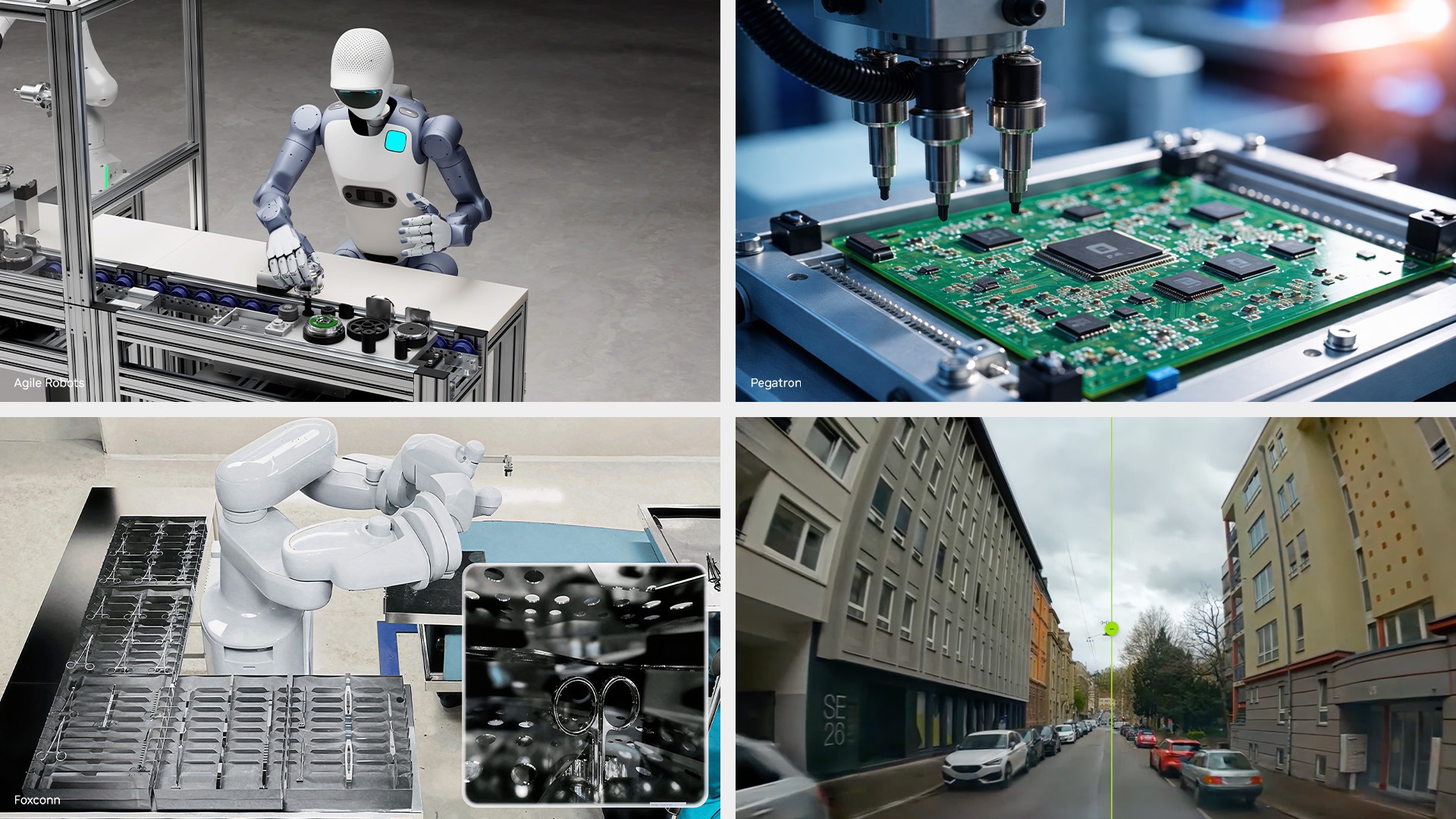
NVIDIA also launched a collection of open-source physical AI skills and tools that allow AI agents to execute tasks across robotics, vision AI, autonomous driving, healthcare, and industrial digital twins. The tools convert complex development workflows into repeatable, agent-executable processes that can automate data generation, simulation, training, and deployment.
From labs to factories
For robotics researchers, NVIDIA introduced the Isaac GR00T Reference Humanoid Robot, an open reference design combining a Unitree H2 Plus humanoid robot, Sharpa dexterous hands, Jetson Thor onboard computing, and the Isaac GR00T software stack.
The platform is intended to simplify humanoid robot development by integrating hardware, simulation, training, and deployment into a single system. Research organizations including Ai2, ETH Zurich, Stanford Robotics Center, and UC San Diego plan to use the platform.
NVIDIA is also bringing AI deeper into semiconductor manufacturing through its collaboration with TSMC.
The chipmaker is using NVIDIA CUDA-X libraries and AI models for computational lithography, transistor simulation, process control, wafer inspection, and fab scheduling. According to NVIDIA, TSMC has achieved improvements in computational efficiency while also using NVIDIA Metropolis and TAO Toolkit to improve detection of nanometer-scale defects.
“NVIDIA and TSMC have worked together for nearly three decades to push the limits of computing,” Huang said. “TSMC is bringing NVIDIA AI and accelerated computing into the fab itself, tackling some of the world’s most complex design and manufacturing challenges with simulation, optimization and AI.”
NVIDIA is also exploring physical AI for autonomous vehicles through Alpamayo 2 Super, a 32-billion-parameter reasoning model designed to help robotaxis understand, plan, and respond to complex road situations.
Recommended Articles

Get the latest in engineering, tech, space & science - delivered daily to your inbox.
With over a decade-long career in journalism, Neetika Walter has worked with The Economic Times, ANI, and Hindustan Times, covering politics, business, technology, and the clean energy sector. Passionate about contemporary culture, books, poetry, and storytelling, she brings depth and insight to her writing. When she isn’t chasing stories, she’s likely lost in a book or enjoying the company of her dogs.