






Food spoilage remains difficult to detect before it becomes a health risk. Consumers often rely on appearance and smell other than expiry dates to judge whether products are still safe to eat, despite the limitations of those methods.
Researchers at the University of California, Berkeley, have developed a sensor system designed to provide a more objective assessment. The technology combines miniature gas sensors with machine-learning software to identify chemical signatures associated with food spoilage and common allergens.
The researchers believe the system could eventually support smart appliances and food monitoring tools that help consumers make safer decisions about what they eat.
The device contains 16 microscopic gas sensors, each designed to respond differently to airborne chemical compounds. Together, the sensors create distinct response patterns when exposed to different foods.
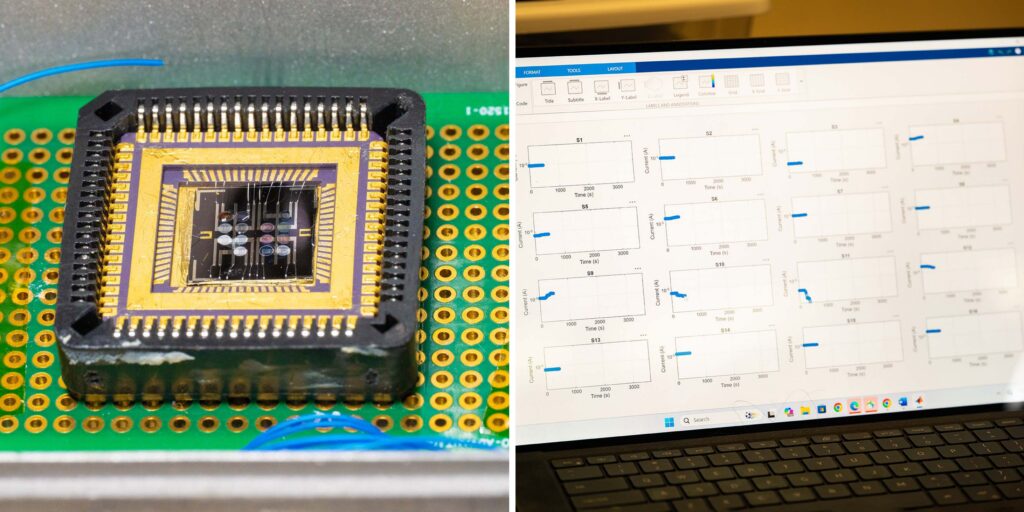
Lead author Carla Bassil, a doctoral student in electrical engineering and computer sciences at UC Berkeley, described the system as a set of digital taste buds. Each sensor converts chemical interactions into electrical signals, allowing the device to generate a unique signature for specific foods.
Researchers then trained machine-learning models to recognize those signatures. The team tested the system on strawberries, blueberries, bananas, walnuts, hazelnuts, cashews, and peanuts. It also learned to distinguish between fresh and spoiled samples of milk, eggs, and raw chicken.
“The idea is that we can use the relative selectivity of the gas sensors, paired with the pattern recognition abilities of machine learning,” Bassil said. By combining sensor data with artificial intelligence, the system can identify food-related chemical fingerprints more consistently than human smell alone.
The study also highlighted the technology’s ability to detect allergen-containing foods. During testing, the electronic nose identified as little as 0.05 grams of walnut material, roughly one-hundredth of an average shelled walnut. That level of sensitivity could support future food safety applications for people with severe allergies.
Researchers caution that the device has not yet been tested in more complex settings. Future evaluations will examine how well it performs when allergens are mixed with other foods or when multiple food odors are present at the same time.
The spoilage experiments focused on chicken, milk, and eggs left at room temperature for 24 and 48 hours. The system successfully differentiated between fresh and deteriorated samples by analyzing changes in the gases they released.
Electronic noses have existed for decades, but manufacturing multiple sensing materials on a single chip has remained a significant challenge. Bassil’s team addressed that problem by using carbon nanotubes instead of conventional metal-oxide materials. The nanotubes form extremely thin conductive layers with large surface areas, making them highly sensitive to chemical compounds at room temperature.
Operating without high temperatures also allowed the researchers to use a wider range of sensing materials, including polymers that might degrade under heat. The design further simplified manufacturing by enabling different sensing materials to be deposited in a single fabrication step.
Although the current study focused on laboratory testing, Bassil has already developed a portable version that connects to an iPhone application. Future work will focus on improving reliability and evaluating the system in real-world environments.
Ali Javey, Berkeley’s Lam Research Distinguished Chair in Semiconductor Processing, served as the study’s senior author. Researchers from Berkeley and the Korea Advanced Institute of Science and Technology also contributed to the project.
The study is published in the journal Science Advances.

Get the latest in engineering, tech, space & science - delivered daily to your inbox.
Aamir is a seasoned tech journalist with experience at Exhibit Magazine, Republic World, and PR Newswire. With a deep love for all things tech and science, he has spent years decoding the latest innovations and exploring how they shape industries, lifestyles, and the future of humanity.
此内容由惯性聚合(RSS阅读器)自动聚合整理,仅供阅读参考。 原文来自 — 版权归原作者所有。