










Researchers have developed an intelligent artificial muscle that mimics biological muscle–tendon systems.
The team at Seoul National University (SNU) created the device using liquid-metal channels embedded in a liquid-crystal elastomer.
The artificial muscle contracts when electrically stimulated while also measuring internal force and length in real time.
The breakthrough could help develop more adaptive next-generation humanoid robots with human-like sensing and movement capabilities.
Recently, a team of researchers at MIT Media Lab and Politecnico di Bari developed electrofluidic fiber muscles delivering natural muscle-like strength, speed, and control for robots and wearables.
As demand grows for more human-like robots and assistive systems, researchers are searching for robotic actuators capable of delicate movement, environmental sensing, and safe interaction.
Applications range from humanoid robots and logistics automation to rehabilitation and medical devices. However, conventional artificial muscles face limitations because their actuation and sensing functions are separate, necessitating additional sensors and complex control systems.
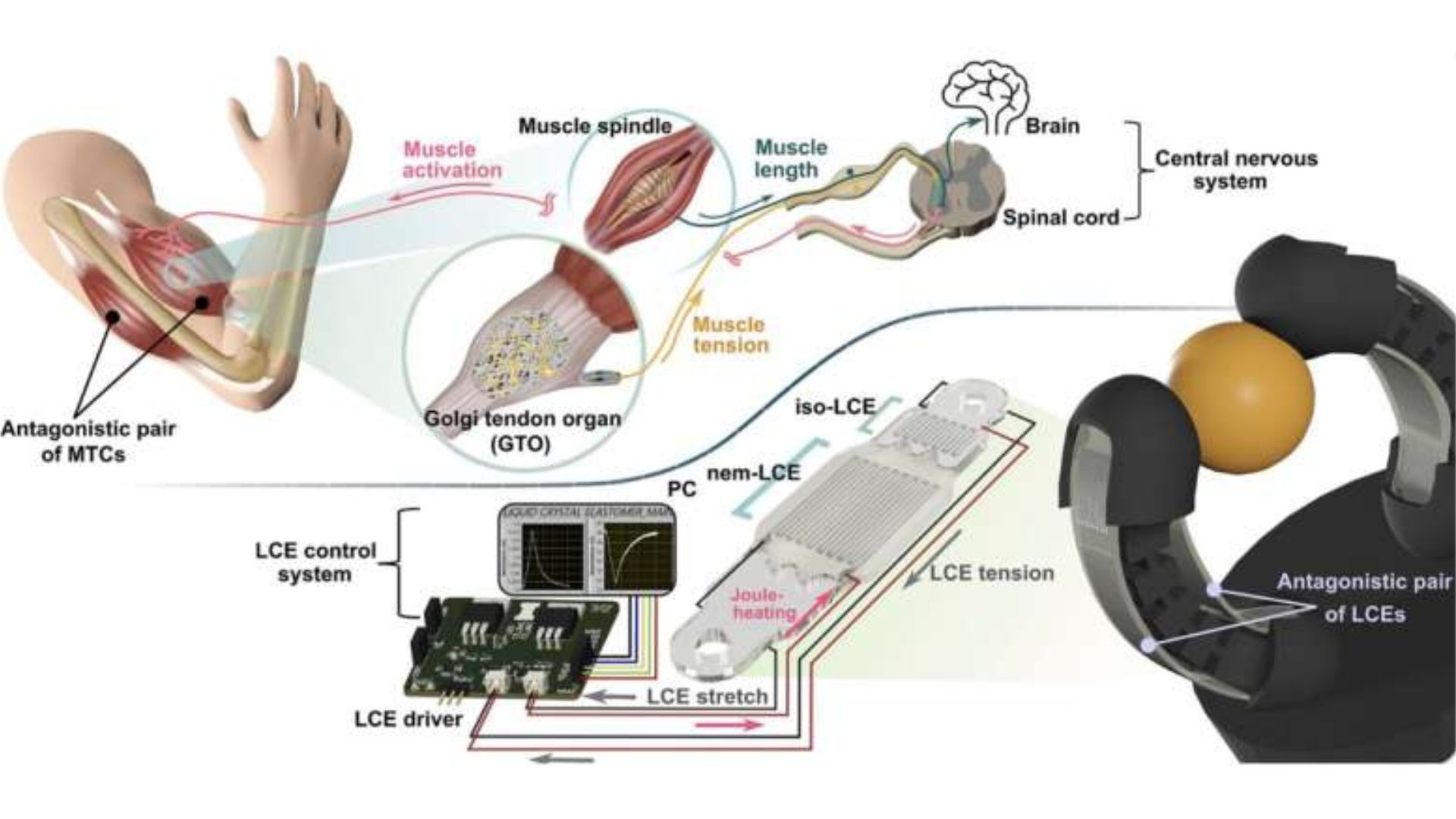
The diagram shows biological muscle feedback and a robotic gripper using LCE artificial muscles.
To overcome these challenges, SNU’s College of Engineering developed an intelligent artificial muscle inspired by biological muscle–tendon complexes. The system is based on liquid crystal elastomers (LCEs) and combines sensing and actuation within a single structure, enabling what researchers describe as physical intelligence.
The artificial muscle connects isotropic LCE and nematic LCE materials in series, performing tendon-like and muscle-like roles. Embedded liquid metal channels enable dual functions: one channel acts as an active actuator that generates contraction through heating, while the other operates as a sensor that detects force and deformation in real time. This allows the system to monitor its own contraction state without external sensors.
The researchers demonstrated robotic fingers and grippers powered by the artificial muscle that could gently pick up objects while also identifying their stiffness and size on their own. By arranging two artificial muscles to work against each other, similar to biological muscles, the team achieved faster and more precise control of movement, including contraction and relaxation.
The system combines sensing and movement in a single structure, allowing the artificial muscle to monitor its own condition in real time without relying on external sensors. This gives the robot a form of embedded physical intelligence, enabling it to react more naturally to changing forces and contact during operation. The researchers showed that the artificial muscles could work together in a feedback-controlled robotic finger and gripper system, improving motion accuracy and reducing control errors.
The study also identified areas that still need improvement. During repeated movements, heat can build up inside the artificial muscle, causing force drift and reducing accuracy. Sudden changes in movement targets can also create tracking errors. To solve these problems, the researchers suggested faster cooling methods, including thinner materials, built-in cooling channels, or cooling systems based on Peltier modules. Faster cooling could improve both response speed and sensing performance.
The team also noted that the current stretch estimation model was developed using experimental data and may need further refinement. Future studies on heat distribution and the mechanical behavior of liquid crystal elastomers could help create more accurate and reliable artificial muscle systems for robotics applications.

Get the latest in engineering, tech, space & science - delivered daily to your inbox.
Jijo is an automotive and business journalist based in India. Armed with a BA in History (Honors) from St. Stephen's College, Delhi University, and a PG diploma in Journalism from the Indian Institute of Mass Communication, Delhi, he has worked for news agencies, national newspapers, and automotive magazines. In his spare time, he likes to go off-roading, engage in political discourse, travel, and teach languages.
此内容由惯性聚合(RSS阅读器)自动聚合整理,仅供阅读参考。 原文来自 — 版权归原作者所有。