


Ten years ago, a few weathered bones sat at the edge of a quiet pond in northeast Thailand. Today, these remains belong to a legend.
International researchers have officially identified Nagatitan chaiyaphumensis, a massive dinosaur that has stomped its way into the record books as the largest ever found in Southeast Asia.
The plant-eating dinosaur discovery was made by paleontologists from University College London (UCL), Mahasarakham University, Suranaree University of Technology, and Sirindhorn Museum in Thailand.
The discovery carries a bittersweet nickname: The Last Titan.
“We refer to Nagatitan as ‘the last titan’ of Thailand. That is because it was discovered in Thailand’s youngest dinosaur-bearing rock formation. Younger rocks laid down towards the end of the time of the dinosaurs are unlikely to contain dinosaur remains because the region by then had become a shallow sea,” said Thitiwoot (Perth) Sethapanichsakul, PhD student at UCL Earth Sciences
“So this may be the last or most recent large sauropod we will find in Southeast Asia,” the lead author added.
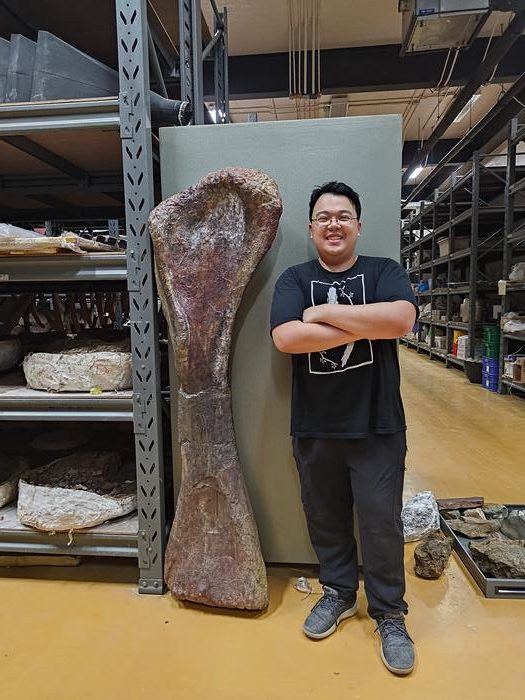
The fossilized remains included a spine, ribs, a pelvis, and leg bones, including a front leg bone.
Imagine nine adult Asian elephants standing on a scale. That is the weight of a single Nagatitan, roughly around 27 tonnes.
Measuring 27 meters (88 feet) from snout to tail, this sauropod was a true behemoth. Its front leg bone alone is 1.78 meters long (5.8 feet) — roughly the height of a grown man.
Nagatitan chaiyaphumensis was a member of the sauropod family, the iconic group of massive, long-necked herbivores that includes famous dinosaurs like Diplodocus.
This particular giant roamed Southeast Asia during the Early Cretaceous period, approximately 100 to 120 million years ago. As a somphospondylan sauropod, it represents a specialized lineage of plant-eaters that thrived in the arid, river-rich landscapes of prehistoric Thailand.
“Our dinosaur is big by most people’s standards – it likely weighed at least 10 tonnes more than Dippy the Diplodocus (Diplodocus carnegii). However, it is still dwarfed by sauropods like Patagotitan (60 tonnes) or Ruyangosaurus (50 tonnes),” said Sethapanichsakul.
The dinosaur’s name is a cultural blend of Thai and Greek influences. It honors the Naga, a mythical serpent from regional folklore, and the Titans of Greek myth, while “chaiyaphumensis” marks its discovery in Thailand’s Chaiyaphum province. This find is significant as the 14th unique dinosaur species to be officially named in the country.
During the Early Cretaceous, Nagatitan inhabited an arid-to-semiarid landscape defined by a meandering river system teeming with fish, crocodiles, and freshwater sharks.
In this environment, the sauropod used its immense surface area to regulate body temperature while sharing the ecosystem with a diverse array of prehistoric life.
This included smaller herbivores like iguanodontians and early ceratopsians, formidable predators such as spinosaurids and carcharodontosaurians, and pterosaurs soaring above the waterways.
Dr. Sita Manitkoon, a National Geographic Explorer and researcher at Mahasarakham University, highlights Thailand’s surprisingly high paleontological diversity, noting that it may host the third-most-abundant dinosaur remains in Asia.
Despite the field being relatively young in Thailand, the country has seen a significant surge in research and interest. This growth is driven by a new generation of local paleontologists who are actively discovering fossils and promoting the scientific importance of paleontology nationwide.
The findings were published in the journal Scientific Reports on May 14.

Get the latest in engineering, tech, space & science - delivered daily to your inbox.
Mrigakshi is a science journalist who enjoys writing about space exploration, biology, and technological innovations. Her work has been featured in well-known publications including Nature India, Supercluster, The Weather Channel and Astronomy magazine. If you have pitches in mind, please do not hesitate to email her.
此内容由惯性聚合(RSS阅读器)自动聚合整理,仅供阅读参考。 原文来自 — 版权归原作者所有。