


A new computer model developed by US researchers could reduce the amount of material for bridges and buildings by up to 90 percent and make future structures far more efficient.
The approach was designed by a research team at the Massachusetts Institute of Technology (MIT). It is based on a process known as topology optimization, which is a computational method that determines the most efficient material placement.
The effort was headed by Josephine Carstensen, PhD, a Gilbert W. Winslow (1937) Career Development Professor in Civil Engineering. As per the team, it bridges the gap between optimized digital designs and practical construction.
Carstensen believes that the technique could significantly reduce both costs and carbon emissions. “There’s an interplay between the materials you’re using, the constructability of designs, and the optimization of the structure,” she said. “You need to be able to address all three at the same time. That’s what we tried to do here.”
A smarter design
Topology optimization uses computer programs to optimally distribute material in a given space, such as creating the strongest possible structures at the lowest weight. But it is mostly used in research and 3D printing rather than by engineers constructing bridges and buildings.
That’s because the designs are often too difficult and expensive to build. They’re complex, spider-web-like structures that would challenge even the most capable engineers.
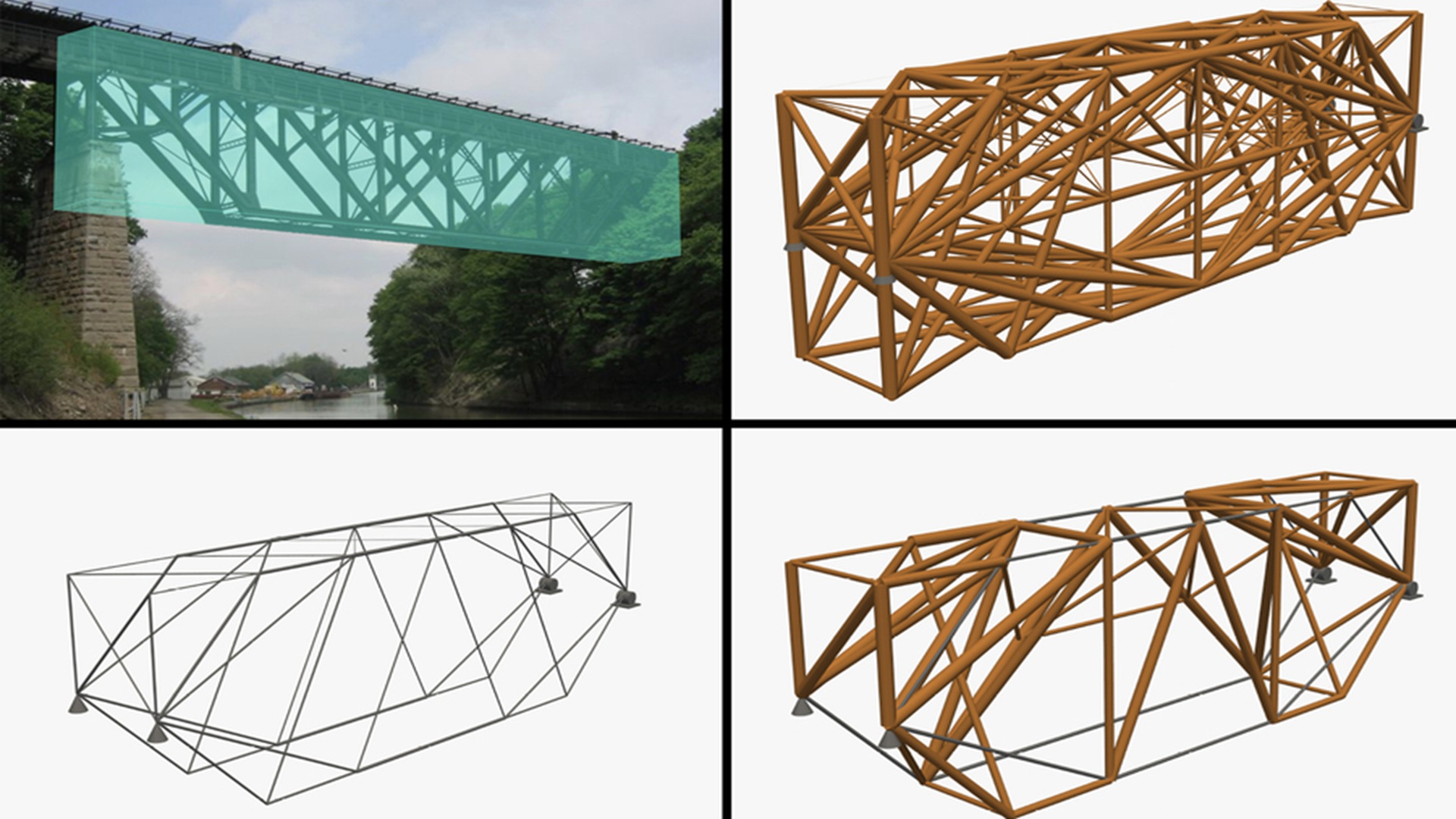
Credit: MIT
To address the challenge, the MIT team developed a framework that allows users to define practical construction limits from the beginning of the design process. Engineers can specify the maximum number of structural members meeting at a joint, minimum connection angles, and minimum component sizes.
The system supports multiple materials and combines steel and timber together. However, it selects a single material for every structural part and then checks that all connections are strong enough to meet engineering standards. “You can’t have a part that’s 72 percent timber and 28 percent steel,” Zane Schemmer, a PhD student at the institute and first study author, said.
From design to reality
To demonstrate the method, the research team redesigned the Lockport “Upside-Down Bridge” near Buffalo, New York. They generated timber-only, steel-only, as well as hybrid timber-steel truss designs. They tested how different construction constraints affected the final structures.
The results proved that stronger designs were not always the easiest to build. “We saw how the system knew that you could design a bridge of pure steel, but that might not be best from a carbon standpoint,” Schemmer explained. “Or you could design a bridge out of purely timber, but that might not be the strongest.”
Schemmer believes that by strategically combining the materials, the framework can use timber where carbon savings matter most, and rely on steel only where additional strength is necessary. “But these materials can work together, so you use timber for the carbon savings and steel where you need extra strength, and there’s a balance you can find in these structures,” he said in a statement.
The optimization requires more computing power than some existing methods, but the researchers said their experiments ran on a standard MacBook Pro. This makes the approach practical for engineering firms.
“This approach has been avoided by industry in the past, but now we think it’s a practical way to solve problems dealing with variable constraints,” Schemmer concluded.
The study has been published in the journal Automation in Construction.
Recommended Articles

Get the latest in engineering, tech, space & science - delivered daily to your inbox.
Based in Skopje, North Macedonia. Her work has appeared in Daily Mail, Mirror, Daily Star, Yahoo, NationalWorld, Newsweek, Press Gazette and others. She covers stories on batteries, wind energy, sustainable shipping and new discoveries. When she's not chasing the next big science story, she's traveling, exploring new cultures, or enjoying good food with even better wine.